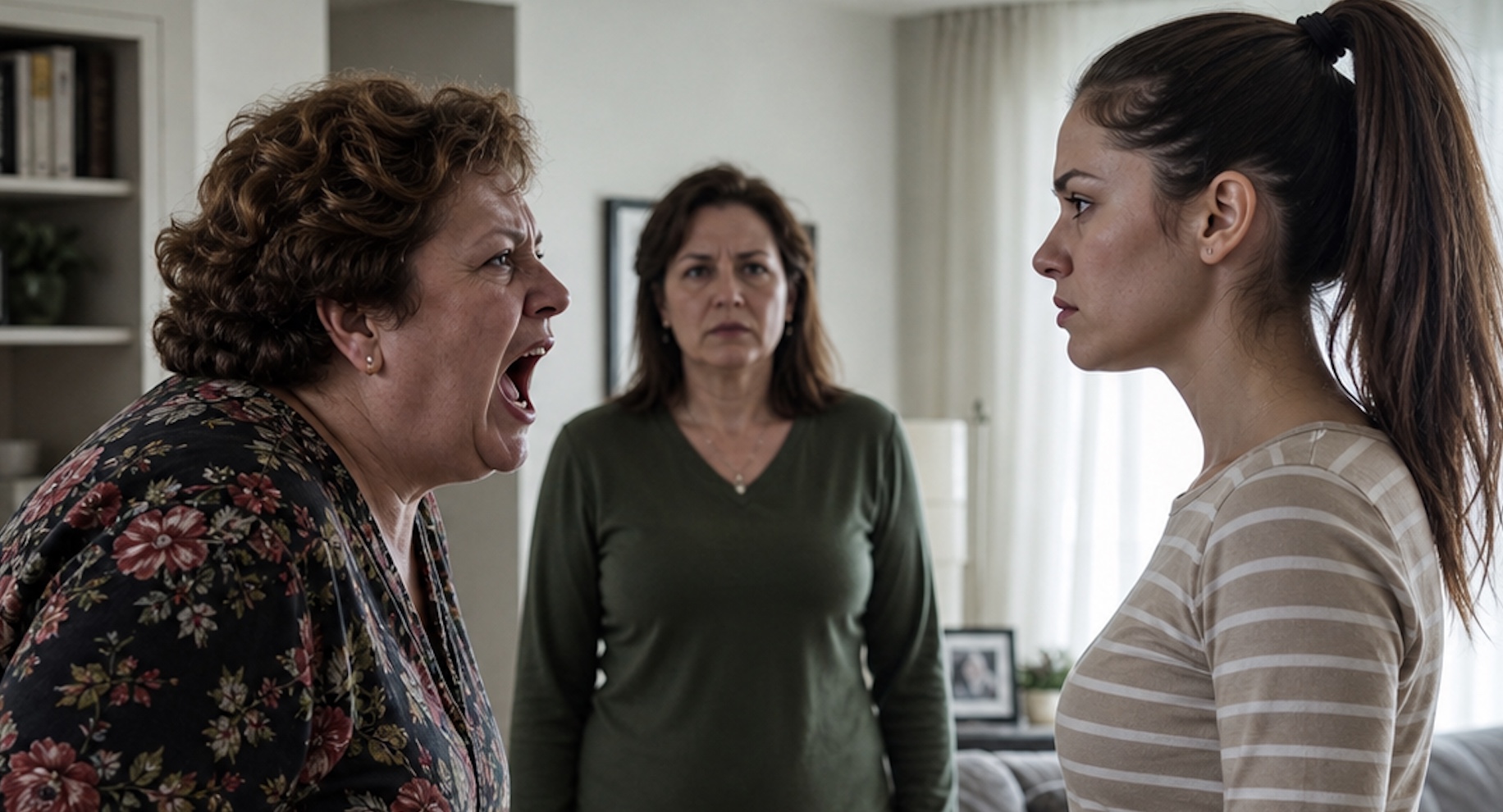
“Get out! Do you hear me? Get out of here with your little brood!”
Zinaida Pavlovna stood in the middle of the hallway with her feet planted wide apart, as if she were guarding territory. A floral blouse, curly hair, hands on her hips — she looked like a brooding hen who had somehow decided the entire henhouse belonged to her.
Katya did not understand what was happening at first. She had just come back from the store — shopping bags in her hands, three-year-old Vika clinging to her jacket, five-year-old Matvey dragging his little dinosaur backpack behind him. An ordinary Tuesday. An ordinary evening. And suddenly — this.
“Zinaida Pavlovna, what happened?”
“What happened?” her mother-in-law threw up her hands. “What happened is that I’m not going to tolerate this anymore! My son worked while you sat here doing nothing! His money, his apartment — and I am the mistress of this house!”
Katya silently placed the grocery bags on the floor. Vika pressed herself against her mother’s leg and stared at her grandmother with wide eyes. Matvey pretended to be extremely busy with the zipper on his backpack.
“Zinaida Pavlovna, the apartment is registered in my name. You know that.”
“I know? I don’t know anything! Oleg told me — it was his money, his everything! And you’re only temporary here!”
Temporary.
Katya almost laughed to herself.
Five years of marriage, two children, a mortgage she had been paying from her accountant’s salary even before they got married — and she was temporary.
The story of that apartment was both simple and complicated, as all stories involving money and family tend to be.
Katya had bought a one-room apartment when she was thirty, before Oleg, before everything. Later they got married, sold the one-room apartment, and took out a mortgage on a three-room place. The down payment came from her money from the sale. The mortgage was supposed to be split equally, but in reality Katya carried it alone, because Oleg was always either changing jobs, “investing in a business,” or simply making his money disappear somewhere.
Two years ago, they divorced. Quietly, without scandals — they simply separated. Oleg moved back in with his mother in the Moscow region. And at the time, Zinaida Pavlovna had not objected. She herself had said, “Let Katya and the children stay there. They need it more.”
But that had been two years ago.
Three months ago, Oleg got married again. His new wife had an apartment in the city center and a good job. And something inside Zinaida Pavlovna seemed to click — apparently, she decided it was time to urgently reclaim everything that “belonged to her son.”
She appeared in April with two suitcases and the confidence of a person who had a plan.
“Zinaida Pavlovna,” Katya said calmly, although everything inside her was burning, “you came here as a guest three weeks ago. I let you stay. But this is my apartment, and I’m asking you…”
“Yours!” her mother-in-law laughed sharply, like a cough. “Have you seen the documents? Oleg is listed there! He’s a co-owner! And that means I, as his mother, have rights here!”
That hit below the belt because it was true.
Oleg really was listed in the documents. They had not managed to re-register everything after the divorce. Katya had not thought about it at the time — it had seemed unnecessary. Oleg himself had said, “Live there. I’m not claiming anything.”
But apparently, Zinaida Pavlovna had convinced him to start claiming it.
That same evening, Katya called Sergey Alekseevich, a lawyer she knew through her company’s affairs. Just to ask. Just to clarify.
Sergey Alekseevich listened in silence, then said:
“Katya, your position is strong. The mortgage payments were made by you. The down payment came from your money. The payment records from recent years are yours. Oleg is formally a co-owner, but his share is much smaller based on actual contribution. That can be proven. Let’s work on it.”
Zinaida Pavlovna was not simply rude. She was systematic.
In three weeks, she had managed to rearrange the furniture in the living room — “it’s more convenient this way.” She had thrown away Katya’s spices from the kitchen shelf — “why do you need so many?” She had forbidden the children from watching cartoons after eight in the evening — “children need discipline.” One day, Katya found someone else’s notebook in her desk drawer. Zinaida Pavlovna had clearly been studying her papers.
But the most interesting thing happened on Friday.
Katya usually left for work early, and the children stayed with the nanny. That day, she came back at lunchtime because she had forgotten some documents. And she walked in on the following scene: Zinaida Pavlovna was sitting at the kitchen table with a woman of about fifty. They were drinking tea, and some papers were spread across the table.
“What is going on?” Katya stopped in the doorway.
Zinaida Pavlovna was not embarrassed for even a second.
“Meet Lyudmila Ivanovna. She’s a real estate agent. We were just looking at some options.”
“What options?”
“Well,” her mother-in-law shrugged, “since the apartment is going to be sold anyway…”
Katya felt the inside of her chest turn cold.
“The apartment is not for sale.”
“Not yet,” Zinaida Pavlovna corrected her gently and smiled.
That smile — calm, almost kind — was more frightening than any shouting.
The real estate agent, Lyudmila Ivanovna, tactfully looked out the window.
That same evening, Katya wrote to Sergey Alekseevich:
They’ve already brought in a real estate agent.
He replied quickly:
Excellent. Then we’ll speed things up.
For the next two weeks, Katya lived in two parallel realities.
The first was ordinary life. Work, children, breakfasts, school, after-school care, the supermarket near the house, Matvey losing his indoor shoes, Vika getting sick and running a fever for three days.
The second reality was meetings with the lawyer, the bank, archives, a notary. Katya collected documents methodically, without panic — like someone putting together a puzzle when she already knows the final picture will eventually appear.
Zinaida Pavlovna continued living in the apartment. Katya did not throw her out. She did not want a scandal in front of the children, and Sergey Alekseevich had said, “Let her stay for now. It may even work in our favor.”
Her mother-in-law carried herself confidently. She called Oleg every day — Katya could hear fragments of conversations from the hallway.
She won’t prove anything. You’re a co-owner. The main thing is not to back down.
Oleg, judging by everything, was hesitating. He was not an evil person — only weak. And his mother had known how to use that weakness all his life.
One day, he called Katya himself.
“Listen,” he said after a pause, “maybe we can come to an agreement? Sell the apartment, split the money…”
“Oleg,” Katya interrupted him, “do you remember who paid the mortgage for the last four years?”
Silence.
“Well…”
“Exactly. Talk to the lawyer. My lawyer. He’ll explain what share you actually have there and what you’ll get from it.”
She was not angry. She was simply tired of pretending everything was fine.
One evening, Zinaida Pavlovna brought up the subject again — this time in a different tone. She did not shout. She sat on the sofa, watching television, and suddenly said without looking at Katya:
“You think I’m your enemy? I’m just worried about my son.”
“Zinaida Pavlovna,” Katya sat down on the edge of the armchair, “your son gave up his share himself. Verbally, yes, but in front of witnesses. And now you’ve come here to reverse that. That is not concern for your son. That is something else.”
Her mother-in-law said nothing. She only pressed her lips together.
Katya got up and went to put the children to bed. Matvey asked her to read about space. Vika demanded a fairy tale about a little fox. Katya read to them both, one after the other, in a quiet voice in the dark, until they both began breathing softly in their sleep.
Then she sat in the kitchen for a long time with a mug in her hands.
Thinking.
She still did not know how it would all end. But something inside her — calm and firm — said:
Hold on. You’re almost there.
At that same moment, Sergey Alekseevich was dialing Oleg’s number.
Oleg called back the next day — on his own, without his mother’s prompting.
Katya was standing in line at the pharmacy. Vika had almost recovered, but the cough was still there. Her phone vibrated in her pocket. She looked at the screen and almost felt surprised — he usually texted, not called.
“I’m listening.”
“Katy…” He paused for a second. “I spoke with your lawyer.”
“And?”
“Well… he explained the situation to me. Financially.”
Katya took a cough syrup from the shelf and compared two bottles. She waited.
“I didn’t know the numbers would look like that,” Oleg continued. “Mom said I had half. But it turns out…”
“Twenty-three percent,” Katya said calmly. “That is the actual amount of your financial contribution. Sergey Alekseevich calculated everything using the bank statements.”
The silence lasted a long time.
“Mom doesn’t know about this?”
“That’s between you and your mother. I’m busy.”
She paid at the register and stepped outside. The city was living its usual life — minibuses, coffee shops, people walking dogs, cyclists on the sidewalk. An ordinary day.
Only inside Katya, something slowly exhaled — like air escaping from a balloon that had been held tight for too long.
Zinaida Pavlovna found out about her son’s conversation with the lawyer quickly — apparently, Oleg had told her after all. And something in her shifted. She became quieter. Commented less. Stopped rearranging things in the kitchen.
It was almost suspicious, this sudden meekness.
Katya did not relax.
She knew this kind of silence. It often came before a person changed tactics.
And sure enough, three days later, Viktor Semyonovich appeared.
Katya opened the door and saw a man of about sixty-five, wearing a jacket, holding a briefcase, with the air of someone accustomed to doors being opened immediately and people smiling at him.
“Good afternoon. I’m Zinaida Pavlovna’s brother. I came to talk.”
Here it is, Katya thought. Reinforcements.
Viktor Semyonovich turned out to be a former lawyer — long retired, but still carrying himself like an active one. He sat in the kitchen, drank the tea his sister poured for him, and spoke for a long time, thoroughly, referring to articles of the civil code that he clearly did not remember very accurately.
The point was simple: Oleg was a co-owner, which meant Katya could not sell, re-register, or “independently dispose of the living space” without his consent.
“I understand,” Katya nodded as she listened. “Yes, of course. That’s correct.”
She did not argue. She simply listened and nodded occasionally.
Viktor Semyonovich had clearly expected resistance — and was slightly thrown off by its absence. Zinaida Pavlovna sat beside him with the expression of a person who had just placed her strongest card on the table.
When the guest finished, Katya stood up, put the cups in the sink, and said:
“Thank you for coming. My lawyer will contact you.”
Something flickered across Viktor Semyonovich’s face.
“Why a lawyer? We’re discussing this as family…”
“We are no longer family,” Katya answered simply. “This is a property dispute. Have a good day.”
When she told Sergey Alekseevich about the visit, he laughed briefly.
“Well done. Now listen carefully. This week, we are filing documents to determine the shares. At the same time, we’ll file a statement about interference with the use of the residence. Formally, you have the right to demand that unauthorized people leave the apartment.”
“Zinaida Pavlovna is the mother of a co-owner. She’ll say she has the right to be here.”
“She will. And we’ll respond that the co-owner has not officially transferred any right of residence to her. It’s a long explanation, but the short version is this: she has no legal grounds to live there. Only self-confidence.”
Katya was silent for a moment.
“And Oleg? Will he object?”
“Oleg,” the lawyer said carefully, “based on our conversation, is tired. He doesn’t need this story. He wants everything resolved quietly. I think he’ll agree to you buying out his share. At market value, fairly.”
“I don’t have that kind of money right now.”
“There are options. But that is the next step. First — paperwork.”
There was a lot of paperwork.
Katya went to the public services center twice, once to the property registry office, and then to the bank for mortgage statements. Matvey was picked up by the nanny, Vika by their neighbor Nina Georgievna, an elderly and kindhearted woman who had long sympathized with Katya and could not stand Zinaida Pavlovna. The two women had once crossed paths in the elevator and instantly sensed something fundamentally incompatible in each other.
“Hold on, dear,” Nina Georgievna would say, taking Vika by the hand. “People like that have to be removed. Methodically.”
Katya would smile and keep going.
Meanwhile, Zinaida Pavlovna continued living in the apartment — but differently now. She had quieted down. She called her son for long conversations in a low voice. One night, Katya heard her crying through the wall. Not loudly. Somehow tiredly.
It was unexpected. Katya even stopped in the hallway and listened — and felt something almost like pity.
Not for what her mother-in-law had done. But for the fact that she apparently believed that if her son went to another woman, she urgently had to secure something material for herself. As though otherwise, she would be left with nothing at all.
It must be terrifying to live like that, Katya thought. To measure everything in square meters and ownership shares.
But pity was one thing.
The apartment was another.
Oleg came on Saturday. Alone, without his mother. He called ahead and asked to talk. Katya opened the door. He stood on the threshold, thinner than before, his face tired.
“Is Mom here?” he asked.
“In the room.”
“The children?”
“At the playground with the nanny.”
They went into the kitchen. Oleg sat down and drummed his fingers on the table.
“I’m ready to sign. For the amount your lawyer named.”
Katya did not answer immediately. She looked at him — at the man she had lived with for five years, the man with whom she had two children, the man with whom things had once been good, and then had become nothing.
“Good,” she said. “I’ll transfer the money in installments. We’ve already discussed the arrangement with Sergey Alekseevich.”
“I know.”
A pause.
“Mom…” he began, then stopped. “She won’t leave easily. You understand that?”
“She will,” Katya said calmly. “When there is a decision.”
Oleg looked at her for a long time, as if he were seeing something new.
“You’ve changed.”
“Everyone changes.” She stood up and put the kettle on. “Do you want tea?”
Zinaida Pavlovna came out of the room. She saw her son, and something alive and anxious immediately appeared on her face.
“Olezhek. Did you talk to her?”
“I did, Mom.”
“And?”
Oleg was silent for a second. Then he said quietly, but firmly:
“Mom, pack your things. I’ll take you home.”
Zinaida Pavlovna stared at her son as though he had just spoken in a foreign language.
“What do you mean, pack your things?”
“I mean exactly that.” Oleg did not look away. “I’ve reached an agreement with Katya. I’m signing the documents. You’re going home.”
“You…” Her voice broke. “You’re betraying me? Your own mother?”
“Mom, enough.”
That “enough” was not said with anger. Only exhaustion. The way people speak when they have explained something too many times and no longer want to explain it again.
Perhaps that was why Zinaida Pavlovna fell silent. She had expected a scandal, objections, a fight. Instead, she received silence and her son’s tired finality.
Katya stood by the window and looked out into the courtyard. The nanny was playing ball with the children. Matvey was shouting something joyfully. Vika fell down and laughed. An ordinary scene. Almost unbearably normal against the backdrop of what was happening in the kitchen.
Zinaida Pavlovna went into the room and closed the door.
Oleg sat with both hands wrapped around his mug. Katya sat down opposite him.
“She won’t come out for a while,” he said. “That’s how she is… she’s thinking about her next move.”
“I know.”
“Katy, I want to say…” He stumbled over the words. “I didn’t know she would go that far. With that real estate agent, with Uncle Vitya. That was already without me.”
Katya nodded. She believed him — and at the same time understood that it changed nothing. Not knowing did not erase the consequences.
“The important thing is that you’re here now,” she said simply.
Oleg finished his tea and went to the bedroom door. He knocked.
“Mom. Let me help you pack.”
Silence.
“Mom.”
“Go away.”
He sighed, turned to Katya, and spread his hands as if to say, You see for yourself.
Katya nodded toward the hallway sofa: wait there.
Then she approached the door herself and said quietly, without emotion:
“Zinaida Pavlovna, you have one hour. In one hour, I’m calling the district police officer. I have the apartment documents. You have no grounds to live here. This is not a threat. It is information.”
Behind the door, something creaked. Then came a rustle, the sound of a drawer being pulled open.
She was packing.
While Zinaida Pavlovna packed her suitcase, Katya went outside. She sat on the bench next to the nanny and watched Matvey try to explain the rules of football to Vika. Vika listened for about ten seconds, then simply grabbed the ball and ran in the opposite direction.
Katya laughed.
For the first time in several weeks — truly, without effort.
Her phone vibrated. Sergey Alekseevich.
“Katya, the documents for determining the shares have been accepted. Now we wait. At the same time, Oleg confirmed he is ready for a settlement agreement. I think we’ll close this in a month or a month and a half.”
“Thank you,” she said. “Truly.”
“It’s my job,” he paused. “How are things there?”
“We’re managing.”
She put the phone away and looked at the children. Matvey finally caught up with Vika, took the ball from her, and she immediately began to cry — then stopped just as quickly because her brother gave the ball back to her.
Small negotiations.
A small world where everything was resolved quickly and without lawyers.
If only adults knew how to do that, Katya thought.
Zinaida Pavlovna came out forty minutes later.
Two suitcases, a shoulder bag, her face closed and unreadable. Oleg took the suitcases. Katya stepped aside to let them pass into the hallway.
And then her mother-in-law stopped.
She turned around. Looked at Katya for a long time, directly. Katya held her gaze.
“You think you won?” Zinaida Pavlovna said quietly. Without shouting, without hysteria — and that made it sound heavier.
“I think my children will live in their apartment,” Katya answered. “That is enough for me.”
“This will still remain ours.” Her mother-in-law said it like an incantation. “Blood will take what belongs to it.”
Katya tilted her head slightly.
“Zinaida Pavlovna, Matvey and Vika are your blood too. Have you thought about that?”
Something passed across her mother-in-law’s face — quickly, like the shadow of a cloud.
She turned away and walked toward the elevator.
Oleg set down the suitcases and looked at Katya.
“I’ll call about the kids. This weekend, maybe?”
“Yes. They’ll be happy.”
The elevator doors closed.
Katya stood in the quiet hallway for a moment. Then she closed the door — locked it, slid the bolt into place — and leaned her back against it.
She exhaled.
The settlement agreement was signed six weeks later.
Oleg received the money for his share. Katya took out a consumer loan — not large, for three years, manageable. Sergey Alekseevich made sure every clause was precise and left no loopholes. The documents were re-registered. Now, in the “owner” line, there was only one name.
Katya’s.
That day, she came home late. The children were already asleep. Katya walked through the apartment — turned on the light in the living room, then turned it off, went into the kitchen, and put the kettle on. Then she simply stood by the window, looking at the city lights.
The apartment was the same.
The same wallpaper, the same creaking parquet by the sofa, the same little crack above the children’s room door that she kept meaning to fix.
But something had changed in it — or perhaps something had changed in Katya, and the apartment was simply reflecting it.
Mine, she thought.
Honestly and completely — mine.
Zinaida Pavlovna reached out only once — a month after leaving. She sent a message. No greeting, just a short line:
I hope you’re satisfied.
Katya read it, thought for a second, and replied:
Good night, Zinaida Pavlovna.
There were no more messages.
Oleg came on weekends. He took the children to the park, sometimes to the cinema. He behaved evenly, without unnecessary conversations. Katya did not know what was happening between him and his new wife, and she did not ask. It no longer concerned her.
One day, Matvey came back from his father’s place and asked:
“Mom, will Grandma Zina come again?”
Katya was silent for a moment.
“I don’t know, sweetheart. If she wants to.”
“She’s strange,” Matvey said thoughtfully. “She was angry all the time.”
“People are sometimes angry when they’re afraid.”
Matvey considered this seriously. He always thought seriously, this five-year-old little person with a dinosaur backpack.
“Was she afraid?”
“Probably.”
“And you?”
Katya looked at him. At his little upturned nose, the cowlick on the top of his head, his completely serious eyes.
“I was afraid too,” she said honestly. “But I handled it.”
Matvey nodded with satisfaction, like someone who had received the correct answer. Then he ran to his sister — and judging by the rising noise from the children’s room, they immediately began arguing about something urgent.
Katya smiled and went to make peace between them.
Life went on.
Ordinary, a little noisy, sometimes difficult — but her own.
Fully and finally her own.
A year passed.
Katya sometimes thought about it — casually, between everyday things. While cooking porridge in the morning, while riding the metro, while putting Vika to bed. A year ago, a strange woman with curlers in her hair had stood in this apartment and screamed that she was the mistress here.
And now — silence.
Her own, peaceful, deserved silence.
Matvey started first grade. It was a whole event. They chose his schoolbag for three weeks before finally settling on a dark blue one with a cosmonaut on it. On the first of September, Katya photographed him near the entrance of their building. He stood there so serious, so grown-up, that her throat tightened.
Oleg came too — they had agreed on it in advance. They stood side by side, taking pictures of their son. It felt a little strange, but bearable.
Almost normal.
Zinaida Pavlovna did not come to the school celebration. She sent a gift through Oleg — a set of colored pencils and a card with a kitten on it. Matvey said “thank you” and ran off to play.
Katya picked up the card and looked at it. On the back, in neat handwriting, it said:
Study well. Grandma Zina.
Nothing more.
No apologies. No explanations.
But Katya had not expected any. Some people do not know how to ask for forgiveness — not because they feel nothing, but because they simply do not know how. That is their burden, not hers.
She placed the card on the shelf beside the children’s drawings and the tiny cactus Vika had brought from kindergarten and now watered with fanatical dedication.
The apartment lived.
The parquet creaked. Katya finally fixed the crack above the children’s room door herself, with putty and instructions. Clumsily, but it held. New curtains appeared in the kitchen — white, with a thin green stripe. A small thing, but hers.
Sometimes in the evening, when the children fell asleep, Katya sat by the window with a book. The city below lived its own life.
And she lived hers.
There was no longer anything to prove.
To anyone.