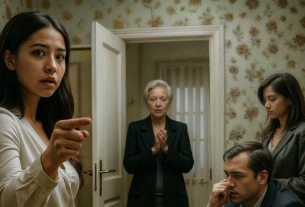
Lyuba stood before the mirror, combing through her client’s hair. Edik was supposed to come at six. With the rings.
At last.
“All done, Maria Ivanovna,” she said with a smile, slipping the cape off the elderly woman’s shoulders. “Goodbye.”
The client left, and the salon fell silent. Lyuba remained alone among the mirrors reflecting her from every angle. Half past six. Seven. A quarter to eight.
At last, the door creaked.
Edik stepped inside slowly. He looked as though someone had forced him to swallow something rotten.
“Lyuba…” he began, not daring to come any closer.
She kept tidying her station. Scissors into the case. Combs into the disinfectant jar. Familiar, automatic movements.
“Lyuba, listen…” His voice cracked. “I’ve been thinking.”
“Thinking?” She turned toward him. “And what did you come up with?”
He swallowed hard. Looked at the floor. Then straight into her eyes.
“I’m sorry. But my mother said there can’t be a wedding to a loser.”
Loser.
The word hung in the air like a sentence passed in court. Edik stood there waiting—for her to cry, to plead, to prove she was worth something.
But Lyuba only nodded.
“I see,” she said softly. “Your mother disapproves.”
“Lyuba, don’t do this.”
“No, Edik, it’s fine. Your mother knows best. She runs a clinic, after all. And who am I? A hairdresser. Cutting hair for pennies.”
He opened his mouth as if to say something, but she raised her hand.
“Go. Don’t upset your mother.”
He lingered by the door for another moment, then quietly left.
Lyuba sat down in the salon chair—the same one Edik had sat in a month earlier, the first time she’d ever cut his hair. She closed her eyes.
A loser.
And you know what? Maybe he was right. Maybe she really was one. Her whole life had been one missed chance after another. Vocational school instead of college. A little hair salon.
And the men she’d met before Edik were nothing special either. Until him. Edik had seemed different. He spoke beautifully, wore glasses, had a scholarly air. His mother was someone important.
He had seemed different.
Lyuba opened her eyes and studied herself in the mirror. An ordinary girl. Not beautiful, not ugly. Average. An average hairdresser in an average salon.
The next morning, she woke up at six-thirty. Got up. Shower. Coffee. An ordinary morning.
Only her head felt strange.
As if someone had pulled something vital out of it the night before and forgotten to close the hole.
“Lyuba,” her coworker Irinka called when she came into work, “how are you? After yesterday?”
“I’m fine,” Lyuba answered honestly. “Why wouldn’t I be?”
Irinka looked at her with sympathy and asked nothing more.
The workday dragged like rubber. The usual clients came in—women over forty who wanted to look twenty again. Lyuba cut, colored, styled. Mechanically. Her hands knew what to do.
But her mind kept turning.
“Lyubochka, have you ever thought about taking advanced courses?” one client asked while Lyuba was touching up her roots. “A friend of mine told me about these classes where they teach all the new coloring techniques. They say they’re expensive, but worth every penny.”
“How much do they cost?” Lyuba asked automatically.
“Oh, around forty thousand, I think. Maybe more.”
Forty thousand. Where was she supposed to get that kind of money?
That evening, she sat at home with a calculator for a long time. She counted what she earned, what she spent, what she managed to save. The numbers were depressing.
Then she opened her laptop and started looking at courses. There were so many. And yes, they really were expensive. But the people who finished them… Lyuba stared at photos of their work and understood at once: this was a completely different level.
Maybe she should try.
A week later, for the first time in her life, she walked into a bank to apply for a loan. She sat in the office of a credit manager—a woman of about twenty-five in a strict business suit—and felt like a complete fool.
“Purpose of the loan?”
“Education.”
“I see. And what is your current level of education?”
“Vocational school. Hairdressing.”
The woman nodded and wrote something down. Probably: typical failure trying to rise above her station.
They approved the loan.
At a brutal interest rate—but they approved it.
Lyuba enrolled in the courses. For three months, every weekend, she traveled to the regional center. She studied color theory, mastered complex dyeing techniques, learned trendy cuts.
The instructor—a man around forty with a fashionable hairstyle and flawless taste—looked over her work and nodded.
“You’ve got good hands,” he told her. “And a good eye for color. You just need more practice.”
Practice.
Lyuba returned to her little salon and tried to apply what she had learned. But her regular clients were conservative. They wanted simple cuts and familiar shades.
“What are all these fancy transitions?” grumbled Galina Semyonovna, one of her long-time customers. “I just need my roots done.”
Lyuba sighed and did the roots. Just like always.
But on social media, she started posting photos of her work—the rare times clients agreed to let her experiment. She didn’t have many followers, but the number of likes kept growing.
Then something unexpected happened.
During her lunch break, a woman Lyuba had never seen before walked into the salon. Pretty, stylishly dressed.
“Are you Lyuba?” she asked. “I saw your work online. I have an important meeting tomorrow, and my stylist got sick. Can you do something interesting?”
Lyuba glanced around. The salon owner was out somewhere. The other stylists were busy.
“Of course,” she said. “What did you have in mind?”
“I don’t know. Something that suits me. Something stylish.”
For two hours, Lyuba worked like someone possessed. She created a complex color treatment—soft transitions from dark to light, building depth, texture, movement. Then came the cut—not just trimming length, but shaping the hair like architecture.
The result exceeded every expectation.
The young woman stared at herself in the mirror as though she barely recognized the person looking back.
“Is that really me? Oh my God. How much do I owe you?”
Lyuba named the regular salon price.
“You’re joking, right?” the woman said, opening her wallet. “In Moscow, they’d charge me five thousand for this. Here—take four. And even that’s cheap.”
Four thousand!
Lyuba nearly choked.
“And can I recommend you to my friends? I’m in this social media group where we share contact info for really good specialists.”
A week later, new clients started showing up for Lyuba. Women from the regional center who traveled specifically to see her. They paid well and asked for exactly the kind of work she had trained to do.
And a month after that, the salon owner called her in for a talk.
“Listen, Lyubasha,” she said irritably, “what exactly are you doing? Clients are complaining that you keep offering them strange things. And those city girls of yours are ruining the atmosphere. They always want this and that.”
“But they pay well.”
“I don’t care. This is a family salon for locals. Don’t try to show everyone how clever you are.”
That evening, Lyuba sat at home for a long time, thinking. Notebook open. Numbers everywhere. Her new clients were bringing in more money than her regular shifts at the salon.
And if there were more of them?
What if…
The idea was insane.
But it lodged in her mind and wouldn’t leave.
What if she opened her own salon?
Ten years passed from the day Edik called her a loser.
Lyuba stood in her new salon and looked at the sign through the window.
Lyuba E. Salon
Gold letters on a dark navy background. Elegant. Confident. Expensive-looking.
Who would have imagined it?
Everything had happened in those years. The insane-interest loan. The advanced courses. The first clients from the regional center. Then leaving the old salon and renting a tiny space in the basement of a shopping center. Sleepless nights counting every last coin and wondering if she had made a terrible mistake.
But it had worked.
First, the basement shop started bringing in more money than her old job. Then came loyal clients who traveled specifically for her. Then a second room. A third. Employees.
And that very morning, the city paper had run an article about the “successful businesswoman who built a chain of beauty salons from nothing.” Full-page photo. Interview included. Lyuba talking about how the most important thing in life is not being afraid to take risks.
Funny how life works.
She was just reviewing a portfolio from a new stylist when the salon door creaked softly open.
Lyuba lifted her eyes and—
Oh God.
She saw him in the mirror before he saw her.
Edik stood at the entrance, glancing around uncertainly. Older now. Different glasses—expensive ones. A good suit. But something inside him had collapsed. As if someone had let the air out of him.
“Could I get a haircut?” he asked hesitantly.
Lyuba turned slowly. Their eyes met, and for a second time froze.
“Eduard Petrovich?” she said calmly, with the faintest smile. “How would you like it cut?”
He recognized her. She saw it instantly—the recognition, the confusion. His eyes moved from her to the interior of the salon, to the framed certificates on the wall, to the photo labeled: Director of the Salon Network.
“Lyuba,” he breathed. “Is that really you?”
“Who were you expecting?”
He walked into the salon like a man sleepwalking and lowered himself into the chair. Lyuba fastened the cape around him and turned on the dryer to fill the silence.
“How do you usually wear it?” she asked professionally.
“Oh… however,” he muttered. “Lyuba, I didn’t know that you…”
“That I what?” She began combing through his hair. “That I had a salon like this? Or that I’m not just a hairdresser anymore?”
“I thought…”
“I know what you thought. You thought I’d stayed a loser.”
He flinched.
Lyuba worked in silence. She cut carefully, professionally. The way she would cut any client’s hair. Only her fingers trembled slightly—and only he could see that.
“How’s your mother?” she asked without looking up.
“She’s retired now. The clinic was shut down. Reorganization.”
“I see. And your wife? Children?”
A pause.
Too long a pause.
“I never got married, Lyuba.”
Well now.
“Really?” She stopped and met his eyes in the mirror. “Did all the losers disappoint you?”
He turned red. Just like ten years ago, when shame had already been trying to claw its way through him.
“Lyuba, forgive me. Please. I was an idiot.”
“You were,” she agreed. “And now?”
“I realized I made a mistake. The biggest mistake of my life.”
Lyuba resumed cutting. Silently. Every movement of the scissors precise, controlled. As if she were not trimming hair but cutting the past away strand by strand.
“You know, Eduard Petrovich,” she said at last, “I’m actually grateful to you.”
“For what?”
“For what you said to me back then. About being a loser. If you hadn’t, I probably would’ve worked my whole life in that same little salon. For pennies.”
He looked at her in the mirror and said nothing.
“Now I have three salons. Twenty employees. An apartment downtown. A car.” She set the scissors aside and brushed the loose hair from the cape.
Edik got to his feet. He stood there, not knowing what to say.
“How much do I owe you?” he asked quietly.
“Three thousand.”
He reached for his wallet and pulled out the money. His hands were shaking.
“Lyuba… maybe we could meet sometime? Talk?”
She looked at him for a long time.
A very long time.
“Why?” she asked simply.
He stood by the door for another second or two, then quietly left.
Lyuba watched him go through the glass door and smiled.
For the first time in ten years, she smiled when thinking about him—and this time, it was real.
For a week after seeing Edik, Lyuba felt strange. Not sad. Not happy. Just light.
As if someone had finally lifted a heavy backpack from her shoulders—a weight she had been carrying for ten years without even realizing how much it hurt.
She went on with life as usual, taking clients, managing work. But every now and then, she caught herself smiling for no reason.
“Lyubov Yevgenyevna, are you all right?” the receptionist, Nastya, asked.
“I’m wonderful,” Lyuba said—and realized she was telling the truth.
The following weekend, she drove to visit her parents. They still lived in the same district where she had once rented a small apartment and worked in that old salon. As she passed by the place, she found herself slowing down.
The sign was peeling. There were “For Rent” notices in the windows.
It had closed.
Couldn’t survive the competition.
“Sweetheart,” her mother said while setting the table after Lyuba arrived, “do you remember that boy who used to court you? Edik?”
“I remember. Why?”
“I ran into his mother at the market.”
“And?”
“She complained that her son never married, that she’ll never get grandchildren. Kept asking how you were doing.”
“And what did you tell her?”
Her mother gave a sly smile.
“What was I supposed to say? I told her my daughter built a whole chain of salons and became a successful businesswoman. That newspapers write articles about her now. And no, she’s not married yet—she’s busy choosing among worthy men.”
Lyuba burst out laughing. Her mother had always known how to put people in their place—gracefully, but with perfect precision.
“And what did she say?”
“She turned pale and hurried off. I suppose it finally hit her what kind of daughter-in-law she threw away.”
It was good to have a mother like that.