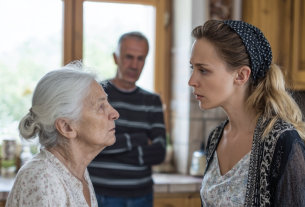
“Oh, how lovely — then we didn’t come for nothing after all…”
Irina flinched at the familiar voice of her mother-in-law. Dishes clinked in the kitchen, borscht simmered on the stove, chicken and potatoes browned in the oven, and a freshly baked apple pie cooled on the table. She glanced wearily at the clock — 10:17 a.m., a Saturday morning that could have been peaceful.
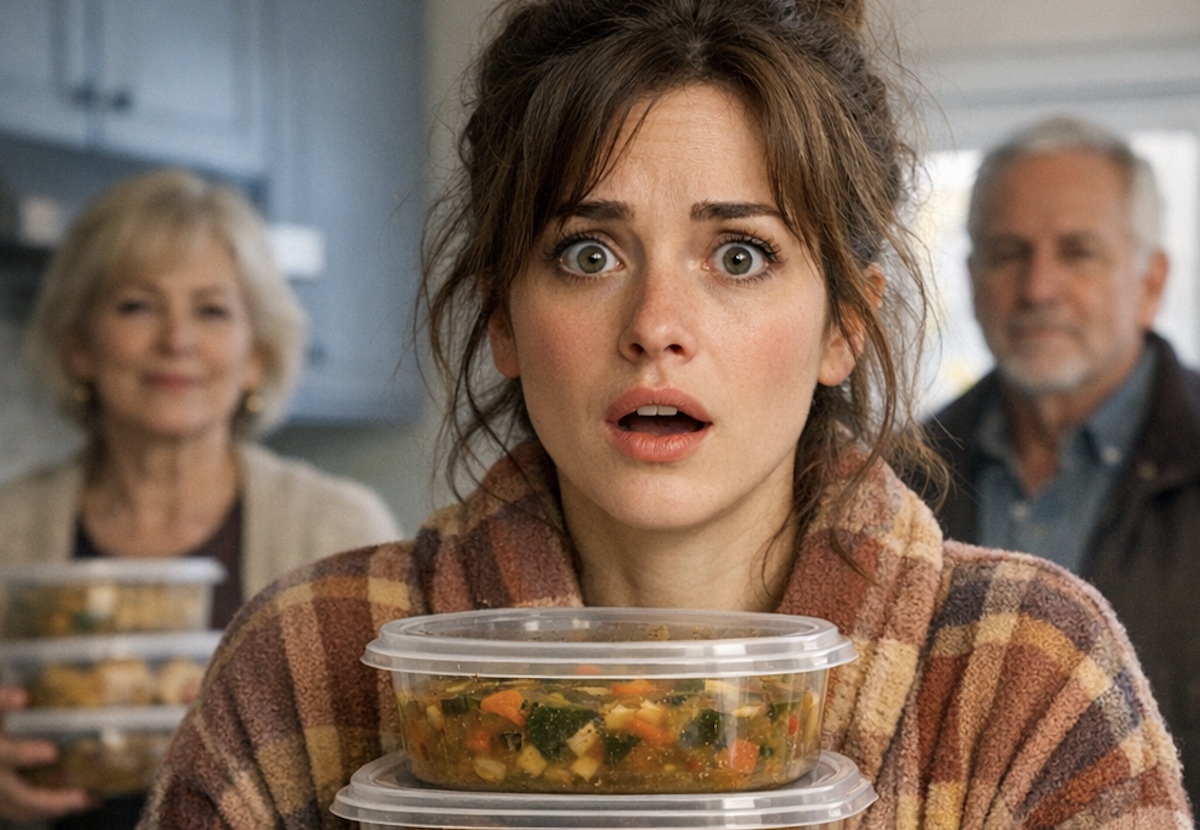
A minute earlier, the intercom had buzzed in the hallway — short, insistent, the kind of ring that suggested the people outside expected the door to be opened immediately. Now Valentina Petrovna and Sergey Ivanovich were standing in the apartment. In her mother-in-law’s hand swung a neat insulated bag. Irina knew exactly what was inside: empty plastic containers labeled in marker — “Soup,” “Meat,” “Salad,” “Dessert.”
Valentina Petrovna swept her gaze over the laid table with the critical look of a woman inspecting someone else’s work. Inside, Irina felt the familiar wave of irritation rise, and just as habitually, she buried it behind a polite smile.
“Polina, sweetheart, Grandma and Grandpa are here!” Irina called toward the children’s room.
Her six-year-old daughter came running into the hallway, waving a drawing.
“Grandma, look! I drew a castle!”
“Well done, my dear,” Valentina Petrovna said, patting the girl on the head, though her eyes had already drifted toward the kitchen. “And what delicious things did Mommy make?”
Irina caught herself thinking that after seven years of marriage, she had learned to predict every move her mother-in-law would make. In a moment she would head to the kitchen, open the fridge “just to take a look,” then start asking about the menu…
“Irina, dear,” Valentina Petrovna began as she lowered herself into a chair at the table, “will there be sour cream with the borscht? It’s not good for Father to eat anything too rich — his stomach.”
“There’s sour cream in the refrigerator,” Irina answered evenly.
“Last time, though, you bought that wonderful homemade one from the market…”
Sergey Ivanovich silently unfolded a fresh newspaper on the table and nodded at Irina in greeting. In all the years she had known him, she could count on one hand the number of times he had said more than a few words during a visit.
“Is Alyosha at work?” her mother-in-law asked.
“Yes. An urgent project. He said he’d be back by lunch.”
“It’s always the same,” Valentina Petrovna sighed. “We come all this way and he isn’t here. Good thing you feed us, Irina. We’re not staying long, just stopping by to see everyone.”
Irina nodded automatically. “Not staying long” usually meant at least four hours.
She remembered how, during the first year of marriage, she had found her husband’s parents’ attention touching. They came every Saturday “to help the young family,” bringing a jar of jam or a bag of apples from the garden. Back then, it had seemed sweet.
“Mom, can I watch cartoons?” Polina asked.
“After lunch, sweetheart. We’re about to eat.”
“And what’s for the main course?” her mother-in-law asked, already peering into the oven. “Oh, chicken! Father, your favorite!”
Sergey Ivanovich lowered the newspaper just enough to give an approving grunt.
As Irina set the table, she thought about how those once-gentle visits had slowly turned into a weekly obligation. At first, her mother-in-law had dropped delicate hints that it would be “nice” if something were prepared for their arrival. Then came the Friday night calls:
“Daughter, we’ll stop by tomorrow. Make a good soup, won’t you? Father loves it rich.”
And one day Valentina Petrovna had even written out a list “just in case”: borscht, cutlets, Olivier salad, herring under a fur coat, and of course some kind of baked dessert.
“Polina has a fever — one hundred point eight,” Irina said into the phone, holding a cool damp cloth to her daughter’s forehead.
“Oh, poor little thing!” Valentina Petrovna exclaimed on the other end. “We’ll definitely come tomorrow to see our granddaughter!”
“Maybe it’s better not to? I took the day off, I’ll be home with her…”
“What do you mean, not come? How could we not, when the child is sick? She needs proper chicken soup. Did you make it?”
Irina looked at her daughter, who had closed her eyes wearily.
“Just a light broth for Polina…”
“Well, that’s good then! See you tomorrow!”
The next day, despite Irina’s request to postpone the visit, her in-laws came as usual. Polina was asleep in her room after fever medicine, and Valentina Petrovna was already taking over in the kitchen.
“This broth is so pale,” she said, shaking her head after tasting it from the ladle. “I would have made it stronger. And it needs more carrots.”
“It’s for a sick child,” Irina said quietly.
“Exactly! A sick child needs vitamins!” her mother-in-law replied in a lecturing tone. “Well then, at least there’s fresh bread, isn’t there?”
Irina silently took out a loaf. She had been up all night bringing down her daughter’s fever, and now she felt barely able to stand.
“Ir, are there no cutlets left?” Sergey Ivanovich suddenly asked.
“No. I didn’t cook anything except the broth.”
“That’s a shame,” he sighed, returning to his newspaper.
An hour later, when they were getting ready to leave, Valentina Petrovna took out her containers.
“Pour us some broth, just a little. Father can have it tomorrow.”
Irina stood there, watching as her mother-in-law poured half the pot into plastic tubs. Broth she had made for her sick daughter. Something inside her gave way in that moment, like a dry branch snapping under snow.
A week passed. Polina recovered and went back to kindergarten. On Friday evening, the usual call came.
“Irina, dear, we’re coming tomorrow, as always!”
“All right,” Irina answered shortly.
She did not buy anything special. She did not stand in line for fresh meat. She did not knead dough for a pie. In the fridge there were only yogurts, a dozen eggs, and a pot of yesterday’s buckwheat.
Saturday morning, the intercom rang at exactly ten.
“Something doesn’t smell delicious today!” Valentina Petrovna said in surprise as she walked in.
The kitchen met her with a clean stove and an empty table.
“Where… where’s the meal?” her mother-in-law asked, confused.
“What meal?” Irina replied calmly.
“Well… we came…”
“I didn’t invite you, and I didn’t promise anything.”
At that moment, Alexey walked in, sleepy, wearing lounge pants.
“Mom? Dad? You’re early today.”
“Alyosha, what’s for lunch?” Valentina Petrovna asked plaintively.
“I don’t know,” he said with a shrug. “Ir, what do we have?”
“Eggs and buckwheat.”
An awkward silence settled over the room. Sergey Ivanovich lowered his newspaper.
“We didn’t come for no reason…” Valentina Petrovna began.
“I don’t live for no reason either,” Irina interrupted. “I work five days a week. I get tired. And I want to rest on weekends instead of standing at the stove all morning.”
Alexey looked at his wife in surprise. In seven years, it was the first time he had seen not a tireless hostess, but an exhausted human being.
The conversation continued around the bare kitchen table. Irina brought out the notebook where she kept the family budget.
“Look,” she began calmly. “Food for your visits costs about three thousand a week. Cooking takes my entire Friday evening and Saturday morning. That’s eight hours of my time.”
“But we never asked for anything special…” Valentina Petrovna muttered, bewildered.
“‘A hearty soup, a salad, something meaty, and definitely dessert’ — those are your words, Mother.”
Sergey Ivanovich cleared his throat and, unexpectedly, spoke up.
“Valya, the girl is right. We’ve been coming here like it’s a restaurant.”
“Father!” his wife protested.
“What do you mean, ‘Father’? Remember when you even made a list of what should be cooked?”
Alexey turned to his wife.
“Ir, I’m sorry. I truly didn’t realize… I thought it wasn’t hard for you.”
“It isn’t hard when it’s your choice,” Irina answered. “But when it becomes an obligation every single week…”
Valentina Petrovna’s eyes filled with tears.
“I only wanted what was best! So the family could gather, so we’d have traditions…”
“Traditions are when everyone feels good,” Irina said gently. “Not when one person serves everyone else.”
Two weeks passed in an unfamiliar silence. No Friday calls, no Saturday morning visits. Irina even began to wonder if maybe everything had happened too harshly.
Then, on Friday evening, the phone rang.
“Irina?” Valentina Petrovna’s voice sounded unsure. “It’s me… Father and I were thinking… Could we come tomorrow? But we’ll bring everything ourselves!”
“Bring what?” Irina asked, surprised.
“I baked a cabbage pie — your favorite. And I already chopped the salad. Father bought the chicken, but if it’s all right, we’ll bake it in your oven. Ours isn’t working properly.”
Irina did not answer right away.
“Of course, come…”
On Saturday they arrived carrying heavy bags. Sergey Ivanovich held a baking tray with the pie, Valentina Petrovna carried a sack of groceries. The usual insulated bag full of empty containers was nowhere in sight.
“Polina, come help Grandma!” Valentina Petrovna called to her granddaughter. “We’re going to cook together!”
Irina stood in the middle of the kitchen, not knowing what to do.
“You sit and rest,” Sergey Ivanovich said, already putting the kettle on himself. “We’ll manage.”
“Ir, where do you keep your chicken spices?” her mother-in-law asked briskly, rolling up her sleeves.
For the first time in all those years, Irina simply sat at the table and watched other people bustle around in her kitchen. Alexey sat down beside her and squeezed her hand.
“This is better, isn’t it?” he said with a smile.
“It is,” she nodded.
“Grandma, look what I can do!” Polina said, skillfully pinching the edges of dumplings.
“That’s my clever girl! Now like this — tighter…”
Three months passed after that conversation. Irina stood at the stove, stirring sauce, but now it was because she wanted to. Nearby, Valentina Petrovna rolled out dough — she had come early on purpose to help.
“Ir, maybe we should add a little dill?” her mother-in-law asked, then quickly added, “Although you know best — it’s your signature recipe.”
The visits became less frequent — once every two weeks. Sometimes they cooked together, sometimes they ordered pizza, sometimes they simply drank tea with a store-bought cake.
“Do you remember those containers?” Alexey suddenly asked, peeking into the kitchen.
“What containers?” Polina asked.
“Never mind, sweetheart,” Irina said with a smile.
Valentina Petrovna coughed awkwardly.
“I threw them away. Every single one.”
“Really?” Irina asked, surprised.
“Really. Father said enough of us dragging bags around like peddlers.”
They all laughed — truly laughed, for the first time, without strain or tension.
And Irina understood something important: the problem had never been that they were bad people. It was the unspoken resentment. Silence ruins relationships more surely than open conflict ever could. But an honest conversation, even an unpleasant one, can become the beginning of real closeness.
Those empty containers belonged to the past now — a symbol of a relationship built on silence and false expectations.