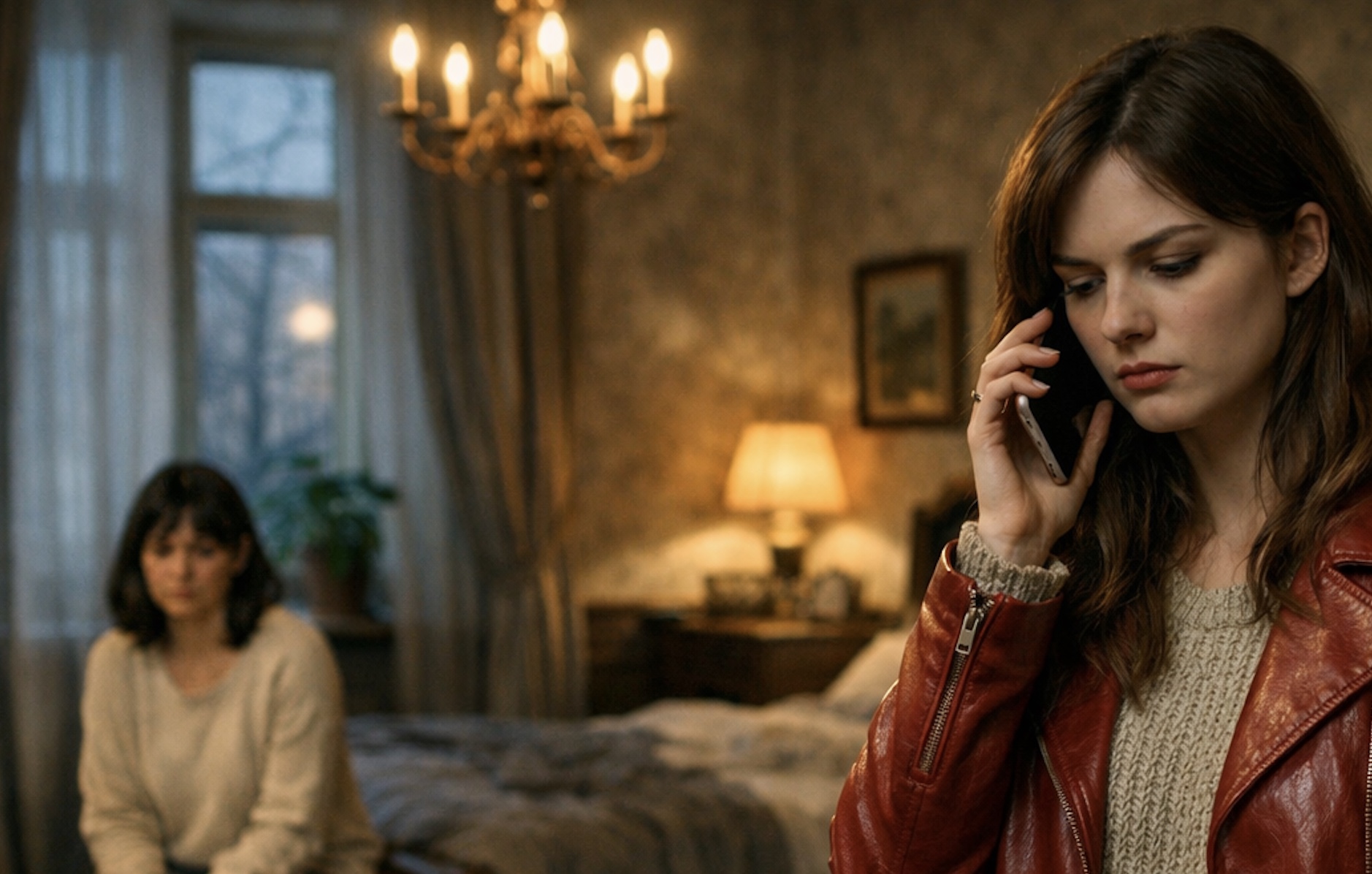
“This isn’t your apartment anymore, Yana. We’re going to stay here for a while, so don’t make a scene,” Angela hissed, lounging on my bed in my robe, tapping ash into a saucer from my wedding china.
I stopped in the bedroom doorway and did not even take off my rain-soaked coat right away. October in Saint Petersburg had been pouring all day, the taxi had barely crawled from the station, my suitcase had nearly pulled my arm out of its socket, and instead of silence and a hot shower, I came home to strangers’ feet on my bedspread. Tolik was sprawled in the armchair by the window, drinking something amber-colored from my wineglass. Dark muddy footprints stained the parquet floor. Cigarette smoke drifted from the bathroom, even though I had asked Kirill at least ten times not to smoke in the apartment, not even in the kitchen, let alone the bathroom. In the hallway, Angela’s glossy handbag lay tossed across the bench, next to her boots, my slippers, and some man’s backpack hanging open like a busted mouth after a fight.
I did not scream.
Not because I had nothing to say. Quite the opposite. But there comes a point when you see people no longer asking you to make room in your own life, only shoving you aside with their elbow, and something inside you gets too quiet for a fight.
“Where’s Kirill?” I asked at last.
Angela smirked and crossed one leg over the other, as if this were not my home but some cheap rental she had come to occupy “for a week or two.”
“He went out for water. We’re just crashing here for a bit. Don’t look like you hate it so much.”
Tolik gave a low chuckle without lifting his eyes from the glass.
“Seriously. We’re family.”
And in that exact second, I understood something clearly: a scandal would only help them.
Angela was exactly the kind of woman who bloomed in chaos. Later she would tell everyone that “Kirill’s wife is insane,” that “we only asked to stay a couple of days,” that I had “nearly attacked her.” Tolik would add a few dirty little details. Kirill would do what he always did—shift awkwardly and say in that weak, worn-out voice of his, Why did you react like that? We could have talked calmly.
And in that sticky family sludge, I would be the hysterical one.
I slowly set my suitcase against the wall.
“I see,” I said.
Angela actually looked disappointed.
“That’s it?”
“For now.”
I stepped out of the bedroom, closed the door from the outside, and turned the key. Then, just as calmly, I locked the guest room too, the one where their jackets and shopping bags were piled. Tolik did not react immediately. Only when the lock clicked.
“Hey!” he barked. “What the hell are you doing?”
I was already walking toward the front door. On the way, I took out my phone, opened my recent calls, and dialed 112.
“Unlawful entry into a private apartment,” I said evenly the moment the operator answered. “Saint Petersburg, such-and-such street, building such-and-such. Unauthorized persons are inside my property without my consent. My belongings have been damaged, and I suspect attempted theft.”
From behind the bedroom door came a second of silence, then Angela’s shriek:
“Are you out of your mind?!”
The stairwell smelled of damp stone, wet metal, and somebody’s dinner frying with onions. My old Stalin-era building had always had those heavy staircases, high ceilings, thick doors, and that peculiar echo only old houses have—the kind that makes other people’s shouting sound especially ugly.
I leaned my back against the wall, and only then noticed how badly my fingers were trembling.
What was under threat now was not just the apartment. Not just the furniture, the parquet, the dishes, my clothes, my papers. What was under threat was the last decent-looking thing this marriage still had on the surface—the illusion that Kirill was simply gentle. That he was harmless. That he just had a hard time saying no.
No.
Gentle people do not bring a circus into your home while you are away on a business trip and hand their sister the key to your bedroom.
Gentle people may fear conflict.
But Kirill had long since learned to disguise someone else’s audacity as his own fear.
The police arrived quickly. October rain rattled against the stairwell window, the downstairs door slammed, and someone heavy-footed started climbing the stairs. I stared at my phone and remembered how any of this had happened in the first place.
When Kirill and I got married, I thought his biggest flaw was his need to be liked by everyone. He was one of those men who would always pull out a chair, pour tea, carry your bags, and spend far too long excusing people who had already made themselves comfortable on his neck. After arrogant, overconfident men, that softness had seemed rare. Back then I was working hard, already handling serious civil cases, already used to keeping my face composed and not folding under pressure. Next to me, Kirill felt almost restful. Domestic, smiling, the sort of man who could spend twenty minutes choosing the right font for a logo as if peace itself lived in tiny aesthetic decisions.
The problem was never just him.
The problem always entered our apartment wearing his family’s face.
Angela was eight years older than Kirill, but behaved as though she were the younger sibling—fragile, wronged, perpetually at the mercy of fate. Something was always happening to her. Her rental suddenly became too expensive. Work was “temporarily not working out.” Another man had disappointed her. Her health somehow always wavered precisely when it was time to repay money. And for some reason, all of her carefully scattered helplessness always landed squarely on my husband’s shoulders.
“She’s my sister,” Kirill would murmur whenever, for the third time that year, I walked into my own kitchen and found Angela there wearing the face of a martyr and carrying another tragic tale.
“She is a grown woman,” I would remind him.
“I know. But if I don’t help her, who will?”
That question was a trap.
If I said I don’t know, he would lapse into wounded silence. If I said let her figure it out herself, I instantly became cold and cruel. And Angela had a special gift for turning other people’s boundaries into a performance of their supposed heartlessness.
Tolik showed up in her life in the spring.
Loud, coarse, smelling of cheap cologne and cigarettes, with a habit of putting his feet on furniture even while the owners were looking right at him. He talked about “projects,” “startups,” “real money,” but in reality he was either unemployed or “helping some friends out for the time being.”
The very first evening Kirill brought them over “just for dinner,” Tolik wiped his hands on my linen towel, looked up at the ceilings, and gave an approving whistle.
“Not bad. You could really live here.”
Even then, something in me recoiled. Not fear yet. Just that particular disgust you feel when a stranger appraises your home too freely, as if mentally measuring it for himself.
Then came the little oddities.
Angela kept asking when I would be away on business trips.
One day Kirill casually asked whether I had a spare set of keys, “just in case something happened.”
I said no.
He was offended.
“So you don’t trust me?”
“I trust you,” I said. “I just don’t trust everyone you’re so desperate to please.”
He sulked, went off to the other room, and for two days spoke to me in that soft, withholding tone people use when they want to punish without raising their voice. And as usual, I eventually went to make peace myself. Because I was tired. Because work burned me out. Because at home I wanted at least some quiet, not another round of guilt about how ungrateful I was toward his family.
The first real blow came a week before my trip to Moscow.
I got home early, opened the closet in the hallway, and saw that one of my handbags was out of place. An expensive one. Dark cherry leather. A gift to myself after winning a difficult case. I barely ever used it. Inside, it smelled faintly of Angela’s sweet perfume.
I stood there holding it and knew this was no longer carelessness. Not some oops, I grabbed the wrong bag. This was someone trying on another person’s life. Testing the taste of someone else’s boundaries.
“Kirill,” I called.
He came out of the room with his laptop.
“What?”
“Did Angela touch my things?”
The pause was brief, but long enough.
“She just looked. What, is that such a tragedy?”
“A tragedy?” I repeated.
“Yana, don’t start.”
“She didn’t steal anything.”
That was the moment I first stopped thinking about an argument and started thinking like a lawyer. About process. About evidence. About the fact that sooner or later I might have to do to my own marriage what I did every day in court—strip away illusion and leave only facts.
And then came the thing I truly had not been prepared for.
When I returned from Moscow a day early, I did not just find Angela in my bedroom. I saw how quickly people stop pretending when they are sure you will not be back for another twenty-four hours.
There were cigarette butts in the ashtray in the kitchen. Her tights were drying on the bathroom radiator. My work tablet lay face down on the table. And worst of all, the air itself was filled with that unmistakable feeling of ownership.
They were no longer asking to stay with us.
They were already living there.
When the police arrived, Angela started shouting first.
“She locked us in!” she screamed the moment Lieutenant Sokolov and another officer reached the landing. “She’s insane! We’re relatives! We had an agreement!”
I stood by the wall, my wet coat turning cold on my shoulders, and spoke calmly. Not because I was above a scene. Simply because in my profession, tone often matters as much as facts.
And by then I had facts.
“The apartment is registered in my name. In my absence, unauthorized persons moved in without the owner’s consent. There is visible damage to my property. They had access to my private room. I want this formally documented.”
Lieutenant Sokolov was young, with the tired face of a man who had already seen too much domestic nonsense in a single shift. At first he regarded me with cautious politeness. Then he looked at Tolik, who had begun waving his hands and talking about it being “a family matter,” looked at Angela in my robe, at the ashtray, the muddy floor, and suddenly his whole posture changed.
“Do you have documents for the apartment?”
“On my phone and in a folder in my office. The office is locked.”
“Key?”
“With me.”
Kirill showed up at the worst possible moment. He must have seen the police car outside and rushed upstairs. He burst onto the landing carrying bottles of water, soaked from the rain, confused, wearing that expression that used to awaken pity in me.
Now it brought only exhaustion.
“Yana, what are you doing?” he blurted. “It’s Angela!”
“I can see that.”
“We could have just talked.”
“To whom?” I asked quietly. “The people settling into my bedroom?”
Angela jumped in instantly.
“There! I told you she’s unhinged! We’re only staying a couple of weeks while we launch a startup!”
The lieutenant raised an eyebrow.
“You’re launching a startup from someone else’s apartment?”
Tolik stepped forward.
“Hey, officer, don’t start with that. This is family.”
“Back up,” Sokolov said flatly.
And that was when Kirill was truly frightened for the first time.
Not for me.
For himself.
For the fact that his usual formula—but they’re family—did not work on a man in uniform who did not care who was related to whom.
“Yana, withdraw the complaint,” he whispered, his voice completely different now. “Let’s not take it this far.”
I looked at him and suddenly saw our whole marriage with perfect clarity: all the times I had not taken it that far. I had not pushed when it came to Angela. Not pushed over the keys. Not pushed when he let her touch my things. Not pushed when every one of my no’s was treated not as an answer but as a delay tactic before another attempt.
Again and again, I had eased off so that something resembling peace could remain in the house.
“No,” I said.
Angela and Tolik were brought out into the corridor. Angela shifted immediately into a new act.
“He’s my brother!” she shrieked. “I have rights! We’re not out on the street!”
“You have the right to rent a hotel,” Sokolov said through his teeth. “Or stay out of someone else’s home.”
While they argued, Valentin Petrovich stepped out of the neighboring apartment. Our retired military man from the third floor—lean, upright, in a knitted vest, with the face of someone who notices everything and forgets nothing. He surveyed the landing, looked at me, and said quietly:
“Yanochka, one moment.”
He disappeared inside and came back carrying a small flash drive.
“There are recordings from the hallway camera on this. I installed it after that business with the couriers. Thought it might help.”
“What recordings?” Sokolov asked at once.
Valentin Petrovich nodded toward Angela.
“The day before yesterday, this lady and her companion hauled bags to the elevator three separate times. Then brought some back in. I noticed because it looked like a very nervous move. Yesterday she was walking around in your fur coat. I stayed out of it—family matters and all—but now I see I was right to save the footage.”
Angela went pale.
Tolik muttered a curse.
“Well,” Sokolov said softly, “that does make things more interesting.”
We checked the flash drive in my office.
The video showed Angela leaving the apartment with my dark handbag, then with another bag, then coming back in while glancing around. Tolik carried a box with small electronics toward the elevator.
That was enough for their “temporary family stay” to become something very different.
Kirill stood against the wall, white as the plaster near the ceiling.
“I didn’t know,” he breathed.
I did not even turn to look at him.
“Of course you didn’t.”
The moment I came closest to doubting myself was when I saw handcuffs snap shut around Angela’s wrists. Not because I suddenly felt sorry for her. But because that was the moment this stopped being ugly domestic filth and became something real—something no one could now rewind and perform differently.
A night at the station. Statements. Reports. Protocols. Kirill pulled between his mother, his sister, and me.
And somewhere inside, for one second, an exhausted and very female thought flickered: Maybe I went too far. Maybe I should have just thrown them out quietly. Changed the locks and left it at that. Family is family. Husband. Relatives.
That thought lasted only a few seconds.
Exactly until Sokolov held up a cosmetic bag of mine and my jewelry case from one of their shopping bags.
“Is this part of the temporary arrangement too?” he asked dryly.
And everything settled into place.
The breaking point itself was almost mundane.
While the officers were finishing paperwork, I called a locksmith. Then I ordered a грузовое такси. Then I opened Kirill’s wardrobe and took out a suitcase.
Into it, quickly and without drama, went his sweaters, jeans, chargers, his tablet box, the socks he was forever losing, two branded notebooks, and a stack of T-shirts I had bought for him because left to himself he always chose shapeless ones.
That was the strangest part of all: packing someone else’s belongings calmly.
No throwing. No speeches.
Just the way a case is closed.
After Angela and Tolik were taken away, Kirill tried one more time to play for pity. Quietly now. Without you don’t understand. Just helpless.
“Yana, they’re my family.”
“And what am I?” I asked.
He said nothing.
And in that silence, he answered more honestly than he had in all our conversations over the last few years.
“I didn’t think they’d go that far.”
“You never think,” I said. “And I’m always the one left to clean up after it.”
He looked at the suitcase by the door.
“You’re throwing me out?”
“No. I’m removing the man who gave strangers access to my apartment.”
Yes, this is probably the part that would divide people. Some would say I overreacted. That I turned family disorder into a criminal case. That I could have handled it more gently. More quietly. With a conversation.
But I know too well how “conversations” end when one side has spent years living with a sense of impunity.
Gentler for whom?
For Angela, who was trying on my life along with my clothes?
For Tolik, who had already started selecting electronics?
For the husband who would once again have let it all slide?
Or for me, who would have spent yet another year in an apartment where I no longer felt safe?
The truck arrived forty minutes later. By then the locks had been changed, Sokolov had driven off with the detainees, and Kirill had already sat down on the edge of the sofa, stood up, paced the room, and repeated several times:
“Let’s at least talk tomorrow.”
“No.”
“You’re not giving me a chance.”
“I gave you too many.”
He stood there in the hallway with that suitcase, not looking angry, or wounded, or even broken.
Just stripped of the environment that had always protected him—the one where somebody else always made the decisions for him and then excused him afterward.
When the door closed behind him, the apartment felt strangely empty.
Not triumphant.
Not frightening.
Simply empty.
The old house hummed through its radiators. Rain still fell outside the windows. Damp traces of чужая обувь still glistened on the floor in the corridor. The bathroom smelled of cigarettes and mint air freshener, which Angela had apparently sprayed in a futile attempt to cover the smoke. The bedspread lay wrinkled on the bed. Tolik’s half-finished drink still stood in the kitchen.
I gathered the dishes, opened the windows, turned on the extractor fan, and made myself coffee.
It was already past midnight.
The city beyond the glass shimmered with wet yellow lights, and somewhere far away a tram rang out so delicately that it almost made me laugh.
I sat at the kitchen table with the hot mug in my hands and, for the first time in a long while, heard my apartment without anyone else’s voice inside it.
Silence can be heavy too.
But this silence was mine.