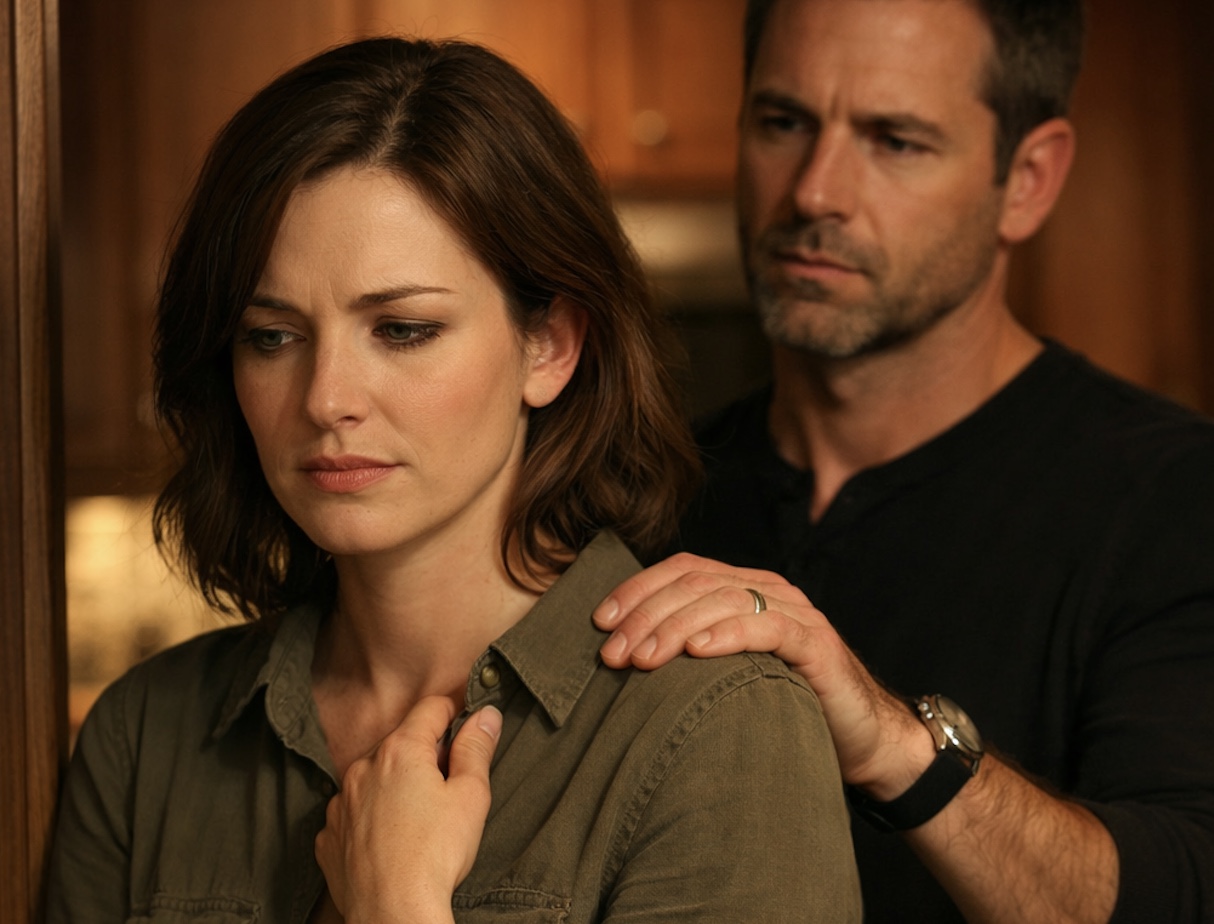
A quiet November evening pressed against the windows—dense and dark, like spilled ink.
In the kitchen of their aging apartment block, only a small light beneath the overhead cabinet was on, casting sharp shadows across Anna’s tired face. She sat at the table buried under papers—utility bills, receipts, bank transfer printouts. In front of her lay an open checkered notebook, where neat columns of numbers lined up one beneath another.
Very large numbers.
On the stove, a kettle had long gone cold. Nearby, two empty plates from a silent dinner remained untouched. Her husband, Maxim, had retreated to the living room over an hour ago; the muted sound of a sports broadcast drifted faintly through the apartment.
Anna brushed her hand across her forehead, pushing back a loose strand of hair. Her fingers paused on the last sheet—a transfer of forty thousand rubles made three days earlier.
Purpose: “For Irina’s treatment.”
Maxim’s sister.
In her mind, Anna saw her clearly—Iрина, loud and carefree, showing off a fresh manicure and a brand-new iPhone on social media the very same day she had begged for money for “urgent tests.”
Anna exhaled slowly, heavily, and lifted her gaze toward the doorway. A flickering blue glow from the TV spilled into the kitchen.
“Maxim…” she called.
Her voice came out softer than she intended, slightly hoarse with exhaustion.
No answer—only the commentator coughing somewhere in the background.
“Maxim, we need to talk. About the money.”
A pause followed. Then the volume dropped slightly.
“What now?” came his voice from the living room—flat, indifferent.
Anna gathered the papers into a stack, stood up, and stepped into the doorway.
Maxim was lying on the couch, his legs thrown over the armrest, staring at the screen where players rushed across a bright green field. He didn’t even turn his head.
“This is already the third large transfer to your sister this year,” Anna said, stopping in the middle of the room. She held the papers close to her chest like a shield. “We’ve sent over two hundred thousand in total. Plus fifty we gave your mother last month for that ‘emergency’ fridge repair—even though she has a decent pension and rents out her dacha. And then—”
“I know,” he cut her off, finally turning his face toward her. In the bluish light, his features looked чужими, almost artificial. “I know all of it. You’ve said it ten times already. They’re family. They’re struggling.”
“Everyone is struggling!” The tension she had been holding back finally broke through her voice. She stepped closer. “I’m struggling too! I’m working two jobs so we can save—for a bigger place, for a child, for our future! But we’re not saving, Maxim. We’re funding the lives of your fully grown, perfectly healthy sister and your mother—who earns more than both of us combined! When does it end?”
He slowly lowered his legs and sat up. His movements were heavy, resigned.
“It will end. They’ll pay it back. Mom promised—after she sells the harvest. And Irina will find a better job.”
“She’s been promising that for three years!” Anna snapped, her voice rising before she could stop it. She bit her lip immediately, trying to regain control. “Every time there’s a new excuse. Tests, tutoring, car repairs… And us? We keep putting our life on hold. We don’t even have a safety cushion! Just that shared account you dip into whenever you want—without even asking me!”
“I don’t have to ask you for permission to help my family!” His voice sharpened for the first time. He stood up, towering over her. “That’s my money too. I earn it.”
“It’s our money!” she cried, and tears—hot, unwanted—burned her eyes. She wiped them away quickly. “We’re a family. Or are we only a family when your relatives need something? When I asked to help my mother with surgery two years ago, you said, ‘Sorry, we can’t afford it right now.’ So the crisis only applied to my family?”
Maxim turned away, walking toward the window, staring into the dark void outside.
“Don’t mix things up,” he said coldly. “That’s different.”
“It’s exactly the same!” She threw the papers onto the coffee table. They scattered across its surface. “This is our life for the past five years! Debts, promises, excuses—and not a single one fulfilled! I’m tired of being an ATM for your family—people who don’t even see me as a person! To them, I’m just an extension of you… a walking wallet!”
She saw his shoulders tense.
Slowly, he turned back toward her.
His face looked unfamiliar—cold, smooth, almost lifeless.
“If you hate my family that much,” he said quietly, every word precise and controlled, “if to you they’re just freeloaders and parasites… then I’m filing for divorce. I’m not going to keep paying for your resentment—or for them.”
The air left her lungs as if she’d been struck.
She froze.
This word—divorce—he had thrown around before, in anger, during arguments.
But now…
Now it sounded different.
Final.
“What?” she whispered.
“You heard me.” He walked past her toward the hallway, his steps firm against the floor. “I’m tired of this. Tired of your constant counting, your dissatisfaction. They’re my blood. And if you can’t accept that… then we’re done.”
She stood there, unable to move, listening as he opened the closet. The faint squeak of hangers. The rustle of fabric.
“Where are you going?”
He reappeared in the doorway, holding her autumn coat.
“Put it on. Go outside. You need to cool off. I need to think,” he said, extending it toward her. His hand was steady.
Anna looked at the coat. Then at him.
No anger. No rage.
Just cold determination.
“You’re… throwing me out? Of our home?” she asked, each word heavy.
“I’m asking you to step outside and calm down,” he replied evenly. “Before we say something worse.”
Anna looked from the coat to his face. No anger. No rage. Only a tired, soul-freezing resolve.
“You’re… throwing me out? Out of our home?” Every sound cost her an unbearable effort.
“I’m asking you to step outside and calm down. So neither of us says too much,” he corrected. “I need time to sort out my thoughts.”
It was not a shout. Not a scandal. It was a cold, calculated shot. And it hit exactly where it was meant to.
Mechanically, she picked up the coat. Her fingers would not obey her; the buttons would not fasten. He watched, arms crossed over his chest. When she finally pulled the jacket on, he nodded toward the door.
“The keys,” she said dully.
“Why? You’ll cool off and come back. Or maybe you won’t.” He shrugged. “That’s your choice.”
For another second she stood there, staring at him, searching his eyes for even the smallest flicker of doubt, regret, pain. There was nothing there.
She turned, opened the front door, and stepped onto the dark landing. Behind her, the lock clicked. Loud. Final.
She walked down the stairs without understanding how her legs were moving. The stairwell smelled of dampness and the stale metal scent of the old elevator. She stepped outside. The sharp cold air burned her face. Above her there were no stars, only the murky orange glow of the city sky.
She pulled the handle of her car, parked by the entrance. Locked. The keys were still inside, on the little table in the hallway, beside his set.
Anna turned and looked up at the kitchen window on the third floor. The under-cabinet light was still on. Everything looked the same. Only now she was down here, in the raw November dark, wearing a thin jacket, with empty pockets and the sickening feeling that her whole world had just been turned upside down by the quiet click of a lock.
She pressed her back against the cold metal of the car and slowly, very slowly, slid down until she was sitting on the curb. The freezing stone cut through the thin fabric of her pants at once. The edge of her phone poked out of her jacket pocket. She pulled it free. The bright screen stung her eyes. Half a dozen social media alerts, advertisements. Not a single message from him.
She lifted her head and looked once more at the warm light in her window. No sound came from inside. No shouting, no doors slamming. Just silence. And that silence was more frightening than any words.
Only now, sitting on the cold curb, did she begin to understand. This had not been a reckless fight. It had been an ultimatum. Cold, deliberate, merciless. And the first clear thought pierced the shock: What if he doesn’t change his mind?
The second thought was worse: Where am I supposed to sleep tonight?
And then, finally, the first quiet, bitter tear slid down her face, already dirty with fatigue and old mascara.
The first night passed in a broken half-sleep, interrupted by icy spasms in her cramped back and the low hum of rare passing cars. Anna spent it in the front seat of her own car, knees tucked up beneath her, wrapped in an old automotive blanket she had found in the trunk. It smelled of dust and gasoline, but it protected her, at least a little, from the piercing cold that seeped through the windows. She could not start the engine to warm up; she was afraid of drawing the attention of the neighbors or, worse, a police patrol. And she could not bring herself to look at the time on her phone. By some miracle it had lasted until morning, but now it sat at five percent battery, dark and useless. Her banking app was inaccessible, which meant she could not even check the account balance.
She watched dawn arrive through the dirty windshield. The sky slowly lightened, shifting from black to muddy gray, to lilac, and then to the pale color of wet asphalt. Yellow kitchen windows blinked on in neighboring buildings. Life was waking up, ordinary and routine. But her own life, in that moment, was crushed into the interior of a foreign-made sedan; her body ached from the awkward position, and only one thought hammered in her mind: What do I do now?
The plan was painfully simple. Wait until nine. Walk to the nearest branch of the bank where their joint account was held. Try to find out everything. Then call Lera.
Lera—officially Olesya, though everyone called her Lera—had been her closest friend since university, the only person Anna had ever shared her doubts with about money and Maxim’s family. Lera worked as in-house counsel at a major firm and had always spoken bluntly: “You fool, everything has to be documented. Spoken words are nothing.” Anna used to brush it off. “Oh, come on, it feels awkward… we’re family.” Now the words awkward and family rang in her ears like the most foolish excuse she had ever made.
At exactly nine, she climbed out of the car. Her legs were numb and stiff; she had to brace herself against the door. She straightened her wrinkled coat and tried to smooth her hair with both hands. Without looking up at the apartment window, she headed out of the courtyard. The banking center was three blocks away.
The walk felt endless. Every passerby seemed like a witness. Every glance felt judging, condemning. There she is, the wife who got thrown out, wandering around at dawn all rumpled. She hunched her shoulders and walked faster.
Inside the bank it was bright, warm, and utterly indifferent. Shiny floors, the sterile smell of air conditioning, a quiet line near the self-service kiosks. Anna stepped up to the information desk. A girl with flawless makeup greeted her with a polished smile.
“How can I help you?”
“I need a full statement for the account. The joint one. For… for the last year.”
“Your passport and the account card, please.”
Passport. Card. Anna froze. Her passport was at home, in the dresser drawer. The card was in her wallet, which she had left on the kitchen table.
“I… I didn’t bring them. My husband has access to that account, and I’m worried about the money. It’s urgent.” Her voice trembled, and strangely enough, that worked better than confidence ever could. “But I know the account number by heart. I know my passport details. I know the security word. We opened it together. Can I go through additional verification?”
The girl looked at her doubtfully, then nodded.
“That’s possible. But you’ll need to fill out a request form and wait for the check. It will take some time.”
“I have time,” Anna said quietly.
The hour she spent in a plastic chair against the wall felt endless. She plugged her phone into a socket and, without turning it on, simply held it in her hands, feeling the casing grow warmer. At last, they called her to a manager’s desk. After answering the security questions—which she remembered, all of them: the name of the first dog, her mother’s maiden name—they handed her a thick stack of paper. A full statement for the joint account over the last twelve months.
Anna left the bank and sat on the cold stone bench outside. Her hands shook as she turned the pages. Columns marked Incoming and Outgoing. Her salary had landed like clockwork, on the tenth and the twenty-fifth of each month. Maxim’s deposits were rarer and smaller. But the Withdrawals column…
It was covered in transfers.
Identical amounts sent to the card of “G.P. Semyonova”—her mother-in-law. Larger ones to “I.R. Semyonova.” Fifty thousand in March. Forty in July. Thirty in September. One hundred twenty thousand in October—marked for treatment. That was the same transfer she had seen yesterday. And another dozen smaller ones, five or seven thousand each, to some unfamiliar phone number. Stepan, the nephew, she thought automatically.
Then her eyes landed on the final figure at the bottom of the last page.
Balance: 3,407 rubles.
Three days ago her own salary—seventy thousand—had hit that same account.
What was left of her world collapsed altogether.
The money was gone. Completely. He had not merely been transferring funds. He had emptied the account.
The tears did not come. A strange, lucid emptiness took their place. She pulled out her phone, pressed the power button with difficulty. Once it booted up, a missed call notification appeared on the screen. Unknown number. No messages from Maxim.
She found Lera in her contacts and called.
Lera picked up almost at once.
“Hello? Anya, why so early? Headache from last night?” Her cheerful voice sounded like a breath of fresh air in a stale tunnel.
“Ler…” was all Anna managed, and the roughness in her voice—raw from sleeplessness and swallowed sobs—gave everything away.
“Anya? Where are you? What happened?” Every trace of cheer vanished from Lera’s tone. All that remained was alarm and readiness.
“He threw me out. Last night. I… I spent the night in the car. There’s no money left in the joint account. Three thousand.”
For a second there was stunned silence.
“Oh my God. Okay. Stay where you are. Send me the address. I’m coming. Right now. And don’t you dare argue.”
Twenty minutes later a gray sedan rolled up to the bench. Lera jumped out—a tiny blonde woman in a sharp coat, her face twisted with fury and concern. Without a word, she pulled Anna into an embrace. And Anna, finally, allowed herself to collapse and cry into her friend’s shoulder.
“That’s it, let it out. Then we think,” Lera said firmly, steering her toward the car. “First coffee. Then food. Then a plan.”
They drove to a small café on the next street. At a corner table, over two steaming cups of cappuccino, Anna, choking on tears and losing track of herself, told her everything. The argument the night before. The bank statement. The empty account.
Lera listened without interrupting. Her face hardened with every detail.
“All right,” she said when Anna fell silent. “First: legally, you are in an extremely vulnerable position right now. You’ve effectively been denied access to your residence. That has to be documented.”
“How?” Anna asked blankly.
“The ideal option is to call the police and get an official record stating that you were denied access. But that’s loud, messy, and, honestly, maybe not necessary yet. For now, evidence. Did you call him?”
“No.”
“Good. Don’t. Send a text. Not emotional. Just state the facts. Write: ‘Maxim, yesterday, November 12, you demanded that I leave our apartment at [address] and did not allow me to take my keys or my personal belongings. I cannot return. I request access to the apartment and to my things.’ Send it.”
“And if he doesn’t answer?”
“He won’t. That’s not the point. The fact that you sent it—and especially that he doesn’t respond—works in your favor. He isn’t denying the situation. Save a screenshot. That’s evidence number one.”
With trembling fingers Anna typed the text and hit send. The two of them stared at the screen. One minute. Two. Ten. No reply.
“Excellent,” Lera said coldly. “Evidence secured. Second: the money. The statement is good. It proves misuse of shared funds. But your bigger problem right now is where you’re going to live and what you’re going to live on. Do you have your own separate account? A personal one?”
Anna shook her head. There had always been just the joint account. “It’s more convenient. More honest,” Maxim used to say.
“Well, there’s the result of ‘more honest,’” Lera muttered. “Fine. We open a new account today. Your next paycheck goes there. And for now…” She opened her purse, took out several banknotes, and held them out. “Take this. It’s not a gift. It’s an interest-free loan until payday. You’re staying with me until this becomes clearer.”
“Lera, I can’t…”
“Be quiet. You can. I’m not letting you sleep in a car. End of discussion. Now the legal side. The apartment. Was it bought during the marriage?”
“Yes. But the down payment… I paid more. I sold my one-bedroom.”
“Do you have documents proving your contribution?”
“I think so. The sale agreement, the receipt… everything’s at home, in my document box.”
“So right now you’re locked out of those too.” Lera sighed heavily. “Listen carefully. First: document the fact that you were pushed out. That’s the text message. Second: secure a roof over your head and a personal bank account. Third: collect evidence of financial abuse. That statement is only the beginning. Try to remember every major transfer. Find old receipts if you have any. Anything showing that money was systematically going to his family and harming your own household. That matters when you divide property. He thinks he tossed out some helpless fool. We’ll turn him into—”
She stopped. Anna’s phone had vibrated.
Both women flinched. But it wasn’t Maxim.
The screen said: Mother-in-law.
Anna looked at Lera with animal fear in her eyes. Lera squeezed her hand hard.
“Answer it. Put it on speaker. And don’t fold. You’re not alone.”
Anna took a deep breath and accepted the call.
“Hello,” she said, her voice quieter than she would have liked.
“Anna? This is Galina Petrovna,” came the familiar measured tone, always touched with mild reproach and superiority. “Where have you been? Maxim is upset, he doesn’t know what to think. You young people are always making drama out of nothing. Come over and we’ll talk like civilized people.”
Lera shook her head violently, eyes blazing. Don’t fall for it, her lips said silently.
“Galina Petrovna,” Anna began, drawing strength from Lera’s grip. “Maxim threw me out. Without keys. Without my things. A civilized conversation should have happened before that. Right now I’m trying to figure out where I’m going to live.”
There was a brief pause on the other end.
“Oh, don’t be so dramatic… He probably just lost his temper. He’s a man, after all. You have to understand that. Come over and we’ll smooth everything out. And as for that money… don’t worry. We’ll return it when we can. Family takes care of these things.”
The oily confidence with which she said family takes care of these things became the final straw. Something cold and furious flared inside Anna.
“Thank you for the offer, Galina Petrovna. But from now on, family won’t be ‘taking care’ of anything. A lawyer will.”
She ended the call and set the phone down on the table. Her hands were trembling, but no longer from fear. From adrenaline.
Lera looked at her with open pride.
“That’s right. First shot fired. Now they know you didn’t break.” She finished her coffee and set down the cup. “Come on. Let’s open that account. Then you’re coming home with me to sleep. Tomorrow we start building the file.”
Anna nodded, staring out at the gray November day. She was still standing on the edge of a cliff. But now, under her feet, there was the first unstable piece of ground that belonged to her. And there was someone beside her—someone who had offered a hand and asked for nothing in return except the will to fight.
The road ahead would be long and brutal. But it had begun. With two cups of coffee in a warm café, and a challenge thrown into the silence at the other end of the line.
Three days in Lera’s apartment became a kind of airlock between Anna’s old life and the new one. Every morning she woke on the fold-out sofa in the living room, stared at the unfamiliar ceiling, and for a few seconds forgot where she was. Then it all came rushing back: the smell of fresh coffee, Lera’s voice muttering into the phone about claims and filings, and the heavy stone lodged in her chest.
That day Lera had gone off to meet a client, leaving Anna the keys and one instruction:
“Rest. Go through old photos. Find something that helps you stop doubting your decision.”
Anna sat by the window wrapped in a blanket, a mug of tea in her hands. An old laptop rested on her knees. She opened a folder with her photo archive. As she scrolled through thousands of images, she wasn’t looking for evidence for court. She was looking for something else. Understanding. Where had it all started to go wrong? When had she allowed any of this to happen?
And then she found it.
A photograph from five years ago, taken the day after their wedding. She and Maxim stood on the threshold of their new apartment, still smelling of fresh renovation. His arm was around her shoulders, his head thrown back in laughter, while she leaned into him, her eyes filled with so much hope and uncomplicated happiness that looking at it now physically hurt. She clicked to the next photo. And the next. Young Maxim. Her Maxim. The one who once drove out of town in the middle of the night just to find her a blooming thistle because she had casually mentioned she had never seen one. The one who made plans aloud: “Once I start my own business, we’ll buy a house by the lake, have three kids, and nobody will tell us what to do.”
She closed her eyes, and the laptop screen ceased to exist. Other images rose in her mind, older than the photographs. She found herself back at what now seemed like the true beginning of the long road that had ended in that night in the car.
The first visit came two months after the wedding. At the time it did not even feel like a visit; it felt like a happy occasion.
“Mom wants to come and see how you’re settling in!” Maxim had beamed with pride.
Anna spent two days scrubbing the apartment from top to bottom, cooked an elaborate meat dish from a cookbook, and bought an expensive cake.
Galina Petrovna entered the apartment like a commander on inspection. Her sharp, appraising eyes swept over the hallway, the new furniture, Anna in an apron.
“Cozy,” she said, drawing the word out in a way that clearly meant small, modest. She took off her coat and handed it to Anna without even looking at her, as if that were the natural order of things.
At dinner, every conversation revolved around Maxim. His work. His health. His plans. Anna was nothing more than a pleasant background figure who poured tea and handed over salads at the right moment. Then Galina Petrovna sighed and laid down her spoon.
“You’ve done well with the renovation, of course. But, Maxim, I’ve got a disaster at the dacha. The roof over the sitting room is leaking. It flooded last autumn, and now there’s mold. The repairmen are asking for insane money, and with my pension… you know how it is.”
“Mom, of course I know. How much do you need?” Maxim straightened at once, setting down his fork.
“Oh, not much… a hundred thousand. It could be less, but then the materials would be poor quality and it would leak again next year.”
Anna froze, a salad bowl in her hands. A hundred thousand. That was almost exactly what they had left after the wedding and the renovation—their emergency fund.
“A hundred…” Maxim echoed weakly. “Mom, that’s a serious amount. Right now we…”
“I know it’s serious!” his mother broke in, suddenly sounding wounded and pleading. “I’m not asking strangers. I’m asking my son. You don’t want your mother’s health ruined by all that dampness, do you? My asthma will flare up again… Never mind. I shouldn’t burden you. I’ll manage somehow.”
“Mom, stop,” Maxim said awkwardly. He looked at Anna. There was guilt in his eyes, and a plea. Guilt that he had a dry roof over his head while his mother’s was leaking. “We’ll… we’ll think of something. We’ll manage.”
“That’s right. Think of something.” Galina Petrovna’s face brightened immediately. She reached for the cake. “I always knew I could rely on you. You’re a treasure, not a son.”
That evening, after his mother left, Anna asked carefully:
“Max, where are we supposed to get a hundred thousand? We have our own plans…”
“Anya, it’s my mother!” he said, looking at her with genuine surprise. “She’s alone. Dad’s been gone forever. She raised me and Ira by herself, worked herself to the bone. How can I say no? We’ll manage somehow. I’ll transfer the money and we’ll save again later. I promise.”
He did transfer it. Not a hundred—seventy, “for now.” What remained of that for now Anna would see only five years later, in a bank statement.
Then came his sister Irina. The first call came six months later.
“Max, hi, sweetheart! Listen, I’m in trouble. My son needs a tutor for college prep and I’m completely broke until payday. Could you lend me thirty thousand? I’ll pay you back next month, scout’s honor!”
Irina always spoke loudly, quickly, with an almost disarming force. Refusing her felt like offending a child. Maxim transferred the money. A month later Irina sent a cute sticker on WhatsApp: Sorry, the money’s delayed! Husband didn’t get his bonus, I’m waiting. Don’t be mad! Maxim replied: It’s fine. What are brothers for? He wasn’t angry. He didn’t remind her.
And so it went. Every three or four months, there was another “crisis.” The car had broken down (“I urgently need ten thousand for parts or I won’t get to work!”), nephew Stepan needed a new laptop for school (“The old one is totally dead, the poor child can’t do his homework!”), they needed help with a vacation (“We found such an amazing package deal, the last one! Only eighty thousand! Can you help?”).
Every time, Anna tried to speak.
“Maxim, we need money ourselves. We wanted to go to the sea.”
“Maxim, the account is empty again. How are we supposed to live?”
“Maxim, Irina hasn’t even repaid the last debt.”
His answers were always variations of the same line:
“They’re family. You can’t refuse family in a hard moment.”
“We’ll scrape by somehow. I’ll take overtime.”
“It’s awkward to remind them. They’ll pay it back when they can.”
The culmination came at a big family dinner for Galina Petrovna’s wedding anniversary. Everyone was there: his mother, Irina with her husband and Stepan, a few distant aunts. Anna worked herself to exhaustion in the kitchen, trying to please everyone. Irina sprawled on the sofa with a glass of wine, talking loudly:
“Oh, Anya, you are such a homemaker! Absolute gold! Maxim, you’re so lucky. She’s a real worker. I, for one, am hopeless in the kitchen. But I probably earn more,” she said with a smug sip.
Later, at the table, the conversation turned to the future. Stepan, a plump sixteen-year-old, announced that after school he wanted “to take a year off and travel.” Irina nodded approvingly.
“That’s right, son. You only live once. You have to see the world. The only issue is money, of course… Grandpa would have helped, but he’s gone.”
She gave Maxim a meaningful look. An awkward silence settled over the table. Galina Petrovna broke it by laying a hand over her son’s.
“Our Maxim is the provider. He always finds a way to help. He’s a family man, not one of those selfish strangers who think only of themselves.”
Every eye turned to Anna. In those eyes she saw an unspoken demand for her approval, her blessing for this family spirit. She smiled, feeling the smile burn on her lips.
After dinner, when the guests were gone and the two of them stood alone amid piles of dirty dishes, Anna broke.
“Did you hear that? Stepan wants to ‘travel’ after school! And they’re already looking at you like you’re supposed to finance it!”
“Oh, come on…” Maxim rubbed the bridge of his nose wearily. “They were just talking. No one asked for anything.”
“They don’t ask, Maxim! They state it as a fact! ‘Maxim will find a way.’ That isn’t a request. That’s an assumption! To them you’re not a person—you’re a function. A money-producing function.”
“Stop it,” his voice hardened. “Don’t talk like that about my family. They don’t mean any harm. Life has just been hard for them.”
“And it’s easy for us?” Her voice trembled. “When was the last time we bought something just because we wanted it? Not because we had to? When was the last time we could plan farther ahead than one month? We don’t even have savings, Maxim! If I got sick, we couldn’t afford treatment!”
“Stop being hysterical!” He suddenly slammed his fist on the table so hard the plates rattled. “I can’t abandon them, do you understand? I can’t! They’re my responsibility! And if you don’t like it…” He didn’t finish, but in his eyes she saw for the first time what she would one day see in full force: irritation toward her, toward her “pettiness,” toward her unwillingness to become part of his “responsibility.”
That time, she stepped back.
Because she loved him. Because she was afraid that if you don’t like it would one day end exactly as it finally did.
But back then she still hoped. She thought it was temporary. That he would come to his senses. That once his family got enough, they would leave him alone. She shut her eyes, closed her ears, smothered the voice inside her. For peace. For love. For the illusion of the family they had dreamed about together on the threshold of their first apartment.
She had become an accomplice. A silent financier. A “good” wife who understood.
And his family, feeling absolutely safe, stopped even pretending to be grateful. Requests turned into expectations. Gratitude disappeared altogether. To them she was no longer Anna, but Maxim’s wife. And then not even that—just Anya, someone convenient enough not to count.
The memory faded as suddenly as it had come. Anna opened her eyes. On the laptop screen, her own happy face from that old photograph still glowed.
She slowly closed the lid.
The room was quiet.
Now she understood.
The problem had not only been his family. The problem had also been herself. Her five years of silence. Her fear of losing him. Her willingness to sacrifice herself for a peace that had never truly existed.
She had allowed them to decide she was easy. And for that convenience, she paid with a night in a car, an empty bank account, and the feeling of being thrown away like an object someone had already used up.
One heavy tear slid down her cheek. But it was not a tear of self-pity. It was a farewell. A farewell to the naive Anya in the old picture, who believed love could fix anything. That Anya had died somewhere between those humiliating family dinners and those unanswered transfers. The woman sitting now on someone else’s sofa, clutching a cooling mug of tea, would have to learn how to live from the beginning. And the first lesson was simple and terrifying:
Silence is a choice too.
And you always pay for it.
When Anna returned to the present, she realized she was still sitting on Lera’s sofa with the laptop in her lap, frozen in one position. The angle of the light outside had changed; it had turned golden, late-afternoon. She stood, stretched her stiff legs, and went to the window. The city was living its own life. People were hurrying somewhere, laughing, heading home. Her home, meanwhile, was here in someone else’s apartment. And her past was trapped inside those columns of bank statements and those memories that now left her with a pounding headache.
She went to the kitchen, poured herself a glass of cold water, and drank it in big gulps. Lera had taught her, “When panic hits—breathe and drink water. Physiology tricks the brain.” But this was not panic. It was something else: a bitter, nearly unbearable nostalgia for what had been destroyed. Not for the last few years. For the beginning. For the Maxim she had loved.
She returned to the living room, sat down in the armchair, and closed her eyes. This time she did not resist the memory. She let it come—bright, warm, so vivid that the contrast with the present made it hard to breathe.
They had not met at a bar or a party. It was something far more ordinary. Her old Lada had stalled on the ring road. It was Friday evening, autumn rain pouring down, and she was stranded in the left lane, desperately trying to restart the engine while furious drivers blasted their horns. Out of the stream of cars, a gray sedan pulled ahead of her and stopped with its flashers on. A tall man in a dark jacket got out, ignoring the rain. He came to her window and knocked.
“Open the hood,” he said simply. Not Do you need help? Just a matter-of-fact instruction.
Confused, she obeyed.
He spent five minutes under the rain with the hood open, then came back to the window. His face was wet, but focused.
“Looks like the crankshaft sensor. It won’t start. You need a tow truck. Want me to drive you home? It’s dangerous to stay here on the shoulder.”
He spoke calmly, confidently, without even a hint of showing off or flirting. He was simply doing what was right. That was what caught her. His name was Maxim.
Later came their first date—in a strange place, of all things, at the space pavilion among old rockets and satellites. He told her it was the most inspiring place in the city. He pointed to a scale model of the Buran shuttle and spoke about humanity’s dreams with such passion that she half believed he was going to the stars himself. And she listened, thinking, God, he’s so unusual.
That Maxim knew how to surprise her. He could call at three in the morning, voice rough with sleep, and say, “Dress warmly. I’m coming to get you. I want to show you something.” Then he would drive her to a deserted riverbank where an old crooked rowboat sat in the dawn mist. They would drink coffee from a thermos, say nothing, and listen to the birds wake up.
He dreamed out loud. Not about money or promotions, but about a business. A small workshop where he would design and build smart systems for smart homes. He had sketches in a notebook, calculations, shining eyes. He would take her hand and say:
“Imagine it, Anya. My workbench will be here. And here there’ll be one huge window. We’ll look out at our garden from there. And everything in the house will work with one touch. I’m going to build that world for us.”
He was tender. He remembered her back hurt after long hours at the computer, and he tried to learn massage, embarrassed by how clumsy he was. He could remember a line from a poem she once quoted and put it in a birthday card months later.
When he proposed, it wasn’t in a restaurant. He brought her back to that same embankment, to the same place where the old boat had once stood before spring floods carried it off. It was early spring. The air smelled of thawing snow and freedom.
“I can’t promise to make you rich,” he said, holding her cold hands in his. “I can’t even promise it’ll be easy. But I promise we’ll be one team. Always. And I’ll build our world. Ours. Do you believe me?”
She did. Completely. Without the smallest doubt. She said yes, and there was more hope and light in that one word than in all the years she had lived before.
The first months of marriage were made of light. They unpacked wedding gifts, pasted wallpaper in their first apartment, argued over the color of the sofa, and laughed at their mistakes. Maxim worked as an engineer at a respectable firm; she managed projects at a design studio. They counted every ruble, but it was almost fun, because they were doing it together, for a shared goal—to save for his workshop. They had a jar where they dropped spare change after every shopping trip, and a plan taped to the wall where they marked each step toward the dream in colored marker.
And then, right in the middle of that small paradise, Galina Petrovna called for the first time about the leaking roof.
Anna remembered how Maxim’s face darkened after that conversation. He paced around the apartment for a long time, then came up behind her, wrapped his arms around her, and rested his head on her shoulder.
“Anya, I’m sorry. I know we were saving. But it’s Mom. She’s alone. I can’t not help. I’ll replace it, I swear. Every ruble. I promise.”
At the time she saw not weakness in him, but burden—responsibility. And it touched her. A real man, she thought. He takes care of his mother. She kissed his temple and said:
“All right. We’ll help. But let this be the last time, okay? We have huge plans of our own.”
He nodded eagerly.
“Of course. The last time. Thank you, sweetheart. You’re gold.”
He transferred the money. And he repaid some of it. Half a year later. The rest, he explained, “Mom hasn’t been able to yet, but she definitely will.”
Anna had worried then, just a little. But Maxim had begged her so sincerely not to push, not to damage his relationship with his mother, that she gave in.
Then came the first call from Irina. Then the second. And with each new transfer, his promises to pay it back grew quieter, and his requests not to pressure them grew firmer. The dream of the workshop moved farther away. First by a year. Then by two. The plan on the wall faded, the marker lost its brightness, and no one updated it anymore.
Anna tried to resist, but her weapons were weak against his guilt and the suffocating unity of his family. Once, after a particularly large transfer to Irina, she confronted him outright. Maxim listened from the kitchen chair, head bowed. Then he looked up, and his eyes were filled with such genuine childlike confusion and hurt that her resolve faltered.
“I don’t understand,” he said softly. “They’re my family. How can I refuse them? Do you want me to become someone else? Cold? Stingy? Like everybody else? Do you want me to betray my own blood?”
It was brilliant. And dishonest.
He forced her into a choice: either you are with me and accept my rules about helping my blood, or you are one of them, one of those selfish people trying to turn me into a monster.
She chose to be with him.
And she lost that war before she had even truly begun to fight.
Little by little, the light in his eyes—the same light that once blazed when he talked about sketches and a future together—began to fade. In its place came exhaustion, irritation, a need to come home and collapse on the sofa without being bothered. He stopped saying we. He started saying I (“I earned it,” “I decided,” “I’ll help”). And then even that disappeared into the faceless word have to (“Mom has to be helped,” “I have to bail Ira out”).
She watched the man who once dreamed of building something extraordinary turn into a bookkeeper of his family’s endless debts. His laughter became rare, and when it came, it sounded formal. He stopped taking her to the embankment, stopped showing her new places. The world he had promised to build remained only a frame, unfinished, buried under other people’s needs.
And inside her, alongside love, settled a quiet, permanent pity.
She pitied the boy who was so afraid of disappointing his mother and sister that he was willing to bury all his own talent and dreams just to keep hearing the word treasure. She thought her love, her patience, could save him. That one day he would wake up and say, My God, Anya, what have I done? Forgive me.
She waited for that awakening for five years.
What she got instead was a cold stare, a hand pointing at the door, and silence in answer to her message.
Anna opened her eyes.
Lera’s apartment was dark. She hadn’t turned on the light. Evening had thickened into shadows.
Her pity disappeared.
It dissolved like the last rays of sunset beyond the window. What remained was cold, impersonal understanding.
She no longer pitied the man who had thrown her outside. She pitied a ghost. A bright and beautiful illusion that had died years earlier, while she, like a foolish girl, kept mourning it as if love might still resurrect the past.
That Maxim—the dreamer by the river—had been real. But he had been weaker than the system that raised him. Weaker than the sense of duty drilled into him since childhood. Weaker than the manipulations of those who called themselves his blood. And when the time came to choose between her and them, he chose them without hesitation.
Because with them, he was safe.
They never asked him to be more than he was. Never demanded that he grow, build, dream, dare. They required only money. And that was the easiest thing he could give, even if it meant sacrificing his dream and his wife.
She stood and went to the window, watching the lights of the city come on one by one. Somewhere out there was their apartment. And the man who had once been her husband.
Between them now lay more than a quarrel.
Between them lay the grave of their shared dream.
And she had finally understood there was nothing left to mourn. No one left to cry for.
She had to go on. But without illusions. Without pity. Only with calculation and the clear determination to reclaim whatever was left of the old Anya—the one who still had a right to part of that unfinished world. And to justice.
She turned on the light. The hard electric glare chased away the dusk and with it the shadows of the past. It was time to make dinner. Time to wait for Lera. Time to think about the next move. Not emotional. Practical. Like that first meeting on the ring road in the rain—simply because it was the right thing to do.
Now the right thing was to fight.
Not for the Maxim who no longer existed.
For herself.
A week passed from the day Anna opened a new bank account and moved into Lera’s place. A week living on someone else’s sofa, of anxious sleep and slow attempts to reassemble herself. She returned to work—remotely, from Lera’s apartment—telling her boss only that there had been family complications. Her next salary would go to her personal account, and that alone gave her a fragile sense of ground beneath her feet.
Lera was working on a formal request to the bank for a full five-year history of the joint account, but that would take time. Meanwhile, on her friend’s advice, Anna began building a spreadsheet: approximate amounts, dates, recipients, purposes. Everything she could remember. The numbers formed a frightening picture of systematic siphoning. And Maxim remained silent.
His silence was louder than any insult. Anna checked her phone a hundred times a day. Not a call. Not a message. As if she had vanished, and everyone found that convenient.
On Friday evening, while she and Lera were sorting through Anna’s old email archive (it turned out she had unconsciously kept some useful thank-you messages from Irina for the help), Anna’s phone vibrated again. Unknown number. This time a landline.
Her heart jumped. What if it was him?
She showed the screen to Lera. Lera frowned.
“Answer. But remember—it’s not him. He has a mobile number. Be ready for anything.”
Anna accepted the call.
“Hello?”
“Aunt Anya?” The voice was young, slightly nasal. She recognized it at once. Stepan. Maxim’s nephew. “It’s me. Styopa.”
“Hello, Stepan,” Anna said, feeling everything inside her clench. “What happened?”
“Well… I wanted to ask…” He hesitated, choosing his words. “When are you planning to clear out the apartment?”
Anna froze.
“What?”
“The apartment. The one where you and Uncle Max live. It’s empty now, right? Since you moved out. Katya and I really need a place. Rent is expensive, and my parents’ place is too cramped. Uncle Max said we could stay at yours for a while. While you… sort things out. So I just wanted to know when you’re taking your stuff. We already got the keys from Uncle Max, but we can’t properly move in while all your things are there.”
Her breath caught. A roar filled her ears. Lera, seeing her face, jumped up and gestured frantically, asking what happened. Anna could not say a word.
“Aunt Anya? Can you hear me?”
“I can hear you,” she finally said. Her voice sounded flat, alien. “And you’re telling me Maxim… Uncle Max… said you could live in our apartment?”
“Well, yeah!” Stepan sounded mildly annoyed now, as if she were being ridiculous. “He said you’d left temporarily. The apartment is just sitting there. So he said, go ahead, guys, help yourselves. We’ve already started bringing boxes over. But your things are in the wardrobe and bedroom… it’s kind of awkward. Maybe you could come this weekend and take them? Or we can pile everything into one room?”
Anna closed her eyes. Red circles swam behind her lids.
Not only had he thrown her out. He had immediately handed over their home—their space, filled with her things, her memories, their abandoned dream—to them. To this spoiled, entitled boy and his girlfriend. Help yourselves. As if it were a garden shed or a spare garage.
“Stepan,” she said, and her voice took on a metallic firmness. “Do not touch anything. I’m coming over right now. And if I see even one of my things moved, I will call the police for unlawful entry and damage to property. Do you understand?”
“What?!” he barked. “Uncle Max said it was fine!”
“Uncle Max can go to hell,” she said coldly. “I’ll be there in forty minutes. Sit still and wait.”
She ended the call. Her hands shook so badly she could barely set the phone on the table.
“What happened?” Lera grabbed her wrist.
“He… he gave our apartment to Stepan. The nephew. He called to ask when I was going to vacate the place. They’ve already started moving in.”
Lera’s face twisted with rage.
“Has he completely lost his mind? It’s jointly owned property! He has no right to let anyone move in without your consent, much less change the locks! We’re going. Right now. I’m coming with you.”
“No.” Anna stood abruptly. The trembling had vanished, replaced by a terrible cold concentration. “I’m going alone. I need to see it with my own eyes. And I need to talk to him. To Maxim. Face to face.”
“That’s dangerous. He could—”
“He can’t do anything more,” Anna cut in. Her voice carried a strange certainty. “He already did the worst thing he could do. Now I want to look him in the eyes and hear it from him. Just turn on the recorder on my phone. And if I don’t call you in two hours, call the police and come.”
The drive to the apartment—that once familiar, now hostile place—took thirty minutes. Anna drove on instinct; her thoughts were crystalline. The shock, the pain, the tears—those had stayed behind in Lera’s apartment. Now something more primitive had taken over: the instinct to protect what was hers.
She parked in the courtyard and lifted her head. Light glowed in the kitchen window.
Someone really was there.
She climbed to the third floor. Two cardboard boxes stuffed with clothes and dishes stood outside the apartment door. The door itself was ajar. Anna pushed it open and stepped inside.
The hallway was cramped. A pair of heavy men’s boots she did not recognize. Women’s UGGs. A strange coat hanging on her wall hook. From the living room came television noise and laughter.
Her living room.
She walked in. Stepan, a bulky young man in sweatpants, was stretched out on her sofa. Beside him sat a thin girl with bright manicured nails. They were watching some comedy show. Empty beer cans and an open bag of chips were on the coffee table.
“Aunt Anya,” Stepan said lazily, glancing up. “Finally. Katya, this is Aunt Anya.”
The girl nodded without taking her eyes off the screen.
Anna kept her gaze on him.
“Where is Maxim?”
“Uncle Max? Uh… at work, I guess. Or at Grandma’s. He said you two would work everything out.”
“We have worked nothing out,” Anna said quietly. “Take your things and leave. Now.”
Stepan rose slowly from the sofa. He was a head taller than she was and much broader.
“And who are you to walk in here and boss us around?” he said. “This is Uncle Max’s apartment. He’s the owner. He said we can stay. And you’re not even really his wife anymore if you ran off.”
His tone was foul—full of inherited entitlement, the kind bred into him from birth: that everything Uncle Max had belonged, by extension, to them.
“This is our jointly owned apartment, bought during marriage,” Anna said clearly, as if speaking to a child. “To move strangers in, both owners must agree. I did not agree. That makes your presence here unlawful. If you do not gather your things and leave within fifteen minutes, I will call the police. And after that I’ll have you formally removed through the courts. You, Stepan, and your girlfriend. With all the consequences that may have for your record and your future chances of renting anything.”
For the first time, he faltered. Law and police belonged to a world that had never really touched him before.
“You don’t even have the right—” he began, but the confidence was gone.
“She does,” said a voice from the hallway.
Maxim stood in the doorway.
He was wearing his work jacket. His face looked gaunt, his eyes shadowed with exhaustion. He looked not at Stepan, but at Anna. There was no surprise there. No remorse. Only a tired, heavy determination.
“Styopa, Katya, gather your things. Go for a walk. An hour,” he said, not taking his eyes off Anna.
“Uncle Max, but she—”
“Take your stuff and go!” His voice cracked like thunder. Stepan flinched, muttered under his breath, and began collecting his cans and snacks. The girl silently followed. Five minutes later, still grumbling, they rolled their boxes into the hallway and left, slamming the door behind them.
Silence fell.
A thick, ringing silence, crowded with memory and the weight of the present.
“You gave them our apartment,” Anna said.
It was not a question.
“I said they could stay here temporarily. While you… while we decide what happens next. The apartment is empty,” he answered.
The same justification. The same logic Stepan had used.
“Without asking me. You moved strangers into my home.”
“They are not strangers! They are my family!” The familiar note flared in his voice. “They need help! They had nowhere to go! And you… you’re not even living here anymore.”
Those words hit her with fresh force.
You’re not even living here anymore.
Because he had thrown her out. And now he was using her forced absence against her.
“I’m not living here because you threw me out onto the street, Maxim. Remember? A night in the car. The keys you wouldn’t give me. That wasn’t my decision. It was yours. And now you’re using my absence to manage our property without me. That’s called abuse of rights. Courts don’t like it.”
“There you go again with courts!” He dragged a hand down his face. “So that’s it? You found yourself a lawyer and decided to rip everything apart?”
“I decided nothing!” she shouted. The words tore up from deep inside her. “You decided! You handed down the sentence the moment you pointed at the door! I’m just trying to survive your decision! And you—you’ve already started giving away my home! Do you even understand what you’ve done? What you’re doing?”
He said nothing. He looked at the floor.
And his silence was worse than shouting.
“Tell me plainly, Maxim,” she said, lowering her voice again until it became almost a whisper, but one edged with steel. “Are you refusing to give me the keys and access to the apartment? Are you insisting that your relatives stay here?”
He raised his eyes.
And in them she saw what she had feared most.
Not hatred. Not rage.
Total estrangement.
As if she were nothing more than a burdensome problem standing in his way.
“I’m not giving you the keys. Because that would create conflict. Stepan and Katya are staying for now. They’ll pay the utility bills. That’ll be their contribution. And you…” He paused. “You decide what you want. If you want a divorce, then let’s get divorced. Divide the apartment. But until it’s divided, people who actually need a place to live are going to stay here.”
They’ll pay the utilities.
That was the last drop.
He had not simply given their home away. He had rented it out—to his own family—and seemed proud of the “fairness” of that arrangement.
Anna laughed. A short, bitter, soundless laugh.
“I see. I understand completely.” She looked around the room. Her sofa. Her wall. Her curtains. None of this was hers anymore in the way it had once been. It was now property to be reclaimed through laws, not memories. “All right, Maxim. Then let it be like that. You’ve made your choice. Finally and irreversibly. Now I’ll make mine.”
She turned and walked toward the door. On the threshold she looked back.
“Expect formal papers. And tell your mother and sister that their ‘contribution’ in the form of utility payments is laughable. Soon they’ll be paying for more than electricity and water. They’ll be paying damages. And court costs. Goodbye.”
She walked out and closed the door behind her. This time she did not cry. She went down the stairs with steady, confident steps. Everything had become utterly clear.
No illusions.
No regret.
War had been declared.
And the first battlefield would be the apartment itself, now smelling of other people’s beer and entitlement.
She got into the car, took out her phone, and called Lera.
“That’s it,” she said into the darkness. “He won’t give me the keys. He moved the nephew in. Says they’ll stay and pay utilities. We’ve crossed the point of no return.”
“I understand,” Lera replied, her voice cold and composed. “Then we stop talking and start acting. Divorce and property division. And in parallel—a claim for denial of access to residential property. We begin tomorrow. Come home. You’re not alone.”
Anna nodded, though Lera couldn’t see it.
She wasn’t alone.
She had Lera. The law. And the new steel inside herself.
For now, that was enough.
Enough to begin taking her life back, one square meter at a time.
Ten days passed after that confrontation in the apartment.
Ten days in which Anna lived as if in two dimensions.
Outwardly there was routine: working from home, helping around Lera’s place, going to the supermarket. Inwardly, silent and relentless work was taking place—the transformation of pain and chaos into a cold, precise plan. She felt like an engineer reconstructing a destroyed bridge, only instead of steel beams she used articles of family and civil law, and instead of concrete she used documents gathered piece by piece.
Lera became her guide through this new world. She brought home a thick binder of templates and methodically explained each step.
“Emotions go aside,” she said, spreading papers across the kitchen table. “Now you are a project. Project ‘Return.’ It has goals, stages, risks. Goal one: establish the financial claims. Goal two: restore your right to use the apartment. They’re linked, but legally they move on separate tracks.”
Anna nodded and took notes in a new black hard-cover notebook.
The first stage was paperwork.
Together they drafted a formal pre-trial demand to Maxim. Not an angry letter, but a dry legal document on the letterhead of Lera’s firm (she had arranged it discreetly). It laid out, with citations to the law, the sums illegally withdrawn from the joint account in favor of his relatives over the last three years—the relevant limitation period—and demanded repayment within ten days. Copies of the statements, with the transfers highlighted, were attached.
“We’ll send it by registered mail with confirmation of receipt,” Lera explained. “That creates an official trail. He’ll ignore it, but it matters later that we tried to settle it out of court.”
The second stage was collecting tangible evidence. Anna went through cloud storage, old laptops, even archived email. It turned out that either instinct or habit had worked in her favor. She found screenshots of transfers she had taken long ago “so she wouldn’t forget.” She found message threads with Irina, full of confused thanks and guilty promises to pay it back next month. There were even scanned handwritten IOUs Maxim had insisted his sister sign in the early days—laughably small amounts, ten or fifteen thousand, but with her signature on them. Anna didn’t even remember why she had scanned them.
Now those files were gold.
Each document was printed, filed in chronological order, and entered into a detailed table with dates, amounts, recipients, and purposes. Working with those numbers stripped the emotion from her altogether. One hundred twenty thousand for an urgent operation for Aunt Ira turned out to match the dates of her spa photos from Kislovodsk. Fifty thousand for car repairs matched a new snow-clearing attachment for Galina Petrovna’s dacha. It was no longer family drama. It was an audit exposing systematic financial abuse.
But the hardest stage, Lera said, would be psychological.
They needed to meet them.
Not to negotiate. To record their position and make it clear the game was now being played by new rules.
Lera called it a demonstration of force.
“You need to go to your mother-in-law. Alone. No screaming. No begging. You present the facts and give them a choice. The goal is to move them out of their comfortable state of feeding off you and into panic. Panic causes mistakes. And we need mistakes.”
So Anna stood outside Galina Petrovna’s apartment, not with flowers or cake, but with a slim black folder under her arm. In her chest was no daughter-in-law’s anxiety. Only the heavy calm of a soldier going into her first real attack. She pressed the doorbell.
Galina Petrovna herself opened the door.
At first her face wore its usual expression of mildly superior tolerance, but when she recognized Anna, it shifted into concerned benevolence.
“Anna! Come in, dear. I’ve been so worried. Wondering where you are, how you are.”
Anna walked in without a word, took off her boots, and went straight into the living room. The apartment smelled exactly as always: lavender air freshener, jam, old books. Stepan lounged on the sofa watching TV. He glanced at her with curiosity.
“Stepan, go to your room,” Galina Petrovna said, and the boy left reluctantly.
“Sit down, tell me everything. Maxim told me what happened. Oh, how I scolded him for being so abrupt. You young people do everything in the heat of the moment. You’ll make up, of course. Every family goes through things.”
Anna sat on the edge of a chair and placed the folder on her lap.
“We are not making up, Galina Petrovna. And I didn’t come for that. I came to talk to you about money.”
Her mother-in-law’s face tightened slightly.
“What money, dear? There were some transfers… family help. We’ll pay it back.”
“That is exactly what I’m here about.” Anna opened the folder and took out the first page—a summary table. “Over the past three years, you and your daughter Irina have received a total of one million two hundred thousand rubles from the joint account Maxim and I shared. I’m not counting earlier periods because they’re harder to prove. Here is the breakdown.”
She held the page out.
Galina Petrovna put on the glasses hanging from a chain around her neck and scanned the figures. Her face remained calm, but her fingers crumpled the edge of the paper slightly.
“Well? So what is this? A son helped his mother. That is his duty and his honor.”
“These are marital funds,” Anna said distinctly. “Spent without my consent. I am entitled to half. Six hundred thousand. Plus interest for the use of my money. But I am willing to limit my claim to just my half. Three hundred thousand from you. Three hundred from Irina.”
Galina Petrovna removed her glasses and set them down slowly.
“Are you joking, girl? Threatening me? Your own mother-in-law?”
“I’m not threatening you. I’m informing you.” Anna took out a copy of the formal pre-trial demand sent to Maxim. “Your son has already received an official written demand for repayment. He is ignoring it. If within ten days I do not receive written acknowledgments of debt from you and Irina, with repayment schedules, I will hand the documents to my attorney and file suit.”
“In court?!” For the first time, Galina Petrovna raised her voice. What sounded in it was not pure anger but genuine disbelief, as if the house cat had suddenly begun to speak. “You would sue your husband’s family? You would shame us? Shame Maxim? He will never forgive you!”
“I no longer care what he forgives and what he doesn’t,” Anna said calmly. “He threw me out of the house. He allowed your grandson to call me and ask when I was finally going to ‘clear out’ my own apartment. From now on, I’m the one deciding what gets forgiven. And I do not forgive this.”
She took out another paper. A printout Lera had prepared.
“For your information, Galina Petrovna. If the court grants my claim and the debt is not repaid, the enforcement order goes to bailiffs. Bailiffs have every right to seize debtors’ property to satisfy the judgment. Any property.” She paused, looking her mother-in-law directly in the eye. “Including this apartment. And your dacha in the Rasvet cooperative. They will inventory and auction anything of value—appliances, furniture, the land, outbuildings. So please don’t assume these are empty words.”
The silence that fell into the room was deafening. Even the ticking of the wall clock sounded like blows. Galina Petrovna sat ramrod straight, but her face had gone pale and yellowed lines appeared around her mouth.
The word dacha had landed like an electric shock.
That dacha was her sanctuary, the symbol of her life, her status, her independence.
“You… you wouldn’t dare,” she breathed, but her voice had already cracked.
“I would,” Anna said indifferently. “I have no choice left. I have been deprived of my home and my money. I will proceed according to the law. The law is on my side. You have ten days to talk to your daughter and give me an answer. No signed acknowledgments—then it goes to court.”
She neatly returned the papers to the folder and stood.
“And please tell Maxim that his attempt to place outsiders in our apartment is a separate violation. I am already preparing the relevant filing. Everything he is doing only worsens his position in the upcoming property division case. Goodbye, Galina Petrovna.”
Anna put on her coat and stepped out to the landing.
She expected shouting, hysteria, insults from behind the door.
There was nothing.
Only the heavy silence of shock.
As she descended the stairs, her knees suddenly began to shake so badly she had to grip the railing. Nausea rose into her throat. She sucked in several sharp breaths.
My God. I did it, flashed through her mind. I said it to her face.
She got into the car, bent forward over the steering wheel, and pressed her forehead against the cool plastic.
Her heart was pounding painfully.
There was no triumph. No joy.
Only a drained, hollow exhaustion, and a strange prickling shame. Shame for the coldness of her tone, for those legal threats hurled at an older woman. Even one who deserved them.
But beneath the shame something else was pushing through. Tiny. Weak. Yet firm.
The knowledge that for once she had not run.
Not excused.
Not gone silent.
She had attacked.
Clumsily, brutally—but according to the very rules they themselves had always used: force, indifference, financial predation.
She had simply changed the battlefield and chosen a different weapon.
She started the engine and drove to Lera’s. She needed to tell her everything. And to hear that she had done the right thing.
Then all that remained was to wait.
Wait for their reaction.
Wait for the counterstrike.
And in that warm apartment thick with lavender and old habits, Galina Petrovna sat frozen in her chair, staring at the figures on the table and at the phrase seizure of property. Her world—so solid, so unquestioned, where her son was a treasure and her daughter-in-law a silent attachment—had taken its first devastating crack.
Now she had to decide how to save what mattered most: the dacha, and the illusion of control.
The first blow had been struck.
The war had moved from passive resistance to open battle.
Three days passed after Anna’s visit to her mother-in-law.
Three days of strained waiting.
Anna checked her phone more often than ever, but no reaction came. No outraged calls. No weeping messages from Irina. Not even an angry text from Maxim. That silence was the worst thing of all. It meant that on the other side, something was happening beyond her sight. And she had no idea what shape it would take.
Lera tried to calm her.
“Inaction is still a reaction. They’re stunned. That means the blow landed. Now we wait for panic to force a mistake.”
On the fourth day, Anna went to the district court to file for divorce. The procedure was simple and painfully impersonal. A girl behind a window handed her a form. Anna filled it out, stating the reason as irreconcilable differences and impossibility of continuing marital life. Her hand did not tremble when she signed. It was just paperwork. Another technical stage in Project Return.
On the way back she stopped in a small park near Lera’s building. She needed to be alone, outdoors, to let the weight of the last few weeks settle. She sat on a cold bench and watched pigeons pecking at crumbs with foolish determination.
Her thoughts drifted.
What if they do find the money? What if they pay everything back and it all quiets down?
But she pushed the thought away at once. Even if they returned every ruble, it would not change the main thing. The doors of their marriage had shut forever the night he put her outside.
Her phone rang and pulled her from her thoughts.
Unknown number again. This time a mobile.
Her heart jumped.
She let it ring for several seconds before answering.
“Hello?”
“Anna?” The male voice on the line was quiet, hoarse, and astonishingly familiar. It sounded as if he were speaking with his hand half-covering the receiver. “It’s… Nikolai Ivanovich.”
Maxim’s father.
He had almost never called her directly. In the rare family gatherings he mostly kept silent, smoking on the balcony and responding with little more than nods.
“Nikolai Ivanovich, hello,” Anna said cautiously. “What happened? Is Maxim all right?”
“He’s… the same as always,” he said after a pause, and she heard the rasp of a cigarette drag through the phone. “I need to meet with you. Not on the phone. Face to face. It’s important.”
“Meet? About what?” Suspicion sharpened her tone. What could he want? To persuade her to drop the claims? To pass on threats from Galina Petrovna?
“Not what you think,” he said, as though reading her mind. “I’m not calling on their behalf. I’m… separate from all that. There’s something you should know. It might help you. Or at least help you understand who you’re dealing with.”
There was no threat in his voice. No pleading either. Only a tired, nearly emotionless resolve.
“Where and when?” Anna asked, her heart beginning to beat faster.
“Do you know the old café called By the Mill on Leningradskoye Highway? The one in the basement. Nobody’s ever there in the daytime. Can you come in an hour?”
“Yes.”
“Good. I’ll be in the back corner. And, Anna…” He paused. “Tell no one. Not your friend. No one. Not until we’ve talked. Agreed?”
“Agreed.”
She hung up and sat for several minutes, trying to absorb what had just happened. Nikolai Ivanovich. The quiet, worn-down man whom both his wife and daughter barely seemed to notice. What could he possibly know? And why, of all times, had he decided to help her?
An hour later, she stood outside the door of the half-basement café. The place was indeed almost deserted. It smelled of stale coffee, damp plaster, and dust. In the far corner, in the shadow of a tall ficus plant, sat Nikolai Ivanovich. He seemed even more hunched than she remembered. A half-finished glass of tea stood in front of him. When he saw her, he nodded and gestured to the chair across from him.
Anna took off her coat and sat down. She waited for him to speak first.
For a while he said nothing. He twisted a paper napkin between his fingers.
“It doesn’t sound like you to go to Galina and threaten her,” he said at last without looking at her.
“It doesn’t sound like you to call me,” Anna replied.
One corner of his mouth moved, as if remembering what a smile was.
“Apparently people can still surprise each other,” he said. He took a sip of tea. “Galina hasn’t slept in three days. Ira too. Whispering, pacing. ‘They’ll seize the dacha…’ Was that you?”
“I told them the truth. The legal truth.”
“The law…” he repeated with a strange tone. “They don’t believe in law. They have their own law. Family law. Where the eldest woman rules, the man provides, and everything the provider has belongs to the family. That’s how I was raised. That’s how Maxim was raised.”
For the first time he looked straight at her. His eyes were tired, but sharp—far sharper than she had ever noticed before.
“And they put you under the same blade. Because once you became ‘family,’ then what was yours became communal too. Only the elder still got to decide how that communal wealth was used. That’s their logic. I spent thirty-five years trying and failing to break it. Eventually… I stepped aside. I just watched.”
“And what are you watching now?” Anna asked.
“I’m watching the system fail. Because you’re not me.” He leaned back. “You didn’t step aside. You hit them where it hurts most. Property. They never expected that. They thought you’d cry and come back on the same terms—convenient, quiet, grateful. But you raised your head. They don’t know what to do with that.”
“Nikolai Ivanovich,” Anna said, unable to hide her impatience any longer, “why did you ask me here?”
He sighed, reached into the inside pocket of his jacket, and placed a folded sheet of paper on the table. But he kept one finger on it.
“I love Maxim,” he said. “He was a good boy. Sensitive. A dreamer. But he was… deformed. Not in his body. In his soul. They turned him into a man forever in debt. In debt to his mother for being born. In debt to his sister for being male and therefore obliged to provide. And he believes it. Honestly believes it’s right. He isn’t evil. He’s… broken.”
He nudged the paper toward her by a fraction of an inch.
“He had a dream. You know that. The workshop. The smart-home systems. He drew plans. Then he was told, ‘That’s nonsense. A waste of money. Better help Irina; she has a child.’ So he helped. And to keep from going insane while burying that dream, he did one stupid thing. And one smart thing.”
Anna did not move.
“The stupid thing was that he kept giving them everything, still hoping one day they’d say, ‘That’s enough, son, now live for yourself.’ They never will.” His voice dropped even lower. “But the smart thing… about six years ago he opened a separate account. Different bank. In his own name. No mobile app, a basic card he kept at work. He started putting away scraps. Bonuses. Small side jobs. Saving for the dream. There isn’t a fortune there. But it exists. And most importantly, they don’t know about it. Galina and Ira would have drained that too.”
Anna stopped breathing.
“You… want to give me the account details?” she whispered.
“No.” He shook his head. “I’m not a thief. And you shouldn’t become one. You don’t need the account details. That’s not the point. The point is that not everything inside him is dead. That the same man who drew those plans is still there somewhere. Buried very deep, but not entirely gone. And now that you’ve started this war, he has two possible paths. Either he fully goes over to their side and becomes as bitter and cruel as they are. Or… he explodes. Finally. Because you’ve forced him into a real choice, not just a moral one. And I want him to have a chance to choose correctly.”
At last he lifted his finger from the paper.
“It’s not the account details. It’s a phone number. An old friend of his. Artyom. They studied together. Artyom started a business in exactly the field Maxim used to dream about—smart-home systems. He offered him a partnership more than once. Maxim refused. Said, ‘My family needs me, I have obligations.’ Artyom still asks. That’s his contact.”
Anna slowly picked up the paper. A name and number were written on it: Artyom.
“I don’t understand,” she said. “What am I supposed to do with this? Call him? Ask him to hire Maxim?”
“No.” He shook his head again. “You don’t have to do anything. It’s information. A card you may choose to play later. When it’s time for the final move. To show Maxim he has a way out. That his dream wasn’t childish nonsense. That there are people who still believe in him—not as a wallet, but as a specialist. That he can have a life of his own instead of living as an appendage to his mother’s and sister’s appetites. Whether he uses that chance or not… that’s his decision.”
He finished his tea and moved the glass away.
“I’m not your ally, Anna. I’m too tired to be anyone’s ally. I’m just… an observer who got sick of watching a good man turned into a talking payment machine. And who saw in you the same victim I once was. Only you turned out stronger. Maybe some of that strength will reach him too. Maybe it’ll light some tiny spark.”
He stood up and pulled a crumpled pack of cigarettes from his pocket.
“I’m leaving. We won’t meet again. Don’t call me. And if you want to send something through me—don’t. I’ve done what I can. The rest is your war. Just try not to destroy him completely. He’s barely breathing as it is.”
Without waiting for her answer, he nodded and walked toward the exit. A minute later, his figure vanished into the street.
Anna remained alone in the dim café, the scrap of paper clenched in her hand.
The information he had given her solved none of her immediate problems. It did not return the money. It did not remove Stepan from the apartment. It did not divide the property.
But it changed everything.
Now she knew Maxim had a secret. A small island of autonomy he had managed to protect from his family. That meant not everything in him had died. And she knew he had a friend still waiting for him. That meant not all doors were closed.
It did not awaken pity in her.
But it did produce something like strategic respect.
The enemy was more complex than she had believed.
He was not simply a puppet.
He was a besieged fortress, part surrendered, part still resisting.
She carefully folded the paper and tucked it into the deepest pocket of her bag. It was not a card for immediate play. It was a key. Perhaps to break his loyalty to his family. Perhaps, at the decisive moment, to offer him an alternative—to be not Galina Petrovna’s “treasure,” but a man. Artyom’s equal.
She paid for her untouched coffee and stepped outside. The evening air was cold and clean.
The war was still going on.
But now there was a quiet dissenter inside the enemy’s territory.
And that changed the balance.
Even if that dissenter was only a worn-out man who had found the strength for one small act of defiance.
Now she had to decide when, or whether, to use that key. Or perhaps simply keep it as proof that even in the most hopeless system, there is always a crack somewhere.
You only have to find the one person who is finally tired of staying silent.
The evening of the family meeting was damp and heavy, the air thick with the promise of November rain. Anna stood below the windows of her mother-in-law’s apartment, looking up at the yellow squares of light and the shadows moving behind them. There, beyond those panes of glass, waited the final act of this entire story.
Under her arm was the same black folder, now heavier with new papers.
This time she had not asked Lera to come.
This conversation had to happen without lawyers or witnesses. Not as a consultation between client and counsel, but as one human being delivering a final reckoning.
She took a deep breath, drawing cold air into her lungs, and entered the stairwell. She rang the bell. Footsteps came from inside. The door opened.
Irina stood there.
Her face, usually full of smug self-assurance, now looked pale and strained. She silently stepped aside to let Anna in.
In the living room, sitting in her high-backed chair like a queen on a throne, was Galina Petrovna. But the queen looked older, tired, diminished. Beside her on the edge of the sofa sat Stepan, fidgeting, not knowing where to put his eyes. In the far corner, leaning against the china cabinet, stood Maxim. He did not look at Anna. His gaze was fixed on the pattern in the rug.
The air in the room was dense with unspoken fear.
“So. You came,” Galina Petrovna said, her voice rough now, stripped of its usual sugary softness. “Sit down. Let’s discuss your… demands.”
Anna remained standing in the center of the room and set the folder on the coffee table.
“There’s nothing to discuss, Galina Petrovna. I came to state the terms. You and Irina have ten days to sign notarized debt acknowledgments for three hundred thousand each. With a repayment schedule. Half within one month, the rest in equal installments over the following year.”
“Have you lost your mind?” Irina gasped, but there was no old arrogance in her voice. “Where are we supposed to get that kind of money?”
“That is your problem,” Anna answered coldly. “You found ways to take it. You can find ways to return it. Sell the dacha. Sell a car. Or, Irina, finally get a proper job.”
“How dare you!” Galina Petrovna tried to rise from her chair, but seemed pinned to it. “You burst into our home and dictate terms!”
“I burst into your home five years ago,” Anna said evenly, “when you began systematically draining my marriage. I’m only presenting the bill now. And yes, I am dictating terms. Because the power is on my side now. Legally and morally.”
She opened the folder and began laying documents out across the table like a card dealer in a poker game.
“The bank statements. My calculations. Copies of your messages, Irina, where you acknowledge the debts. The draft repayment forms already prepared. Clean. Transparent. Legal.”
“And if we don’t sign?” Galina Petrovna asked. Her voice held the last thin thread of hope that this might all still be a bluff.
“Then the day after tomorrow my attorney files suit. There will be two actions. The first—recovery of funds from you and Irina in my favor. The second—division of marital property between Maxim and me.” She slowly shifted her gaze toward her husband. He was finally looking at her, and in his eyes she saw not resistance, but a deep, animal exhaustion. “In the property case, the court will consider Maxim’s misuse of marital funds for your benefit. His share will be reduced. The apartment will be sold. The proceeds will be divided. I will receive my part. His share…” She paused. “His share will be used to satisfy the debt owed to me under the first judgment. In the end he will be left with nothing. No apartment. No savings. Just debts to you, which I’m sure you’ll graciously forgive.”
Silence.
Heavy enough to cut.
“You… you want to leave him without a roof over his head?” Galina Petrovna whispered, and for the first time real fear entered her eyes.