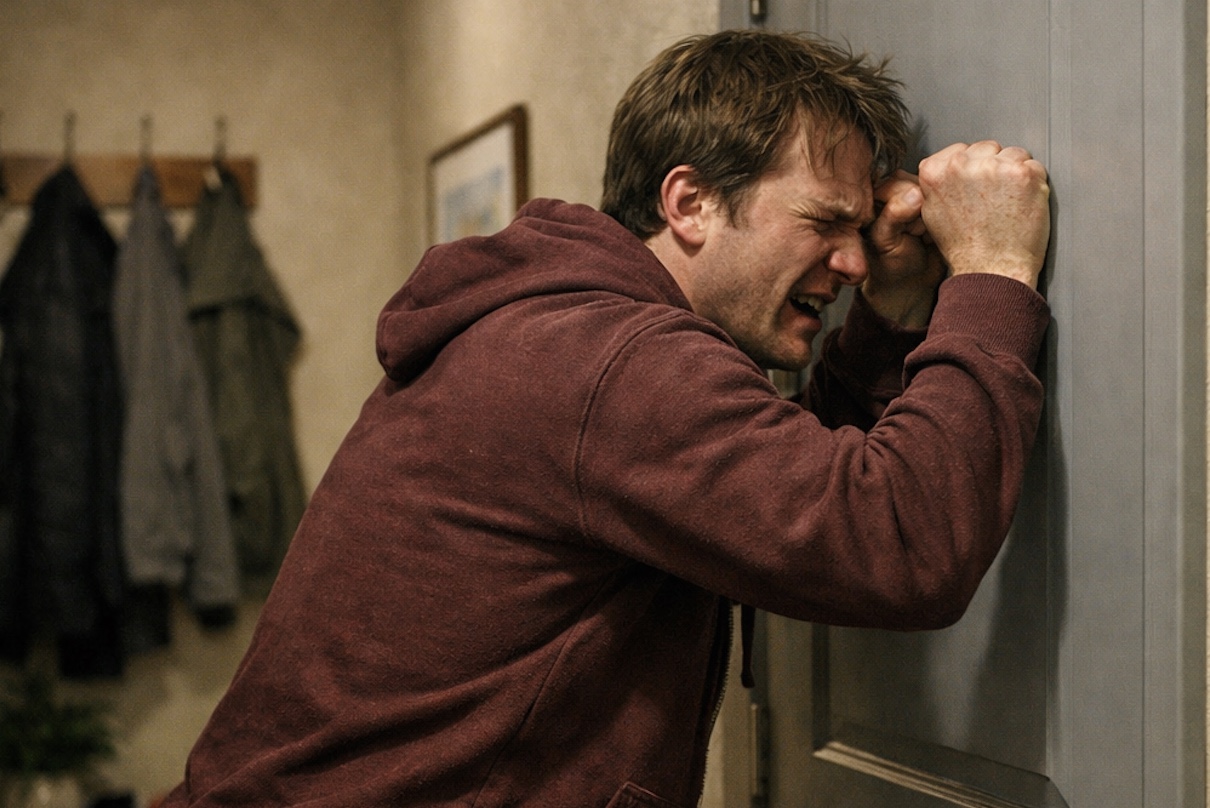
“Olena, open up, quick! Dad’s really sick!” Lenya slammed his fists against the bathroom door as if the world were ending. “We need smelling salts right now!”
“My mascara’s running. Give me a minute,” I answered, turning on the water and staring at my reflection.
Thirty-two… and I already look forty, I thought. Thanks to married life—and to my caring father-in-law, who somehow “falls ill” every single time I try to be alone for even a couple of minutes.
“Olena, are you deaf? He’s not well!” my husband shouted again.
I opened the door.
“Where are the smelling salts? Hurry!” Lenya blurted out.
“In the medicine cabinet in the kitchen. Third shelf from the top,” I said calmly.
After years of marriage, I knew these little performances by heart.
Lenya rushed off, and I already knew exactly how it would go. In a minute, Pyotr Sergeyevich would “recover,” ask for some valerian drops, then tea with honey… and after that he would start his usual speech about how hard it was for him to live alone. And Lenya would say, once again:
“Maybe he could stay with us for a while? Just until spring?”
Every winter, the same story repeated itself. Only last time, that “temporary stay” dragged on until July, until I finally threw my father-in-law out with his suitcases.
“That’s enough! Go home! You’re only fifty-eight, you’re a healthy man, you can work!”
Do you know what he did? He collapsed right there on the landing and started groaning dramatically. Our neighbor, Valentina Pavlovna, ran out when she heard the noise and walked into the middle of the scene.
There I was, standing with his bags, while the “poor old man” writhed on the floor. Since that day, she hasn’t even said hello to me. She probably thinks I’m heartless.
But the truth was very different.
Before our wedding, Lenya lived with his father. His mother had died when he was twenty, and from that moment on, his father settled completely onto his shoulders.
He hadn’t worked a single day. He constantly complained about his “heart,” his “nerves,” his “asthma.” Meanwhile, he smoked nonstop, drank regularly, and somehow still found the energy to chase after the neighbor women—pretty lively for someone supposedly so frail.
When Lenya and I got married, I set one condition right away: we would live separately.
Lenya was afraid to leave his father alone, so we bought a one-room apartment on mortgage—in the next building over.
The peaceful life lasted exactly one month.
Then Pyotr Sergeyevich started dropping by “for tea.” Then for dinner. Then he began spending the night because it was “too late to walk home” and his “head was spinning.”
Within six months, he had practically moved in.
He slept on a folding cot in the kitchen, but that didn’t stop him from barking orders like he owned the place:
“Olena, the soup is too salty!”
“Olena, these shirts aren’t ironed properly!”
“Olena, why is there dust on the television?”
And all the while, he never lifted a finger himself. He spent his days sitting around, watching soap operas, and waiting to be served.
I put up with it for three years. Then one day, I said:
“That’s it. Either he goes, or I do.”
Lenya chose me. But the guilt stayed with him—and his father used it shamelessly. One day it was his “heart acting up,” the next it was his “blood pressure,” and after that he was “too weak without homemade food.”
“Olena, where are you?” Lenya called, peeking into the room. “Dad wants some tea.”
“I’m late for work,” I replied.
“Please, just make it quickly… He really doesn’t look well…”
I wonder how much he drank with Mikhailovich last night, I thought. Judging by the bloodshot eyes and trembling hands—plenty.
I went into the kitchen. Pyotr Sergeyevich was sitting at the table like he was king of the apartment. Dirty T-shirt, unshaven face, reeking of stale alcohol.
“Wouldn’t mind some tea,” he muttered without even looking at me. “And cheese sandwiches.”
“The kettle’s on the stove, the bread’s in the breadbox, and the cheese is in the fridge,” I said, slipping on my shoes.
“Are you mocking me?” he snapped. “A man’s sick, and you…”
“Pyotr Sergeyevich,” I said evenly, “do you still have two arms and two legs?”
He stared at me.
“Then you’ll manage.”
He immediately turned to his son.
“You hear the way she talks to me? To your own father?”
That was the moment I’d had enough.
I took out my phone, found the recording, and pressed play.
A drunk, slurred voice spilled from the speaker:
“She’ll end up out on the street, you’ll see, Mikhailovich! I’ll drive her out the same way I drove out my late wife… She thought she was smarter than everyone too.
And my Lenya? He’s a weakling. He’ll do whatever I tell him. I’ll milk him for the rest of my life…”
Lenya went pale.
“That… that’s not me,” Pyotr Sergeyevich stammered. “It’s edited. Fake.”
I played the next recording. Then another. Then another.
I had around twenty of them, all from the past six months.
Whenever he got drunk, he talked enough to fill a whole book—about me, about the neighbors, about all his “plans” to put me in my place.
“I wasn’t in my right mind…” he tried to protest. “Son, why are you even listening to her?”
“Get out of our house,” Lenya said quietly.
“What?”
“Leave. And don’t come back.”
“You’re throwing out your own father?” he shouted.
“A real father doesn’t say he ‘drove’ his wife away!” Lenya yelled back. “Get out!”
My father-in-law stepped backward toward the door. Standing on the threshold, he turned around and hissed:
“You’ll regret this.”
“Is that a threat?” I asked, switching the recorder on again. “Go ahead. Say it one more time.”
He slammed the door so hard the sugar bowl flew off the shelf.
We sat there in silence. Lenya was hunched over, his face buried in his hands. I wrapped my arms around him.
“I’m sorry… I didn’t want you to find out like this.”
“He… he drove Mom away…” he whispered. “All this time I thought she left on her own…”
A month later, we sold the apartment. We bought a two-bedroom place in a different neighborhood, changed our phone numbers, and told no one our new address.
At first, Lenya struggled with it. He wanted to visit his father. I wouldn’t let him—he was a grown man, he could manage on his own.
Then one day I ran into Valentina Pavlovna.
“So, how’s Pyotr Sergeyevich doing?” I asked.
“Oh, just fine,” she scoffed. “He’s working as a loader now. Says his health has improved. Carries sacks so heavy even young men would struggle!”
That evening, I told Lenya.
He gave a bitter little smile.
“Well, look at that… sick for thirty years, and suddenly cured…”
Two years have passed. We have a new home now, and our daughter is growing up. Lenya doesn’t worry about his father anymore.
I know the wound is still there. Maybe it always will be.
But we’ll get through it.
As for him… let him answer for his own life now. He made his bed. Now he can lie in it.