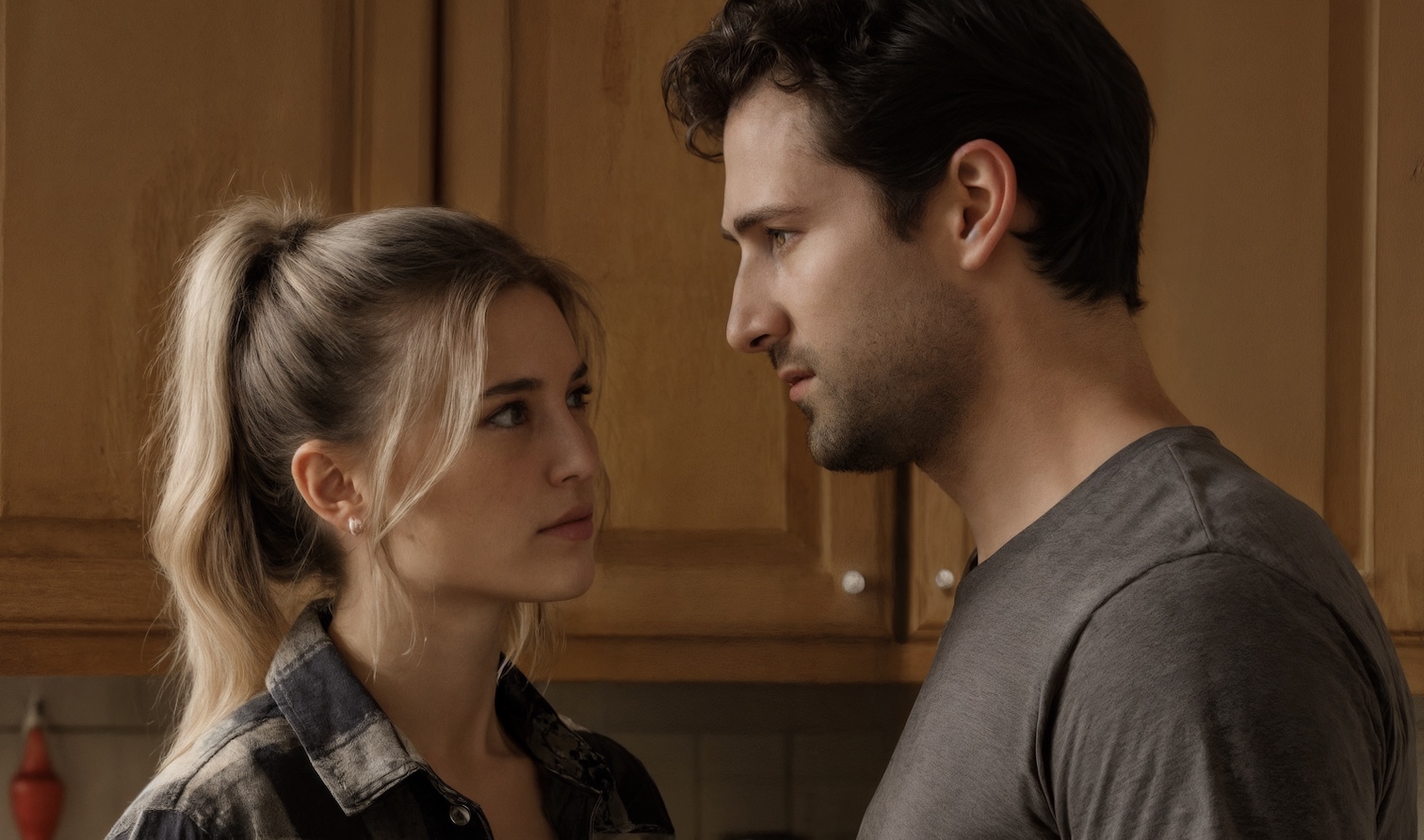
“Ira, I was thinking…” Maxim came up behind his wife, rested his hands on her shoulders, and pressed his cheek lightly to the top of her head. “What if we sent the kids to my mother’s for a week? To the village. Fresh air, fresh milk… and maybe things would finally get better between everyone.”
Irina, who had been methodically wiping down an already spotless kitchen table with a damp cloth, froze. Her hand, still gripping the microfiber rag, stopped halfway through the motion. For a moment it seemed as though she simply had not heard him. But then her shoulders beneath his hands tightened, turning rigid as stone. She did not shrug him off. Slowly, with a frightening kind of smoothness, she straightened and turned toward him.
There was no anger on her face. There was something worse—a cold, immeasurable astonishment laced with contempt. The ingratiating, guilty smile slipped from his face under the force of that look.
“Did you forget what she said to me the last time she came here?” Her voice was low, but there was no warmth in it at all. It sounded like shattered glass rubbing together.
Maxim instinctively pulled his hands away and took a tiny step back. He started gesturing nervously, as if trying to wave the tension out of the air.
“Ira, come on. She just blurted it out in the heat of the moment, without thinking. She’s a simple village woman—she says whatever’s on her mind. She’ll soften, you’ll see. They’re her grandchildren, her own blood. Try to understand, it’s hard for her too. She’s all alone there…”
At that moment, her calm snapped. Not like a balloon bursting, but like a string stretched too tight—sharp, vicious, sudden. She flung the cloth into the sink, and the wet smack of it seemed deafening.
“Your mother openly said that our children aren’t yours and that she doesn’t want to see them, and now you want to take them to her village for a whole week? Have you completely lost your mind because you’re so desperate for your mother’s love?!”
Her voice did not break into a scream. Instead, it gathered force, hard and metallic, filling the entire kitchen. It bounced off the glossy cabinet fronts, the tiled wall, the children’s drawings held to the fridge with magnets. Maxim flinched as if he had been struck. He looked at her with a mix of hurt and stubbornness. He truly did not understand why she was reacting this way. In his mind, it had only been an unfortunate remark, an awkward misunderstanding that should simply be endured and forgotten.
“This is not about mending relationships, Maxim!” she went on, taking a step toward him. “It’s not about fresh air or fresh milk. It’s about the fact that you are ready to put your own children in harm’s way, to send them into the house of a woman who hates them, all for the faint hope that your mommy will finally pat you on the head and tell you you’re a good son!”
She looked straight into his eyes, and in her gaze he no longer saw his wife but a prosecutor reading out a final sentence. Every syllable was measured, every word struck the target exactly. He wanted to argue, to start again with the excuses about emotions, age, loneliness—but the words stuck in his throat. He could already see that any defense would only prove her right.
“I will not hand them over to that woman,” Irina finished, now much quieter, which only made her words heavier. “No one is going to examine my children under a magnifying glass, searching for someone else’s features. No one will make spiteful little comments about their looks or their character through clenched teeth. If you are that starved for her love, go by yourself. And you can stay there.”
Maxim stared at her as if she were speaking a foreign language. His face, which moments earlier had shown wounded indignation, twisted now into stubborn incomprehension. He stepped closer, invading her space, as if physical proximity alone could force her to accept his point of view.
“You always exaggerate. Always. You grab onto one careless phrase and turn it into some massive tragedy,” he began, and that patronizing, instructive tone entered his voice—the one she hated most of all. “Yes, she said something stupid. I’m not denying that. But she is my mother, Irina. My mother! We can’t just erase her from our lives because of this. Family is something bigger than that. Sometimes you have to be wiser, forgive, meet people halfway.”
He was saying all the correct, polished things about wisdom and forgiveness, but behind them there was nothing except a selfish desire to silence the conflict, cover it over, and pretend nothing had happened. He was not protecting his family. He was protecting his own comfort.
“Wiser?” Irina gave a quiet laugh. It was short and dry, like the crack of a branch snapping. “You want to talk about wisdom, Maxim? Fine. Let’s talk. You say it was one careless word? One? Do you really remember nothing, or is it just more convenient for you not to?”
She moved away from him and began walking through the kitchen—not in a flustered way, but with measured steps, as though pacing through her own memory and pulling one ugly exhibit after another from its dark corners.
“Let me remind you. Liosha’s fifth birthday. We spent a month getting ready. He was waiting for his grandmother more than anyone else. And what happened? She didn’t come. She didn’t even call. And when I called her myself, she said her ‘blood pressure had gone up.’ The next day Aunt Valya told me on the phone that your mother had been baking pies and carrying them to the neighbor’s little boy because it was his birthday and his parents were in the city. She didn’t forget. She simply chose whose birthday mattered more. And back then you told me I was being petty.”
Maxim jerked as if she had pressed a finger into a fresh wound.
“That’s completely different…”
“No, it’s the same thing!” she cut in, turning sharply toward him. “And do you remember the way she looked at Anya when she had just been born? The way she pressed her lips together and said, ‘Her hair is awfully fair. We’ve never had that in our family. That must come from your side.’ Your side, Maxim! She spoke about my family as if it were some kind of stain. And you stood there smiling, saying, ‘Mom, come on, she’s just a baby.’ You didn’t tell her to stop. You didn’t put her in her place. You merely scolded her lightly, like a naughty little kitten!”
Every memory she brought up was not just a reproach. It was an accusation, and the main defendant was not his mother. It was him—her constant defender, her silent accomplice by default.
“And those endless stories about her friends’ sons? How Kolya built his mother a bathhouse, how Sergey takes his mother to the seaside. She said those things in front of you, in front of me, in front of the children. She kept hammering into your head that you were a failure. That you had not lived up to her expectations. And if you were a failure, then what did that make me? The woman who ruined her son. She never said it directly. She’s smarter than that. She simply created the atmosphere, the background, in which all of us were supposed to feel guilty and inadequate. And you allowed it. You sat there with your head down and swallowed every word.”
He stopped defending himself. His face turned crimson. He had been cornered by facts he could not deny. And in that corner, what awoke inside him was not conscience, but a bitter, helpless rage toward the one who had dared drag all this ugliness into the light.
“You just hate her! And you’re turning me against her!”
“I don’t hate her, Maxim. I simply see her very clearly,” Irina replied coldly, stopping right in front of him. “But you—you are afraid of her. You are terrified of her disapproval. You are willing to sacrifice your children’s peace, my respect, anything at all, just for the chance that one day she might finally say you’re good enough. But she never will. Never.”
The accusation of fear hit Maxim harder than anything else she had said, because it was true. Not the truth he was ready to admit, but the one that lived inside him like a parasite and ruled his actions. The red drained from his face, leaving it ashen. He looked at his wife, and there was no condescension left in his eyes now. Only naked, undisguised hatred. He hated her for seeing straight through him.
“You think I’m afraid?” he breathed. His lips barely moved. “You think she hates them? That’s what you want to believe, because it justifies your own spitefulness! You like being the victim! Fine. Let’s check. Right now.”
Without waiting for an answer, he spun around, snatched his phone from the windowsill, and jabbed at the screen with a furious, theatrical determination. Irina did not move. She stood there with her arms folded, her face turned into an expressionless mask. She had no intention of stopping him. She knew this performance had to be played through to the end. He had chosen this public execution himself.
Maxim pressed the contact labeled “Mom” and, with a defiant glance at his wife, turned on speakerphone. The ringing, amplified by the speaker, filled the kitchen with a harsh, unpleasant sound. It resembled the ticking of a bomb timer.
One ring. Two. On the third, the line clicked.
“Hello,” came his mother’s voice from the speaker, even and stripped of all emotion. No joy. No surprise. Just acknowledgment.
Maxim forced himself to smile, though the smile came out crooked and pitiful.
“Hi, Mom! How are you? How’s your health?” His voice sounded unnaturally cheerful, like that of a bad actor trying to play happiness.
“Hi. Fine,” came the short, final answer. Then a pause. She did not ask how he was, or how the children were. She simply waited for him to get to the point.
Maxim cleared his throat, his cheerfulness already beginning to evaporate beneath that icy calm.
“Mom, I was thinking… the weather’s nice. Maybe I could bring the kids to stay with you for a week? Let them run around outdoors a little?”
Silence filled the speaker. Not thoughtful silence, not a pause for consideration. It was a heavy, crushing silence filled with unspoken irritation. It lasted perhaps five seconds, but it felt endless. Irina kept her eyes on Maxim, watching the last traces of confidence slide off his face.
At last, with a sigh full of universal weariness, his mother replied,
“Well, if you’ve decided, then bring them.”
It was not an invitation. It was not joy. It sounded like: if you insist, I’ll tolerate the inconvenience. Maxim was ready to seize even that phrase and twist it in his favor, but his mother gave him no chance. After another short pause, she added the sentence that finished him off completely. She said it in the same flat, indifferent tone people use to talk about the weather or the price of potatoes at the market.
“At least I’ll see who they’ve started taking after.”
And that was all. There was no direct accusation in those words. But they contained everything Irina had been talking about. Cold distance. Suspicion. A readiness to judge and pronounce sentence. It was the direct continuation of the very conversation Maxim had tried so desperately to forget.
He froze. The blood drained from his face. He felt exposed, as if standing naked in the middle of a square. His own mother had just confirmed every word his wife had said, without planning it, without trying to, and in doing so had made him look like a pathetic, blind fool.
“Okay, Mom… I… I’ll call you later,” he muttered, frantically stabbing the screen to end the call.
Absolute silence settled over the kitchen. Maxim did not look at Irina. He stared at the dark phone screen in which the whole miserable life he had spent begging from his mother had just flickered and gone out. He had lost. Not the argument with his wife. He had lost to himself. And the humiliation of that defeat was already beginning to turn into something much darker and more destructive.
The silence in the kitchen became thick, almost tangible. It pressed against the ears, swallowing the ticking of the wall clock and the hum of the refrigerator. Maxim did not move. He stared at the black screen of the phone as though it were an entrance to hell itself, and cold air had just breathed out of it. The humiliation was absolute. It had not merely scorched him—it had seeped inside, filling the empty place where pride should have been, turning into thick, black bile. He could taste its bitterness on his tongue.
Irina remained silent. She did not savor her victory. She did not say the sacred words, “I told you so.” She simply waited. She could see something inside him breaking and rearranging itself. This was not the moment of remorse. It was the moment of mutation.
Slowly he lifted his head. Irina shuddered inwardly. The eyes looking back at her were not her husband’s. The gaze was чужой—foreign, murky, heavy, full of poison that needed somewhere to go. Shame, unable to crash down upon its true source—his mother—was searching for the nearest and easiest target.
“So that’s what it is,” he said dully, as though the words had to force their way through a spasm in his throat. “Now I understand everything.”
He took a step toward her. There was no direct threat in the movement, but there was something final, something frighteningly definite about it.
“It was never really her. That was never the issue. It’s you. Them.”
Irina went still. She understood that something irreversible was about to happen. He was not simply going to insult her. He was about to destroy the very foundation of their life.
“Have you ever wondered why she doesn’t accept them?” he went on, his voice gaining force, though not volume. It was the force of a madman’s conviction, the power of someone who had found his simple, ugly explanation for everything. “Not because she’s cruel or cold. Because she sees. She sees what I, blinded by my love for you, failed to notice. She sees there is nothing of me in them. Nothing of our family. Your character. Your habits. Your breed, as she said.”
He spat out that word—“breed”—with the same disgust one uses for something filthy, contagious. It was no longer his mother’s word. It was his. He had claimed it, made it his weapon.
“She senses what is чужое—what doesn’t belong. And now I feel it too. You gave birth to children my own mother cannot love because they are not mine. Maybe not in blood, but in spirit. They are an extension of you. That’s why she doesn’t want to see them. And I… I don’t think I want to anymore either.”
He said it. He crossed the final line, burned the last bridge behind him, and danced on the ashes. He did not merely betray his wife. He renounced his own children in order to justify his mother and salvage the pitiful remains of his crushed ego.
Irina listened, and her face did not change. It remained calm, almost unreadable. The storm inside her had passed, leaving behind only a scorched, frozen emptiness. When he finished, she did not answer right away. Quietly she walked to the table, picked up the cloth she had thrown into the sink, and began wiping the surface again. Slowly. Methodically. Erasing invisible stains. As though his words were nothing more than dirt that needed to be cleaned away.
When she was done, she straightened and looked at him. Her gaze was absolutely calm. There was no pain in it. No hatred. Only conclusion.
“Have you finished?” she asked evenly.
Maxim said nothing, breathing heavily. He himself was stunned by what he had just spoken aloud.
“Good,” she said with a small nod. “Now everything is finally where it belongs. You have made your choice at last. Your place is there, in that village, beside the woman who ‘sees the truth.’ Go to her, Maxim. She’s waiting for you. She’ll stroke your head and tell you what a good son you are. But here… here your home is over. In this house, there is no longer any place for you—or for your truth. Never again.”