Sveta was coming home from work tired, but in a good mood. The July evening was warm, and fresh air streamed through the open car windows. Her two-room apartment in the city center welcomed her with its usual comfort—bright rooms, modern furniture, every detail carefully arranged. Three years earlier, Sveta had bought the place with her own savings while working as a programmer at a large IT company.
Andrey was sitting on the couch, scrolling through his phone. He looked thoughtful, even a little tense.
“Hi, darling,” Sveta said, kissing him on the cheek. “How was your day?”
“Fine,” Andrey replied shortly, without taking his eyes off the screen.
Sveta went into the kitchen and started making dinner. In the year and a half since they had married, her husband had changed. He used to greet her after work, ask about her day, her plans, her thoughts. Now he was often silent, lost in himself.
At dinner, Andrey unexpectedly brought up the topic of family relationships.
“Listen, Svet,” he began, setting down his fork, “do you think there should be secrets in a family?”
Sveta raised her eyebrows, surprised by the sudden question.
“What kind of secrets? What do you mean?”
“Well… I mean, should spouses split everything equally, or can each of them keep something just for themselves?”
“Andryusha, what is this about?” Sveta set down her spoon and looked at him closely. “Did something happen?”
“Nothing really, just thinking,” Andrey answered vaguely. “I’m just curious what you think.”
Sveta shrugged. The conversation felt strange, but nothing more.
The next day, Andrey came home with his mother. Raisa Petrovna rarely visited them, usually preferring to invite the young couple over to her place. This time, however, she looked determined, as though she had come for a serious discussion.
“Svetochka,” Raisa Petrovna began as she sat down at the table, “Andryusha and I have been talking about family values.”
“What values exactly?” Sveta asked carefully.
“That everything in a family should be fair,” her mother-in-law explained. “A husband and wife are one whole. That means property should belong to both.”
Sveta frowned, not yet understanding where this was heading.
“Raisa Petrovna, what exactly is bothering you?”
“What bothers me is that my son lives like…” the older woman searched for the right words, “…like a temporary guest. But a family is supposed to be a partnership. Equality.”
Andrey sat there in silence, avoiding his wife’s eyes. Sveta felt that something was wrong.
“I don’t understand what you mean,” she said firmly.
“I mean that by law a husband has rights to half of the family property,” Raisa Petrovna explained. “And what do you have here? The apartment is yours, the car is yours. So what is Andrey—completely powerless?”
Sveta slowly set down her cup of tea.
“The apartment is mine because I bought it with my own money. Before the marriage. The car too.”
“So what?” her mother-in-law objected. “Now you’re a family. Family law still exists.”
“What family law exactly?” Sveta felt the muscles in her neck tense.
“The kind that guarantees equality between spouses,” Raisa Petrovna declared confidently. “My Andrey is no worse than you. Why should he have to live in someone else’s apartment?”
“In someone else’s?” Sveta said indignantly. “But we’re husband and wife!”
“Exactly!” her mother-in-law exclaimed. “Which means the apartment should be shared. And the car too.”
Sveta turned to her husband, expecting him to deny his mother’s words or at least say what he really thought. But Andrey remained silent, staring at the pattern on the tablecloth.
“Andrey,” Sveta said, “what do you think about all this?”
He raised his eyes, uncertainty clearly written on his face.
“Well… Mom isn’t completely wrong,” he muttered. “Maybe it really should be… settled somehow.”
“Settled how?” Sveta could hardly believe her ears.
“By changing the documents,” Raisa Petrovna cut in. “Into joint ownership. Fair and square.”
Silence filled the apartment. Sveta looked at her husband and mother-in-law, trying to process what she had just heard. Were they actually serious?
“Wait,” she said slowly. “You want me to transfer half of the apartment and the car to Andrey?”
“To both of you,” Raisa Petrovna corrected her. “That’s what joint ownership is called.”
“But why?” Sveta asked, unable to understand. “For what? I bought all of this with money I earned before I even met Andrey.”
“Because he’s your husband!” her mother-in-law shot back. “Because he’s building a family with you, supporting you, taking care of you.”
Sveta wanted to point out that she had noticed very little of that so-called care, but she stayed quiet. Better to deal with the situation calmly.
“Raisa Petrovna,” Sveta said evenly, “property acquired before marriage remains personal property. That’s the law.”
“Laws can be worked around,” her mother-in-law said smugly. “What matters is desire and fairness.”
“What fairness?” Sveta protested. “I worked for five years, saved money, took out loans to buy this home. Where was Andrey then?”
“But now he’s here,” Raisa Petrovna shot back. “And he’ll be here for life. Doesn’t that count for anything?”
At last Andrey spoke.
“Mom, maybe there’s no need to be so категорical…”
“There is!” his mother interrupted. “I’ve seen many families where wives cheat their husbands. They keep everything for themselves and then leave the man with nothing.”
Sveta jumped to her feet.
“What do you mean, cheat? Did I hide my property from Andrey?”
“You didn’t hide it, but you’re not sharing it either,” her mother-in-law insisted stubbornly.
“I am sharing it!” Sveta threw up her hands. “We live here together, we both use everything!”
“Using something and owning it are two different things,” Raisa Petrovna observed as though delivering wisdom.
Sveta felt blood rush to her face. Her mother-in-law’s nerve exceeded every expectation.
Over the next week, the atmosphere in the house became strained. Andrey walked around gloomy, avoiding direct conversations about the apartment, but constantly dropping hints. One day he complained that he felt like a guest in his own home. Another time he remarked that the neighbors were surprised the documents weren’t in his name.
“Andrey,” Sveta said one evening, “let’s talk honestly. What is really bothering you?”
He was silent for a long time, then sighed.
“You see, Svet, it turns out I’m living on your territory. Like… like some kind of dependent.”
“But we’re a family!” Sveta objected. “What dependent?”
“Yes, a family. But on paper, everything is yours. So what am I?”
“Andryusha, but you knew that when we got married,” Sveta reminded him. “I never hid the fact that the apartment was mine.”
“I knew,” Andrey admitted. “But I thought things would change after the wedding.”
“What exactly would change?”
“Well… that we would become a real family. With everything that comes with it.”
Sveta frowned.
“So you think that until the documents are changed, we’re not a real family?”
“Not that we’re not real,” Andrey mumbled. “But… somehow incomplete.”
That weekend Raisa Petrovna came again. This time she arrived armed with printouts from the internet.
“Svetochka,” she began, waving the papers, “I’ve been studying family law. Do you know what it says?”
“No,” Sveta answered shortly.
“That spouses have equal rights to family property,” Raisa Petrovna read out triumphantly. “No matter who acquired it.”
“That applies to property acquired during the marriage,” Sveta corrected her. “My home was bought before the wedding.”
“So what?” her mother-in-law refused to back down. “Right now you are spouses. That means everything should be divided equally.”
“Raisa Petrovna,” Sveta said tiredly, “by your logic, if Andrey had debts before marriage, would I be responsible for them too?”
“Debts are a different matter,” the older woman said, suddenly embarrassed.
“Why are they different?” Sveta pressed. “We share property, but not debts?”
“Well… debts are bad, and an apartment is good,” Raisa Petrovna replied helplessly.
Sveta could barely hold back a laugh. Her mother-in-law’s logic was astonishingly selective.
Meanwhile, Andrey was becoming more and more persistent. One morning, while getting ready for work, he said abruptly:
“Svet, let’s finally change the paperwork.”
“Why?” Sveta asked wearily.
“Because we’re a family. Everything should be shared.”
“Andrey,” Sveta said, turning toward him, “what exactly have you invested in this apartment? What money? What effort?”
“I live here,” he answered. “I help keep things in order. I pay the utility bills.”
“The utility bills,” Sveta repeated. “For an apartment worth three million, you pay five thousand a month in utilities.”
“Not just utilities,” Andrey objected. “I buy groceries. I contribute things to the home.”
“What exactly do you contribute?”
“Well… participation, care,” he replied uncertainly.
Sveta realized the conversation was going nowhere. Andrey had no concrete arguments except the fact that he was her husband.
That same evening, he came home looking determined. Right after dinner he declared:
“Sveta, enough dragging this out. Tomorrow we go to the notary and put everything in both our names.”
“We’re not going,” Sveta said calmly.
“Why not?” Andrey burst out. “I’m your husband. I live here. I use all of this. By law I’m entitled to half.”
“By what law?” Sveta asked.
“Family law!” he exclaimed heatedly. “Mom explained that spouses are equal.”
“Your mother explains a lot of things,” Sveta said. “Not all of them are true.”
Andrey stood up from the table and began pacing the room.
“So to you I’m nobody! I live like a tenant, pay utility bills, and have no rights at all!”
“What rights do you want?” she asked.
“The rights of an owner!” he blurted out. “The rights of a full master in his own home!”
“In his own?” Sveta slowly stood up. “Andrey, this is my home. Bought with my money, earned by my work.”
“But now we’re a family!” he insisted.
Sveta walked into the bedroom, took a folder of documents from the closet, and returned to the living room. She spread the papers out on the table.
“Here,” she said calmly. “The apartment purchase agreement. The date is March fifth, two thousand twenty-one. We met in June of that same year.”
Andrey reluctantly leaned over the documents.
“And this,” she continued, laying down another page, “is my income statement for the years from 2018 to 2021. Do you see the amount I had saved?”
He stayed silent, staring at the numbers.
“And the car contract,” Sveta said, placing a third paper on the table. “Purchased in February 2021. Again, before we even met.”
“The apartment and the car were bought with my money,” Sveta said clearly. “The fact that you are my husband did not turn my property into joint property.”
Andrey looked up, irritation obvious in his eyes.
“Svet, you know what I mean,” he began, softening his tone. “I thought we were a family. But you treat me like I’m some outsider.”
“I don’t treat you like an outsider,” Sveta replied. “But family and ownership rights are different things.”
“How are they different?” he demanded. “If we love each other, then we should share everything!”
“I do love you,” Sveta said firmly. “But that doesn’t mean I have to hand over half of what I earned before marriage.”
Andrey got up and began pacing nervously again.
“So your love has limits! It ends where the property papers begin!”
“Andrey,” Sveta said, putting the documents back into the folder, “you’re saying foolish things right now. Love and property rights are completely different matters.”
“Aha!” he shouted. “So they are different after all! And I thought that in a family everything was shared!”
“In a family, what is shared is what was built together,” Sveta explained. “Not what each person brought into the marriage.”
Andrey stopped and turned to her.
“Listen, what if I refuse to live like this?” His voice turned threatening. “If you don’t change the documents, I’ll go live with Mom!”
Sveta looked at him carefully. So it had come to ultimatums.
“That’s your choice,” she answered calmly.
“My choice?” he said, confused. “You don’t want me to leave, do you?”
“I don’t,” she admitted. “But if you’re forcing me to choose between my property and you, then I choose my property.”
Andrey froze, clearly not expecting that answer.
“So the papers matter more to you than the family?”
“My principles matter more,” Sveta corrected him. “I won’t let anyone dictate how I should dispose of what I earned through honest work.”
At that moment his mother called. Andrey answered in front of Sveta and turned on speakerphone.
“Well, son, how did it go?” Raisa Petrovna asked. “Did you agree about the paperwork?”
“No, Mom,” Andrey answered gloomily. “Sveta refuses.”
“What do you mean refuses?” his mother exploded. “Give me the phone!”
Andrey held it out to his wife. Sveta took it.
“Svetochka,” Raisa Petrovna began in a sugary voice, “why are you being so stubborn? You’re destroying the family over some papers!”
“Raisa Petrovna,” Sveta replied evenly, “this issue is closed. We are not discussing it again.”
“Closed? What do you mean closed?” her mother-in-law cried out. “My son has rights!”
“Your son has the right to live in my apartment and use my car,” Sveta explained. “But he does not have the right to demand that I change the ownership documents.”
“What, did you buy him with money?” Raisa Petrovna screeched. “And now you order him around however you please?”
“Goodbye,” Sveta said dryly, and ended the call.
Andrey stared at her in shock.
“You hung up on my mother?”
“I did. And I suggest you stop these conversations too.”
But Andrey was in no mood to let it go. The entire next day he walked around gloomy, and by evening the tension had reached its peak.
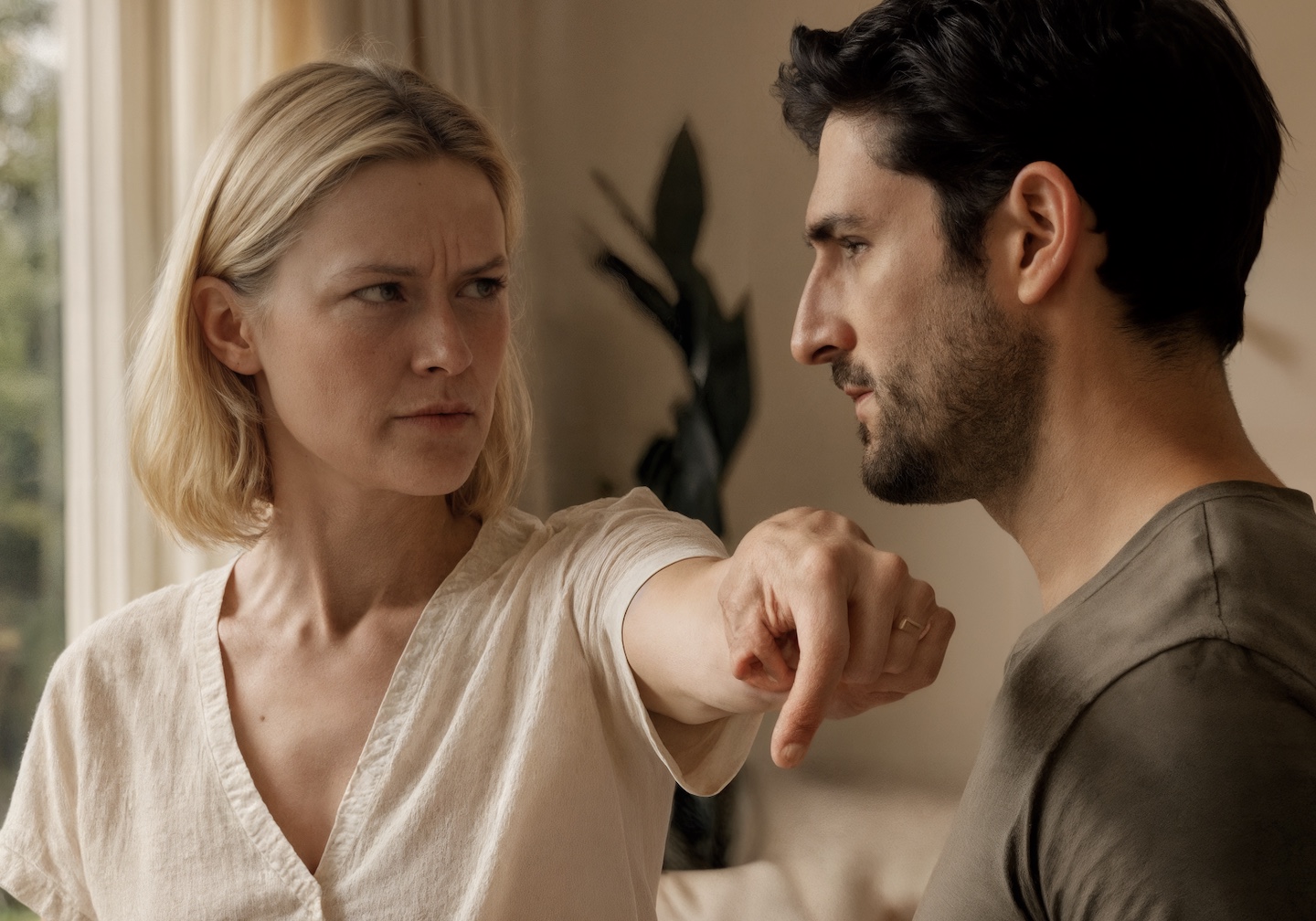
“Sveta!” he shouted, storming into the room. “I’m asking you one last time! Are you going to change the paperwork or not?”
“No,” she answered shortly.
“Then you bought me!” Andrey yelled. “You think that because you have the money, you can control me!”
“I’m not controlling anyone,” Sveta replied. “I’m protecting my property.”
“Property!” He slammed his palm onto the table. “Your precious property means more to you than your husband!”
“It means more to me than being manipulated,” Sveta corrected him.
“Manipulated?” Andrey exploded. “I lived with you for a year! I put up with your character for a whole year! And what do I get in the end? Nothing!”
“What exactly do you think you deserve?” Sveta asked. “Why should I give you half the apartment?”
“Because I’m your husband!” he shouted. “Because I’m building a family with you!”
“Building it or destroying it?” she asked.
Andrey fell silent, breathing heavily. Then he turned sharply toward the wardrobe and pulled out a suitcase.
“If that’s how it is, then I’m leaving!” he declared, throwing shirts into the suitcase. “I’m only taking what’s mine, since I’m apparently not allowed anything that’s yours!”
Sveta silently watched him pack.
“These are my socks,” he muttered bitterly. “My jeans. My jacket. Everything else is your sacred property!”
“Andrey,” Sveta said, “it’s not too late to stop.”
“Too late!” he snapped. “Since you chose documents, go live with them!”
He zipped up the suitcase, grabbed a bag with the rest of his belongings, and headed for the door.
“Now go keep your certificates company!” he threw over his shoulder. “Maybe they’ll keep you warm!”
The door slammed. Sveta was left alone in the silence of the apartment.
An hour later her friend Natasha called.
“Sveta,” her friend said anxiously, “Raisa Petrovna called me. She says you and Andrey had a huge fight.”
“We did,” Sveta confirmed.
“She says you’re greedy and won’t give your husband half the apartment,” Natasha said. “Is that true?”
“It’s true,” Sveta replied calmly. “I won’t.”
“But why?” her friend asked, baffled. “You’re a family!”
“Nata, I bought the apartment with my own money before the marriage,” Sveta said tiredly. “Why should I hand over half?”
“Well… because… you’re husband and wife…”
“That is not a reason to rewrite ownership.”
Her friend fell silent, thinking it over.
That evening several more people called. Raisa Petrovna had phoned all their mutual acquaintances, complaining about her greedy daughter-in-law.
“Sveta,” Andrey’s cousin said, “maybe you can find a compromise. Family is worth more than money.”
“I agree,” Sveta answered. “Only here it isn’t the family asking for money. It’s money destroying the family.”
“But Andrey isn’t asking to throw you out on the street,” the cousin insisted. “He just wants to feel equal.”
“Equal in what?” Sveta asked. “In using the property? Fine. In disposing of it? Sorry, but no.”
The calls went on for several days. One by one, Andrey’s relatives tried to talk sense into her. But Sveta did not waver.
“I know I seem harsh,” she told Andrey’s sister. “But otherwise it can’t be done. If I give in now, I’ll be giving in on everything later.”
“But he’s your husband,” her sister-in-law tried to persuade her.
“A husband who demands my property simply because we’re married,” Sveta answered. “That’s not love. That’s calculation.”
A week passed, and Andrey did not come back. He did not call. He did not send a message. Sveta understood: he was hoping loneliness would make her surrender. But her principles proved stronger than her fear of being alone.
Sveta continued living her normal life. She worked, met up with friends, took care of the home. Without her husband, the apartment felt larger, calmer.
She realized the most important thing: she had drawn a line that could not be crossed. She was ready for any outcome, but she would not betray her beliefs. Property earned through honest work would remain hers. And a husband who valued paperwork more than the relationship could stay with his mother and keep making plans for someone else’s property.