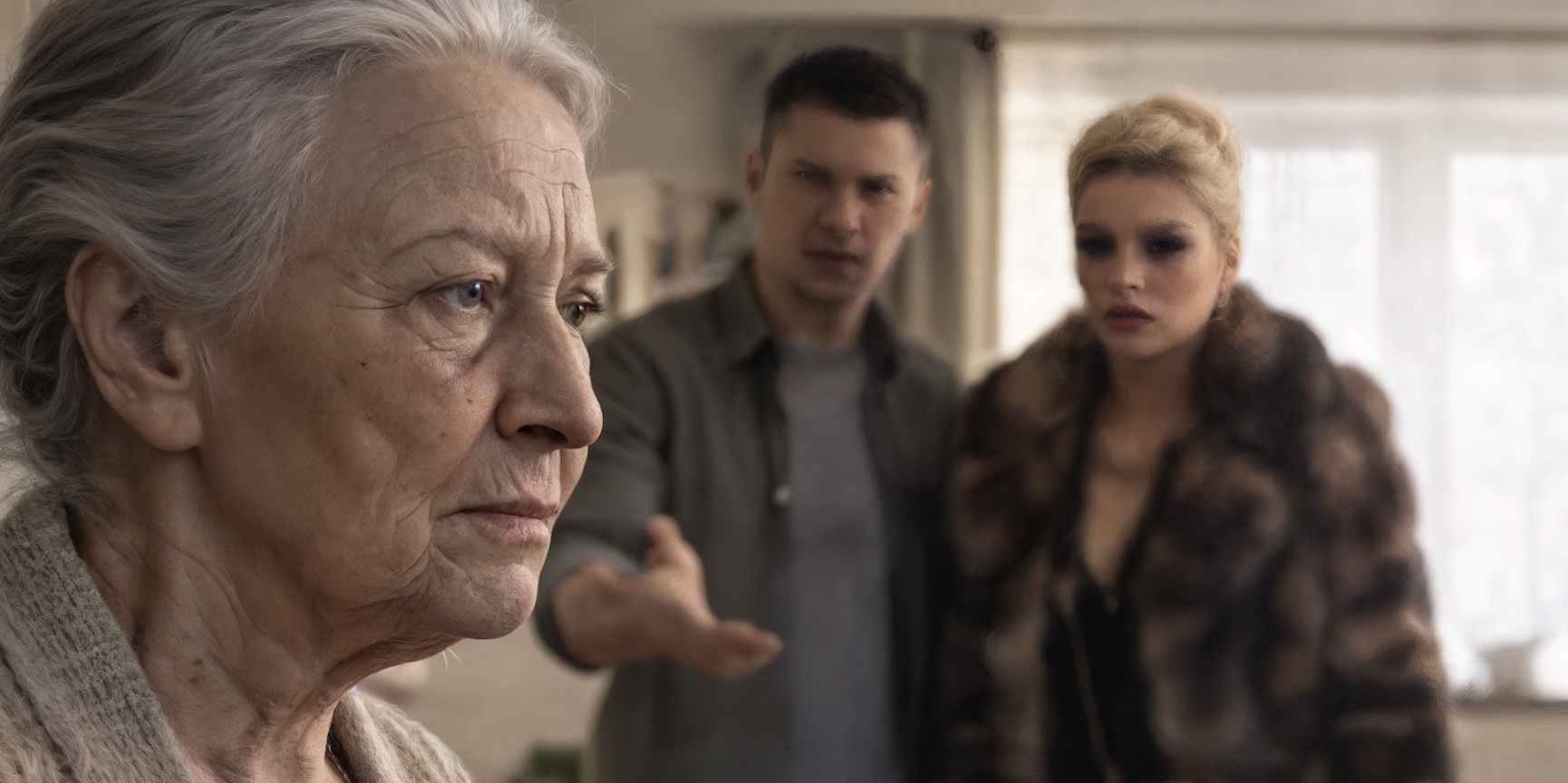
“Mom, you know how it is. We’ve got a mortgage, a car loan, and now Danil’s in sports classes too. There’s just no room for extra expenses. But your pension is steady—it comes in every month. You’ll get by somehow.”
Igor said it without even lifting his eyes from his phone, scrolling as he spoke.
Nina Pavlovna stood at the stove, stirring a pot of soup. She had invited her son over for lunch because she wanted to ask him for help buying her medicine. Her blood pressure had been unstable, and the doctor had prescribed a new medication. It cost nearly two thousand rubles. On a pension of nineteen thousand a month, that was a serious amount—especially when more than five thousand went toward the apartment, then electricity, the phone bill, and, of course, food.
She had not intended to complain. She had simply asked, “Igor, could you help me with my medicine this month?”
And that was the answer she got.
“Igor, I’m not asking for much. Just two thousand for the pills. You know about my blood pressure.”
“Mom, then buy something cheaper. There have to be alternatives. Ask at the pharmacy—they’ll find you a substitute.”
Nina Pavlovna turned off the stove and lifted the pot away. Her hands were calm and steady—she had worked as a seamstress at the factory for thirty years, and her hands did not shake.
Something else did.
Inside.
Igor finished his soup, wiped his mouth with a napkin, kissed his mother on the top of the head, and left. Nina Pavlovna cleared his plate, washed it, and set it in the rack to dry. Then she sat at the kitchen table, propped her cheek on her hand, and began to think.
She had two children. Igor was the eldest, thirty-eight, married to Sveta, with a seven-year-old son named Danil. Larisa was younger, thirty-four, married to Oleg, and they had four-year-old twins, Ksyusha and Maxim. Both children lived in the same city. Both worked. Both seemed to be doing well enough. Apartments. Cars. Brand-new phones every year. Larisa’s husband had recently bought her a mink coat, and she had proudly posted a photo in the family chat with the caption: Girls, I’m a queen!
And while the “queen” was celebrating her new coat, her mother was sitting at home counting whether there would be enough money left for the rest of the month after buying medicine.
Nina Pavlovna had raised her children alone. Her husband left when Larisa was two years old. He simply packed his things and said, “Nina, forgive me, but I can’t do this anymore.” He never really explained what exactly he couldn’t do, or why. For a while he sent some money. Then less. Then nothing at all. Nina Pavlovna filed for child support, but he moved to another city, worked off the books, and there was no way to collect anything from him.
So she carried everything herself.
She sewed at the factory by day and took extra work home in the evenings—hemming, altering, patching clothes. She slept five hours a night. Her children were clothed, fed, and cared for. Igor went to sports practice. Larisa took art lessons. Nina Pavlovna cut corners on herself—in clothes, in food, in everything. But her children had all she could possibly give them.
When they grew up and moved out, Nina Pavlovna retired. By then the factory was barely hanging on, layoffs had started, and she chose to leave before they pushed her out. Thirty years of work behind her, and the pension was what everyone got: small, modest, not enough, but survivable. At first it was manageable. Igor and Larisa helped. They chipped in for groceries, brought her medicine, and sometimes slipped her a little cash “for the household.”
But little by little, the help faded.
At first it was subtle. Instead of helping every month, they started helping every other month. Then less often. Then they simply stopped thinking about it. Nina Pavlovna never reminded them, because she felt embarrassed. Asking her own children for money felt humiliating. She believed they should notice on their own. They should understand without being told.
But they did not notice.
Or they chose not to.
The grandchildren, however, were brought over regularly. Every weekend. Sometimes during the week too.
Larisa usually called on Friday evening.
“Mom, Oleg and I are going to the mall tomorrow to look at bedroom furniture. Can I bring the twins to you for the whole day? Please? They adore you!”
And Nina Pavlovna always agreed. Because she really did adore them. Ksyusha and Maxim were funny, noisy, almost identical in appearance, though completely different in temperament. Ksyusha was quiet and loved to draw, happy to sit in a corner with pencils. Maxim was a tornado—running, jumping, overturning everything in sight. After his visits, Nina Pavlovna would spend half the next day picking up scattered toys and pasting wallpaper back onto the wall where he had peeled it off.
Danil, Igor’s son, came less often, but when he did, it was never for as short a visit as promised. Igor usually brought him over whenever he and Sveta were going out—to the movies, to a restaurant, to visit friends. “Mom, just for a couple of hours.” Those couple of hours always turned into six or seven. Danil stayed the night, and Igor picked him up only the next morning.
Nina Pavlovna cooked porridge for the children, fried pancakes, took them to the park, tucked them into bed, and read them bedtime stories. She loved it. She loved feeling needed.
But her body was no longer what it had been ten years ago. Her knees hurt. Her back ached every time she bent over. Her blood pressure spiked. And the medicines she needed cost money she did not have.
One day, during one of Larisa’s visits, as she was helping the twins out of their coats in the hallway, she casually said:
“Mom, by the way, could you watch them on Wednesday too? Oleg has a corporate event, and I need to get my hair done.”
“Larisa, I have a doctor’s appointment on Wednesday.”
“Reschedule it, Mom. It’s for my hair! My stylist only had Wednesday open.”
And Nina Pavlovna rescheduled.
Because she was used to it.
Because all her life she had pushed her own needs aside for the sake of her children.
Because she feared that if she ever refused, they would be offended, stop calling, stop bringing the grandchildren—and she would be left alone in her one-room apartment, with only the geranium on the windowsill and the kind of silence that rings in your ears.
But the turning point came on the most ordinary weekday.
Nina Pavlovna went to the pharmacy for her medicine. She handed over the prescription, and the pharmacist told her the price: eighteen hundred rubles. Nina Pavlovna opened her wallet. Inside were two thousand-ruble bills and some small change. If she bought the medicine, she would have only two hundred rubles left to live on for the next five days until her pension came.
Five days.
Two hundred rubles.
She bought the medicine.
Then she walked out of the pharmacy, sat down on a bench by her building, and stared at the yard. The playground. The swings. The sandbox. In two days Larisa would bring the twins again for the whole Saturday. Nina Pavlovna would take them outside, feed them lunch, play with them, put them down for their afternoon nap. And in the evening Larisa would return, tanned from the salon and smelling of expensive perfume.
And that was when Nina Pavlovna finally allowed herself to think the thought she had pushed away for months:
They were using her.
Not out of cruelty. Not deliberately. They had simply grown used to it.
Used to Mom always being there, always available, always willing. Used to Mom being a free babysitter, a free cook, a free laundress. Used to the idea that “Mom’s pension is enough,” so there was no need to help her. But Mom, naturally, should still help them—with the children, with cleaning, with meals. Because she was Grandma. Because surely it made her happy.
Happy.
Nina Pavlovna loved her grandchildren. But happiness is when you watch them because you want to, when you feel well, when you still have the energy. When you cannot straighten your back after a whole day with two four-year-old whirlwinds and then sit counting coins for bread, that is no longer joy.
That is exploitation.
Gentle, polite, family-shaped exploitation—but exploitation all the same.
On Saturday morning Larisa called.
“Mom, we’ll be there in an hour with Ksyusha and Maxim! Get the pancakes ready!”
“Larisa,” Nina Pavlovna said, “that won’t work today.”
Silence.
Long, bewildered silence.
“What do you mean, it won’t work? Mom, Oleg and I have plans!”
“I understand. But I have plans too.”
“What plans?” Larisa sounded confused now, almost wounded, as if her mother had said something impossible.
“My own plans, Larisa. I want to rest. My back hurts. My blood pressure is up. I need a day for myself.”
“Mom, don’t be childish! Just keep them for a while—they’re quiet! Ksyusha will draw, Maxim will watch cartoons. You won’t even have to do anything!”
“Quiet? Last time Maxim ripped down the curtain rod in the bedroom. I had to call the neighbor to come and fix it.”
“Well, he’s a boy! Boys are like that!”
“Larisa, I said no. Not today.”
Nina Pavlovna hung up and stood in the hallway for a long time, pressing the phone to her chest. Her heart was pounding. For the first time in many years, she had refused her daughter. For the first time, she had said no. And that one word cost her more than any yes ever had.
Twenty minutes later, Igor called.
“Mom, Larisa says you refused to watch the kids?”
“Yes.”
“Are you sick?”
“I’m tired, Igor.”
“Tired of what? You’re retired, Mom. You sit at home all day.”
That phrase—you sit at home all day—cut through her so sharply that Nina Pavlovna shut her eyes. Sit at home, as if she were some pampered lady living in comfort on her nineteen thousand rubles.
“Igor,” she said slowly, clearly, as though dictating each word, “I stay at home because my legs hurt and it’s hard for me to walk. I stay at home because after your visits with the grandchildren it takes me two days to recover. I stay at home because I only have enough money for food and medicine, and nothing else. And you and Larisa decided that my pension was ‘enough,’ so you stopped helping. At the same time, you bring me the grandchildren every weekend, and sometimes during the week too. For free. Because Mom is Grandma, and surely that’s reward enough.”
Igor was silent. Nina Pavlovna could hear him breathing into the phone—heavy, snuffling, the way he used to breathe as a child when he was sick.
“Mom, it’s not like we meant to.”
“I know you didn’t mean to. That doesn’t make it any easier. Tell me something, Igor. If you hired a nanny for Danil for a whole day, how much would that cost?”
“Well… I don’t know. Maybe a thousand. Maybe fifteen hundred.”
“There you are. And I do it for free. And not just babysit—I feed them, give them drinks, entertain them, clean up after them. With my own money. From my own pension. Because when Ksyusha and Maxim come over, I’m not feeding them air. Porridge, soup, pancakes, compote—those things cost money. Money that, according to you, I have ‘enough’ of.”
“Mom, I didn’t realize it was that serious.”
“Because you never asked.”
The conversation ended. Nina Pavlovna sat down in her armchair, wrapped her legs in a blanket, and turned on the television. Some village melodrama was playing, but she wasn’t watching. She stared at the wall and wondered if she had done the right thing. Maybe she should have stayed quiet, the way she always did. Maybe now the children would be offended and stop calling altogether.
But then she remembered the two hundred rubles in her wallet. Maxim tearing the curtain rod from the wall. Larisa in her mink coat. Igor scrolling on his phone over lunch and telling her, You’ll get by somehow.
No, Nina Pavlovna decided. I did the right thing.
The week passed quietly. The children did not call. Nina Pavlovna did not call them either. She went to the doctor, took her medicine, went for a walk in the park. She sat on a bench and fed the pigeons. She stopped by the library, where a handicrafts club for pensioners had just opened, and signed up. She had sewn all her life, but never learned embroidery. Now she finally had the time.
There she met Tamara, a woman her age, a retired schoolteacher—talkative, cheerful, the sort who made conversation feel easy. Tamara embroidered in cross-stitch. They sat side by side, chatted, and drank tea from a thermos. Tamara told her about her own children—also two, also grown, also convinced they knew everything.
“I told mine five years ago: I’m not your nanny. If you want help, ask. If you don’t, fine. But then I live my own life too. We fought, of course. Then things settled.”
“And how is it now?” Nina Pavlovna asked.
“Now they come to visit, bring groceries, the grandkids draw me pictures. But I don’t run myself into the ground anymore. If I’m tired, I say I’m tired. If I don’t want to, I say I don’t want to. And you know what? They respect me more.”
Nina Pavlovna listened and thought that Tamara was saying things so simple, so obvious—and yet somehow almost impossible to apply to one’s own life.
Ten days later, Larisa called. Her voice no longer sounded hurt. It sounded quiet, unfamiliar.
“Mom, can I come over? Alone. Without the kids.”
“Of course.”
Larisa arrived Sunday afternoon carrying two large grocery bags. Without a word she went into the kitchen and began putting things away. Nina Pavlovna stood in the doorway and watched: chicken, buckwheat, butter, cottage cheese, sour cream, bread, apples, tea, a jar of coffee, a package of cookies. Larisa arranged everything carefully in the usual places, because she knew her mother’s kitchen by heart.
“Larisa, what is all this?”
“Groceries, Mom.”
“I can see that. But why?”
Larisa turned around. Her eyes were red, her nose swollen—she had clearly been crying, either in the car or long before that.
“Mom, I was talking to Oleg after that conversation. I told him what you said. And he told me something that shook me so badly I couldn’t recover for two days.”
“What did he say?”
“He said, ‘Larisa, your mother lives on nineteen thousand a month, and you and I spend fifteen thousand on one dinner in a restaurant. Aren’t you ashamed?’”
Larisa sat down on the stool and clasped her hands together.
“And I was ashamed, Mom. Truly ashamed. I sit there in a mink coat while you don’t have money for medicine. I book a hair appointment for three thousand, and you ask for two thousand for pills, and Igor tells you to buy a cheaper substitute. Mom… did we really become those people?”
“Yes,” Nina Pavlovna said quietly.
“How did we let that happen?”
Nina Pavlovna was silent for a moment. She had thought about that question all week and had come to only one conclusion.
“Little by little, Larisa. So gradually no one noticed. The first time you forgot to help, nothing happened. Then the second, then the third. You got used to the idea that Mom would manage. And I got used to not asking. That’s how it happened.”
“Mom, I want us to fix this. Igor and I talked yesterday. We decided we’ll both contribute every month. Five thousand each. Ten thousand total—for medicine and household needs. And this is not up for discussion, Mom, so please don’t refuse.”
“Larisa, I feel awkward.”
“Mom, it isn’t charity. It’s our responsibility. We’re the ones who forgot that.”
Nina Pavlovna stayed quiet. Ten thousand. That would be enormous help. It would mean buying proper medicine without choosing between pills and food. It would mean not counting the days until her pension arrived. It would mean she could even buy herself a new pair of slippers—her old ones were worn through, and she had been walking around the apartment in socks.
“All right,” she said softly. “Thank you.”
“And one more thing, Mom,” Larisa added, looking at her directly. “About the grandchildren. I understand now. I’m not going to just drop them off every weekend anymore. If you want to see them, you can tell us. We’ll bring them. Or we’ll all come together and have lunch. But no more of this ‘Mom, watch them, I need to go to the tanning salon.’”
“I love my grandchildren, Larisa. I miss them.”
“I know. But loving them and being free childcare are not the same thing. You made me understand that. Thank you, Mom. Even if it hurt.”
“It hurt me too,” Nina Pavlovna said. “The day the pharmacy door closed behind me and I had only two hundred rubles left in my wallet.”
Larisa covered her face with her hands.
“Please, Mom. Don’t. I already feel terrible.”
“I’m not saying it to make you feel terrible. I’m saying it so it never happens again.”
They sat in the kitchen drinking tea. Larisa talked about the twins—Ksyusha had learned to write her own name, and Maxim had stopped pulling down curtain rods but had apparently moved on to taking apart electrical outlets. Nina Pavlovna listened and laughed, and for the first time in a long while, her laughter came easily.
That evening, Igor called.
“Mom, I transferred five thousand to your card. And I’ll do that every month, on the first.”
“Thank you, Igor.”
“Mom… I’m sorry.”
He said it briefly, stiffly, like a man to whom those words did not come easily. But he said them. And Nina Pavlovna heard him.
“I forgive you, son.”
“We’re coming on Saturday. Me, Sveta, and Danil. Around lunchtime. If that’s okay with you.”
“That’s fine. But I’m not making pancakes anymore—my back won’t let me. Let’s order pizza instead. Does Danil like pizza?”
Igor laughed, surprised, as if he had not expected to hear something like that from his mother.
“He loves it. Absolutely. Mom, we’ll bring it ourselves. The pizza and everything else. You just open the door.”
On Saturday they all came together. First Igor with Sveta and Danil. Then Larisa with Oleg and the twins. The apartment was small, and once everyone crowded into the kitchen, there was barely room to turn around. Maxim immediately crawled under the table. Ksyusha climbed into her grandmother’s lap. Danil seriously began arranging plates like a little host.
Sveta brought salad. Larisa brought a pie—store-bought, but tasty. Oleg opened the pizza boxes. Igor pulled a cake from a shopping bag, large and decorated with a cream rose in the middle.
They sat elbow to elbow in that tiny kitchen, passing slices of pizza over the children’s heads. Maxim knocked over a glass of compote, Sveta wiped up the spill, Larisa laughed, and Danil launched into a long story about the class hamster escaping from its cage.
Nina Pavlovna looked at all of it and thought: this was why it had been worth saying no. Not for the money. Not for the principle. But so that her children would finally see her not as a function, but as a person. A living, tired person who also needed help and care—just as once they had needed hers.
After lunch the children washed the dishes together, all four of them crowding around the sink and bumping into one another. Nina Pavlovna sat in her armchair with her legs tucked under a blanket while Ksyusha drew her a picture—a little house with smoke coming from the chimney and a great big sun whose rays looked like eyelashes.
“Grandma Nina, this is your house,” Ksyusha said. “And this is all of us inside.”
“What a lovely house,” Nina Pavlovna said. “And who is standing here next to it?”
“That’s you, Grandma. In your new slippers.”
Nina Pavlovna laughed. Then she looked down at her own feet in their worn-out socks and thought that tomorrow she would definitely go and buy herself a new pair of slippers. Warm ones. Soft ones. With soles that would not slip.
Because now she could.
Not because she had suddenly become rich.
But because her children had finally remembered that she was a person too.
That evening, after everyone had gone home, Nina Pavlovna pinned Ksyusha’s drawing to the refrigerator beside the family photographs. The little house with smoke, the sun with eyelashes, and Grandma in her new slippers.
The most beautiful picture in the world.