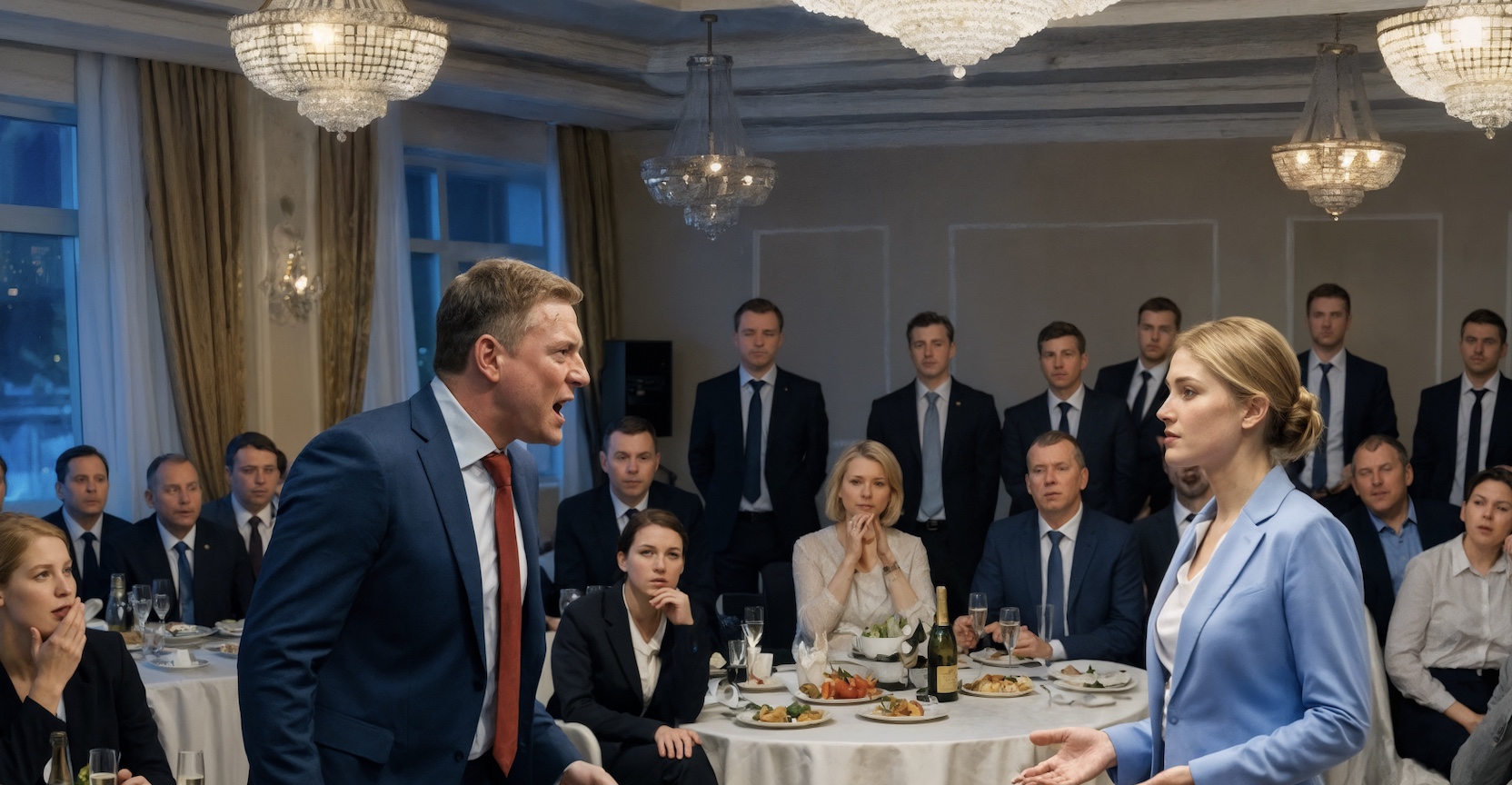
The sound of the microphone hitting the parquet floor was like a gunshot fired inside an empty hangar. The plastic casing cracked, the battery flew out, and rolled beneath the table toward Lyudochka from accounting. I looked at the shattered pieces, and inside me a cold, professional mechanism was already running: “Damage assessment: equipment — 15,000 rubles; Oleg Sazonov’s reputation — zero; Elena Sazonova’s reputation — due for correction.”
The banquet hall of the hotel in Apatity smelled of expensive perfume, burnt sparkler dust, and fear. Oleg’s twenty-three coworkers froze like mannequins behind a shop window. In that moment, there were only the two of us: him, flushed red with rage and cognac, and me, with a stiff half-smile and a flash drive clenched in my fist, stamped with her company’s logo.
“Shut up, you pathetic wreck!” His voice cracked into a shriek. “Know your place! You’re nobody here! You were nobody, and you’ll stay nobody! This is my celebration! Mine!”
Oleg stepped closer, his hand jerking, carrying the metallic smell of his tie clip. I did not flinch. I simply kept counting the seconds. In marketing, timing is everything. My pause was perfect. I did not cry. My hands did not tremble. I only watched him, registering every detail: the drop of sauce on his lapel, the twisted mouth, the darting eyes. This was point D3 — the arc where the antagonist’s humiliation becomes the foundation of his collapse.
“So you thought that because Petrov invited you, that made you important here?” he sneered, and that sneer was worse than shouting. “He quit! That’s it! Your protector is finished! And you… you’re just some bedding I picked up in a dormitory!”
Twenty-three people listened in absolute silence. Petrov, Oleg’s old director, sat in the corner with his head lowered. He really was leaving that day. The event was his farewell evening. He had asked me, as an expert, to give a brief market overview as a gift to the team. He knew what I was capable of. Oleg saw it as my attempt to make him look “pathetic” next to my success.
“You’re worth nothing, Lena,” he hissed, bringing his face close to mine. “Everything you have is because of me. Your apartments, your cars — all of it means nothing without my permission. Know your place. Pathetic.”
It was 7:04 p.m. I opened my fist. The broken clip on the flash drive had left a red mark on my palm. Eleven minutes. It took the system exactly eleven minutes to answer that insult. And the answer did not come from me.
Oleg Sazonov’s twenty-three coworkers remained rooted to their chairs. Some, like Lyudochka from accounting, studied the pattern on the tablecloth with exaggerated interest. Sanal, the head of sales, for some reason began polishing his glasses furiously with a napkin. No one moved. In Apatity, in that tiny corporate world where everybody knows everybody, a deputy department head publicly humiliating his wife was treated like part of the entertainment.
Pleased with the effect he had created, Oleg returned to his seat at the head of the table. He poured himself more cognac. His hand was still trembling slightly, but he had regained that lazy “king of life” posture he cultivated so carefully.
I remained standing by the microphone stand. The broken plastic pieces lay beside me. I did not pick them up. That would have been the gesture of a victim. Instead, I absentmindedly adjusted the cuff of my dress. The fabric was cold and smooth, like metal. In marketing, there is no room for emotion. There is only analysis.
Oleg called me pathetic. That word struck harder than a slap. Because I knew whose savings from before the marriage had paid the down payment on his car loan. I knew who had written his meeting presentations while he drank beer in the garage with friends. I knew whose salary — two and a half times higher than his — had allowed us to vacation in Pyatigorsk instead of Kirillovsk.
But those twenty-three people did not know any of that. They saw only Oleg, the strong, “well-bred,” commanding man, and me, a silent figure standing beside broken equipment.
“Why are you still standing there?” Oleg smirked at me over his shot glass. “Waiting for me to buy you a new microphone? Sit down. And stop embarrassing me.”
Petrov, the old director, suddenly stood up. He looked at Oleg, then at me. There was no anger in his eyes. Only a deep, dragging exhaustion.
“Oleg, you’ve had too much,” Petrov said quietly. “Calm down. Elena Igorevna… forgive us. I didn’t know it would provoke… this kind of reaction.”
Oleg slammed his glass onto the table. Liquid splashed across the cloth, spreading in a yellow stain.
“Elena Igorevna?!” he shouted. “Andreich, are you in on it too? She’s a theorist! She just shuffles papers around! I’m the one driving the numbers! My men are the ones doing the real work! And she—”
He never finished.
The clock read 7:15 p.m. Exactly eleven minutes had passed.
The heavy oak doors of the banquet hall swung open. In the doorway stood a tall man in a perfectly tailored gray suit. Men in Apatity do not wear suits like that — they bring them in from the capital. His face was unreadable, like a plaster mask.
The room fell so silent that you could hear someone in the kitchen of the Zapolyarye Hotel drop a spoon. All twenty-three of Oleg’s coworkers turned their heads toward the doors in unison. Petrov, the old director, straightened up, and on his face appeared that expression of deference he saved only for very important people.
The man in the gray suit entered. His movements were smooth, confident. He did not have the theatrical swagger Oleg Sazonov mistakenly considered leadership. He had power. Real, calm, documented power, backed by corporate charters and official signatures.
It was Volkov. The company’s new director. A man no one in Apatity yet knew personally, but about whom stories had already begun to circulate.
“My apologies for being late, Andreich,” Volkov said in a low, resonant voice. “The flight from Lipetsk was delayed. Heat.”
He surveyed the room. His gaze moved over Lyudochka from accounting, over Sanal with his glasses, and then stopped on Oleg. Oleg sat clutching his drink, his crimson face slowly turning gray. There was no hatred in Volkov’s expression. Only dry, accountant-like bewilderment.
“But I see the event is already in full swing,” Volkov said, looking at the microphone debris on the floor. “Your team certainly favors large-scale forms of self-expression, Andreich.”
Petrov hurried forward, flustering around him.
“Vitaly Borisovich, let me introduce him! Oleg Sazonov, deputy head of sales. Our locomotive, so to speak! He carries the plan, the team follows him!” Petrov nudged Oleg with his elbow.
Oleg stood, awkwardly bumping the chair. His swagger had evaporated, leaving behind only a sweaty shirt and trembling hands.
“Oleg Anatolyevich,” he managed, trying to force his trademark smile, the one that had always worked so well on Petrov.
Volkov ignored the outstretched hand. Slowly, he turned his head toward me. I was still standing beside the microphone stand. I wore a dress the color of burnt sugar, perfectly tailored to a figure I was prouder of than my Sorbonne diploma. I knew there was no mistake. I knew Volkov.
Three years earlier, we had worked together on a complicated asset merger. Back then, I had written the legal rationale for the Trust-Center deal in Lipetsk.
Volkov looked at me for a long moment. There was no warmth of recognition in his face. Only professional registration. In lyrical language, this would be called meeting an old friend. In my world, it was called activating a dormant asset.
“And you…” Volkov took a step toward me, “don’t seem to be part of Petrov’s team.”
“No, Vitaly Borisovich. I’m an invited expert. Elena Sazonova. Lead marketing specialist for the Zapolyarye Resource network. Andreich asked me to present a brief market review as a… farewell gift to the staff.”
I spoke evenly, in facts. No emotion. But inside me, everything was singing. This was D3 — the mechanics of revenge I had been building for the last three months without even realizing it. Oleg, standing five meters away from me, still had no idea that his time had run out.
“Zapolyarye Resource…” Volkov gave a faint smile, the same one I remembered from three years earlier in Lipetsk. “So you, Elena Igorevna, are the very same ‘theorist who shuffles papers around’ I just heard described so loudly?”
“Job description number fourteen, clause 3.2. Analytical support of transactions. I do shuffle papers, Vitaly Borisovich. Just the right ones.”
I glanced at the wall clock. 7:16 p.m. Exactly one minute since Volkov entered. Yesterday, the security system of Trust-Center Bank had blocked all transactions after my power of attorney was revoked. Today, Vitaly Volkov blocked my husband’s career.
Vitaly Borisovich Volkov did not rush. He walked to the table, pulled out an empty chair, and sat down without waiting for an invitation. His presence changed the density of the air in the room. The twenty-three employees who, one minute earlier, had been silent witnesses to my humiliation now looked like schoolboys caught smoking behind the garages.
Oleg stood gripping the edge of the tablecloth with his fingers. His “locomotive” confidence had deflated, leaving red blotches on his neck.
“Vitaly Borisovich, we were just…” Petrov began, smiling in that oily, ingratiating way. “We were only celebrating. Sazonov here… got a little overwrought. Targets, discipline, you understand.”
Volkov raised a hand, cutting off the stream of excuses. He was looking at me.
“Elena Igorevna, three years ago in Lipetsk, you explained to me why the merger with Trust-Center was a long-term mistake. I didn’t listen to you. The deal went through. Eight months later, we lost forty-two million on it. You were the only person in that room who wasn’t nodding along with me.”
Then he turned to Oleg.
“And now I walk into this hall and see my deputy department head — future deputy, I should say — throwing equipment and shouting at a woman whose analytical memo is currently sitting in my briefcase as the key document for restructuring this branch.”
The room was so quiet now that the hum of the bar refrigerator could be heard. Sanal had stopped polishing his glasses. Lyudochka from accounting was staring at Oleg with an expression that held no sympathy at all.
“I… I didn’t know,” Oleg muttered. His voice had gone thin, almost childish. “Lena never said… she’s just… at home she’s different.”
“At home?” Volkov raised an eyebrow. “At home, perhaps, she is your wife. But here she is a world-class expert whom I have spent the past month and a half trying to recruit away from Zapolyarye. And you just called her pathetic.”
I saw Oleg’s eye twitch. This was no longer mere anger. It was a total systems failure. His world — the one where he was the provider, the head, and I was merely a convenient backdrop — was collapsing piece by piece.
“Vitaly Borisovich, this is a family matter,” Petrov cut in, trying desperately to save what was left. “These things happen. A spark, a storm…”
“In my company,” Volkov said, standing, “family matters end where property damage and destructive conduct begin, especially when they undermine the authority of an invited specialist. Elena Igorevna, you had a presentation. The microphone, I see, has died a noble death. But we still have a voice. And we still have an audience that seems very eager to hear what awaits this branch in the next quarter.”
I nodded. My hands were dry. I took a spare flash drive out of my purse — an identical one, with a broken clip, the one Oleg had not noticed in my hand. In marketing, there must always be a Plan B.
“May I have your attention,” I said, turning to the room. My voice was level. No tears, no excuses. “Let’s begin with the demand volatility charts.”
Oleg slowly sank into his chair. He watched me, and I saw the realization begin to boil in his eyes, drop by drop: he had not merely lost his temper. He had committed career suicide in front of twenty-three witnesses.
For the next twenty minutes, the hall of the Zapolyarye Hotel held no sound except my voice and the rustle of notebook pages. Oleg’s colleagues, who had once seen me as merely “an accessory to Sazonov,” now hung on every word. I saw Sanal taking notes. I saw Lyudochka from accounting nodding along at the numbers in the tax optimization section.
Oleg sat perfectly still. He no longer drank his cognac. He stared at one point on the tablecloth, his face turned gray and earthy. In Apatity, that is the face men wear after a long shift in the mines, when there is not enough strength left even for anger.
I ended the presentation on the profit forecast slide.
“If we implement these changes within the next month,” I said, closing the laptop, “this branch will reach self-sufficiency by the end of the year. If we leave things as they are, the previous leadership…” I glanced briefly at Petrov, “will drive the company into bankruptcy by March.”
Volkov began to applaud slowly. Two people from marketing joined him, then Sanal, and within seconds the whole room — except for Oleg — was clapping. It was not polite anniversary applause. It was recognition.
“Brilliant,” Volkov said, walking over to me. “Elena Igorevna, my offer still stands. Salary, relocation package, stock options. Think it over. I need people who know how to tell the truth, even when the microphone gets thrown at the floor.”
Then he turned to Oleg.
“And you, Oleg Anatolyevich, I expect to see in my office tomorrow at eight sharp. We’ll be discussing your professional suitability. We have no need for ‘locomotives’ who cannot control themselves in front of colleagues.”
Volkov nodded to the room and left. Petrov rushed after him, babbling explanations as he went. The doors shut behind them with a heavy, final sound.
An awkward pause settled over the room. The coworkers began drifting away, trying not to look at Oleg. They curved widely around his table the way people walk around the site of an accident.
I walked back to our table. My handbag was beside Oleg’s plate. I picked it up and checked that my apartment keys were still inside. That same premarital apartment where Oleg had lived for the past five years, calling himself its master because, as he liked to say, “I’m the man, I pay for everything here.”
“Lena…” He lifted his head. His eyes were red, his voice hoarse. “Why would you do this to me? You knew about Volkov. You timed this on purpose, didn’t you? To humiliate me in front of everyone?”
“I didn’t time anything, Oleg. I came here to do my job. You simply showed everyone who you really are. Wasn’t it enough to humiliate me at home? You needed an audience too? Well, now you had one. Twenty-three people now know exactly what you are.”
“I love you,” he said suddenly, and it sounded so false it made my skin crawl. It was the classic mechanism of an antagonist: once power is lost, bargaining with feelings begins.
“No, Oleg. You loved the way I looked pathetic next to you. That made life easier for you. But I’m done playing that role. Take off the ring.”
He froze.
“What?”
“The ring. Take it off. And put your keys on the table. The ones to the apartment on Stroiteley Street. Tonight you sleep at your mother’s. Tomorrow I’m calling a locksmith and changing the locks. I’ll pack your things in bags and leave them in the vestibule.”
“You can’t…” He started to raise his voice, but stopped the moment he noticed that Sanal and Lyudochka were still in the hall, watching.
“I can. Under Russian civil law, that apartment is my personal property, acquired before marriage. You’re not even registered there. Go, Oleg. You’ve got an early morning tomorrow. The director is waiting.”
I turned and walked toward the exit. My heels struck the parquet in an even, confident rhythm. I did not look back. I knew he was still sitting there, alone in the empty hall, among dirty plates and broken microphone pieces. And that was his true place.
The night air in Apatity was cold and clean. I walked toward my car, breathing in the scent of pine and the nearness of snow. The parking lot was quiet. I got into the driver’s seat, fastened my seat belt, and simply looked at my hands. They were not trembling. On the contrary, I felt a strange, ringing lightness, as though someone had removed a huge stone from my back — one I had been carrying for years.
The apartment was quiet when I got home. I turned on the hallway light and saw his sneakers — expensive ones, bought with my bonus last year. Beside them stood the suitcase we had taken to Pyatigorsk.
I went into the kitchen and put the kettle on. While the water heated, I took out the large black garbage bags from the cupboard. I began with the wardrobe. His suits, shirts, ties — everything went into the bags without sorting. I felt no anger. I was simply restoring order. In marketing, that is called clearing non-performing assets.
My phone kept exploding with messages. Oleg’s mother, his friends, mutual acquaintances. “Lena, come to your senses!” “Men are just like children.” “Have pity on him, he’ll lose his career.” I did not answer a single one. I blocked every number.
At two in the morning, I placed four bags in the vestibule. The apartment keys, which he had in fact left at the restaurant table — Sanal handed them to me when he caught up with me at the exit — I put into the drawer of the hallway stand. Tomorrow the locksmith would come and change the lock cylinder. Nine thousand rubles for peace of mind was a good investment.
I went to bed at three in the morning. And contrary to all expectation, I fell asleep instantly. I did not dream of shattered microphones or flushed red faces. I dreamed of Lipetsk, new projects, and a blank white page.
I woke in the morning to silence. Good silence. Proper silence. On the state services portal, there was already a notification confirming the divorce application — I had filed it online in my pajamas while drinking coffee. Waiting period: one month. Legally, it was easier than I had expected.
At 8:15, Volkov called.
“Elena Igorevna, good morning. Sazonov didn’t show up. He submitted his resignation at 6:30 a.m. Ran off. You were right — he isn’t a locomotive. He’s just an empty railcar.”
“Good morning, Vitaly Borisovich. I accept your offer. When do I start?”
“I’ll see you on Monday. We have a lot of work ahead of us.”
I hung up and looked out the window. The first snow had covered Apatity. The city looked white, clean, and very still. I went to the mirror and fixed my hair. There were no red blotches of stress on my neck. My eyes were clear.
Some people would say I was cruel. That I destroyed a man in a single evening. But you know what? All I really did was stop pretending to be pathetic so he could feel comfortable. I chose myself. And it was the best marketing strategy of my life.
I picked up my bag and keys and stepped out of the apartment. At the threshold, I stumbled over an empty shoebox of his that I had forgotten to throw away. I smiled, nudged it toward the trash chute with my foot, and locked the door behind me. Two full turns.
Victory does not smell like triumph. It smells like fresh coffee, a new job, and silence — silence with no room left for someone else’s shouting. I walked toward the elevator, and each of my steps echoed through the empty corridor in a calm, certain rhythm.
Life did not end. It had only just begun — at the very moment the broken microphone hit the floor. And that sound was the most beautiful one in the world.