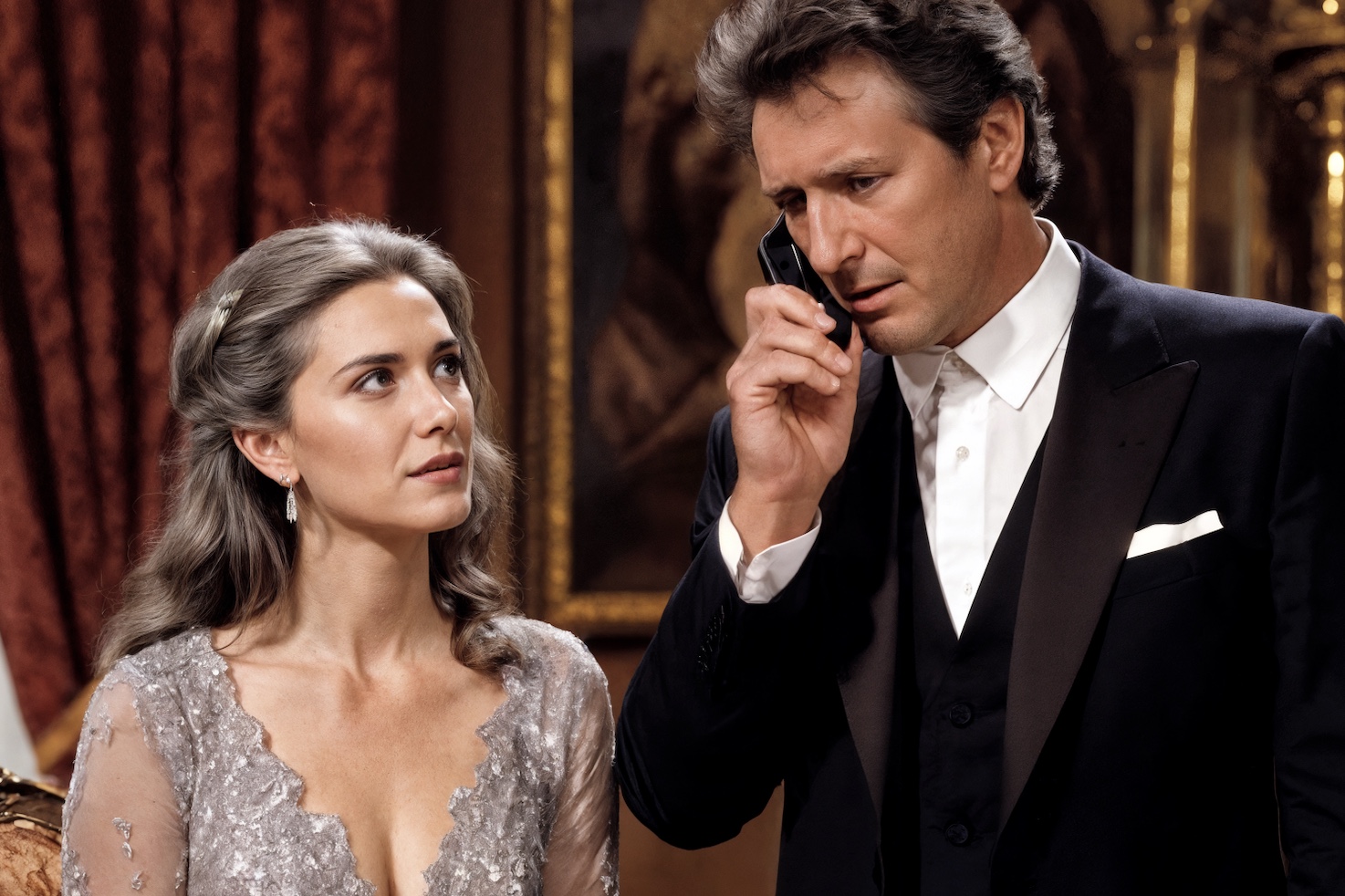
The glass walls of their penthouse loomed over the night city like an aquarium suspended above an abyss. Inside, the air smelled of expensive hardwood, the leather couch, and a faint, almost imperceptible strain. Artem sprawled in an armchair, rolling a crystal snifter of cognac between his fingers. A man used to giving orders, he wore a look of open disgust.
“What on earth is that?” His raspy voice cracked like a whip. “That sackcloth dress again? I gave you my card! Do you have any idea what people will think when they see Artem Sokolov’s wife dressed like she bought it at a street market? You were a nobody, and you’re still a nobody—plain as a gray mouse!”
Marina stood at the panoramic window with her back to him. Her slender figure in the simple dress really did disappear against the glittering skyline. She didn’t flinch. She didn’t turn. She simply stared down at the endless stream of cars, where the lives of people her husband contemptuously called “plankton” swarmed and scurried.
“Can you hear me?” he snapped, rising to his feet. “Do you even know what date it is? The ambassador’s reception! And you… you always look like someone blew your candle out!”
Slowly, she turned. Her face was calm—nearly detached. No fear. No hurt. Not even annoyance. Only weariness in eyes that seemed too large for her pale face.
“I’ve prepared everything the way you asked, Artem,” she said quietly, but clearly. “Your tux is pressed. The car will be here at seven.”
Her obedience only made him angrier. He grunted something under his breath, took a swallow of cognac, and stomped into his study, slamming the door.
Marina exhaled and moved toward the table to take his glass away. At that moment, her phone—left on the sofa—vibrated in an odd, muted way: not a regular ringtone, but a series of short, clipped pulses. She changed instantly. Her shoulders squared, focus sharpened in her eyes. She grabbed the phone and, with quick steps, went out onto the terrace, pulling the heavy glass door nearly shut behind her.
Artem stepped out of his study to grab a cigarette he’d forgotten on the desk. Hearing low voices from the terrace, he frowned. Who could she be talking to at this hour? He crept closer.
Through the glass he could see her profile. Her lips moved fast, and her expression was unfamiliar—hard, professional, even sharp. This wasn’t his timid little Masha.
“…the data checks out,” he caught a fragment. “No, it isn’t laundering. It’s direct funding routed through offshore entities in Nicaragua… Yes, I can see the chain… an account at Banco Central… linked to number 449…”
Artem froze. A cold thread of panic slid down his spine. Banco Central… that was the bank he used for his darkest arrangements—the ones nobody knew about. Nobody except his accountant and a couple of trusted contacts in Latin America.
“…the transfers are disguised as charitable contributions,” her steady, dictating voice continued. “Run a cross-check under code 78-B… Yes, exactly. I’ll send the file with the full breakdown.”
He pressed himself to the wall, the floor suddenly seeming to tilt beneath him. Nicaragua. Account numbers. Codes. This wasn’t a call to a friend about dresses. It was a report—precise, competent, lethal.
The terrace door opened. Marina stepped back into the living room. When she saw how pale he’d gone, she stopped. Her face held no surprise and no fear—only a cold, almost indifferent expectancy.
“Wh… what was that?” Artem rasped, forcing the words out. “Who were you calling?”
She placed the phone on the table, slowly. Her movements were calm again—only now that calm felt ominous.
“The Federal Tax Service, Artem,” she said softly, looking straight into his eyes. “My supervisors. I’ve been running your file for three years. Since the day you brought a ‘gray mouse’ from a provincial tax office into this home—so she wouldn’t irritate you, and so you’d have a wife who looked acceptable beside an oligarch.”
She paused to let the meaning land.
“They needed someone with steel nerves and an unremarkable face. Who would ever suspect that Artem Sokolov’s wife was an audit investigator? You gave me access to everything—your documents, your computers. You demanded I be quiet and invisible. I simply did my job.”
Artem stared at her—at the woman in the plain dress who had suddenly become the sole owner of his fate. His fortune, his power, his yachts and castles—all of it crumbled to dust under the unblinking gaze of the “gray mouse.”
And in the hush of that luxurious living room, for the first time in years, he felt utterly naked and helpless.
—
The silence turned thick, ringing—like the air after an explosion. Artem stood with his back against the cold glass wall and couldn’t tear his eyes away from his wife. His mind—trained to calculate risk and multi-million deals in an instant—refused to accept this new reality. His Marina. Quiet, compliant Marina. The one who made his coffee in the mornings and swallowed his humiliations without a word.
“You’re… tax enforcement?” he croaked, the words scraping his throat. “For three years?”
She didn’t nod. She just watched him. Her gaze was different now—sharp, appraising, professional. There was no gloating in it, no revenge. Only a chill statement of fact, as if he weren’t her husband but a file that needed auditing.
“Operation Thunderer,” she said in an even, official tone. “My assignment was to embed and collect irrefutable proof of tax evasion and asset flight abroad. Everything you left lying around so trustingly—USB drives, passwords scribbled in a notebook, conversations here in the living room—was recorded, copied, and analyzed.”
Artem swallowed. He remembered laughing at her “stupidity” when she couldn’t figure out the new sound system. Remembered condescendingly explaining basic economics, certain she was incapable of understanding. And all the while… she had been documenting him.
“Why?” he breathed. “I gave you everything—money, luxury, status!”
For the first time that evening, something like a smile flickered across her mouth. There was no warmth in it.
“You gave me access, Artem Nikolaevich. It was the best operation of my career. You practically led me by the hand, showing me every shadow account, every scheme. You didn’t even try to hide, convinced I was too stupid to understand.”
She took a step toward him. To his own surprise, he stepped back.
“And this ‘linen sack’?” he jerked his chin at her dress. “That was… camouflage too?”
“Work uniform,” she shot back. “Unnoticeable, comfortable, doesn’t distract from the job. Unlike your Brioni suits you’re so fond of.”
Suddenly rage twisted his face. He lunged, grabbed her shoulder, his fingers digging into the linen.
“You think you’ve won? I’ve broken tougher people than you! I’ll buy everyone—judges, prosecutors… I’ll destroy you!”
She didn’t even try to pull away. She glanced at his hand clamped on her shoulder, then lifted her eyes to his. Cold. Metallic.
“I suggest you let go, Artem Nikolaevich. Assaulting an officer in the line of duty is an aggravating factor. And besides,” she nodded toward the bookshelf where a framed photo of the two of them stood, “the camera in that frame is recording in 4K. Excellent sound.”
He yanked his hand back as if burned. His gaze snapped to the frame. He’d always assumed it was just a tacky gift from some business partner.
“Y-you…” he gasped.
“Me,” she confirmed. Then she checked her watch. “The team will be here in fifteen minutes. Search warrant, seizure of documents and electronics. You should call a lawyer. Although…” her eyes shifted slightly, “…your primary attorney, Mr. Zaitsev, is already giving a statement. Witness protection.”
That was the final blow. Artem swayed and dropped into the chair. His whole universe—money, power, immunity—collapsed in a single instant. He wasn’t the king. He was a pawn. Not the hunter, but the hunted. And his hunter had been the woman he’d treated like a trophy.
Marina stepped to the table and took her phone. Her fingers moved quickly over the screen, sending a message—businesslike, unhurried.
Then she returned to the panoramic window and looked out over the city again. Only now her posture didn’t speak of submission, but of possession. She looked down from above, like a commander surveying a battlefield where the war was already won.
Below, near the entrance, several black, unmarked cars rolled up in silence.
“They’re here,” Marina said without turning. Her voice was quiet again, but now it carried no timidity—only absolute control. “Go greet your guests, Artem Nikolaevich. Your reception is about to begin.”
The hush was split by the steady, rising hum of the elevator climbing toward their floor. Artem sat as if paralyzed. He no longer saw the glittering city beyond the glass, or the lavish living room. He saw bars. A cramped cell. Shame. Everything he’d built over decades fell apart in a heartbeat—and it fell by the hand of that… mouse. Gray, invisible, perfect.
The elevator doors opened soundlessly. Three men in strict suits entered the living room, their faces blank and official. Behind them came two uniformed officers with Federal Tax Service patches. No special forces with rifles were needed. The walls of his fortress had been breached from inside.
“Artem Nikolaevich Sokolov?” the lead officer addressed him in a dry, emotionless voice. “We have authorization to conduct a search and place you under detention under articles…”
Artem didn’t listen. He stared at Marina.
“Marina…” he rasped. It wasn’t anger anymore—just a last, desperate attempt to reach something human. “We… we lived together. I… I supported you!”
She turned her head slowly. There was no malice in her eyes, no triumph—only faint fatigue and… emptiness.
“It was work, Artem Nikolaevich,” she answered just as quietly and clearly as always. “And as for ‘support’—every gift, every payment, every piece of jewelry has already been sealed and will be entered into evidence. You will also be charged with attempting to bribe an officer.”
One of the investigators handed her a slim tablet. She signed the screen with a confident, firm hand—not the timid little scribble she used on designer receipts.
“Protocol for seizure of original data carriers,” she said, handing the tablet back. “Everything is in order.”
Artem understood at last. To her, he wasn’t a husband. Not a man. A case file. A case she was closing.
They lifted him from the chair. He didn’t resist. His strength was gone. At the doorway, he turned once more. Marina wasn’t looking at him anymore. She was back by the window, speaking into her phone in the same crisp, professional tone he’d heard on the terrace.
“Yes, the operation is complete. Subject detained. Begin seizure of documents in the study. Pay special attention to the flash drive hidden in the monograph on the Rothschilds. Yes—that one.”
The elevator doors slid shut, carrying him down toward the cars, toward interrogation, toward ruin. His wealth and influence remained up there, behind the glass walls that no longer protected him—only displayed his defeat to the world.
An hour later, Marina walked out of the building. In her hand she carried only a small grocery bag with the essentials. No suitcases. No diamonds. A modest sedan waited for her.
She slid into the passenger seat, tipped her head against the headrest, and closed her eyes. For the first time in three years, her shoulders loosened. The mask was off. The job was done.
“To headquarters?” asked the young man behind the wheel, dressed in a simple jacket.
“To headquarters,” she nodded without opening her eyes.
The car pulled away and dissolved into the night traffic—into thousands of identical lights. Being unnoticed had been her greatest weapon. And her trump card. A gray mouse that quietly tore the throat out of a sleeping lion.