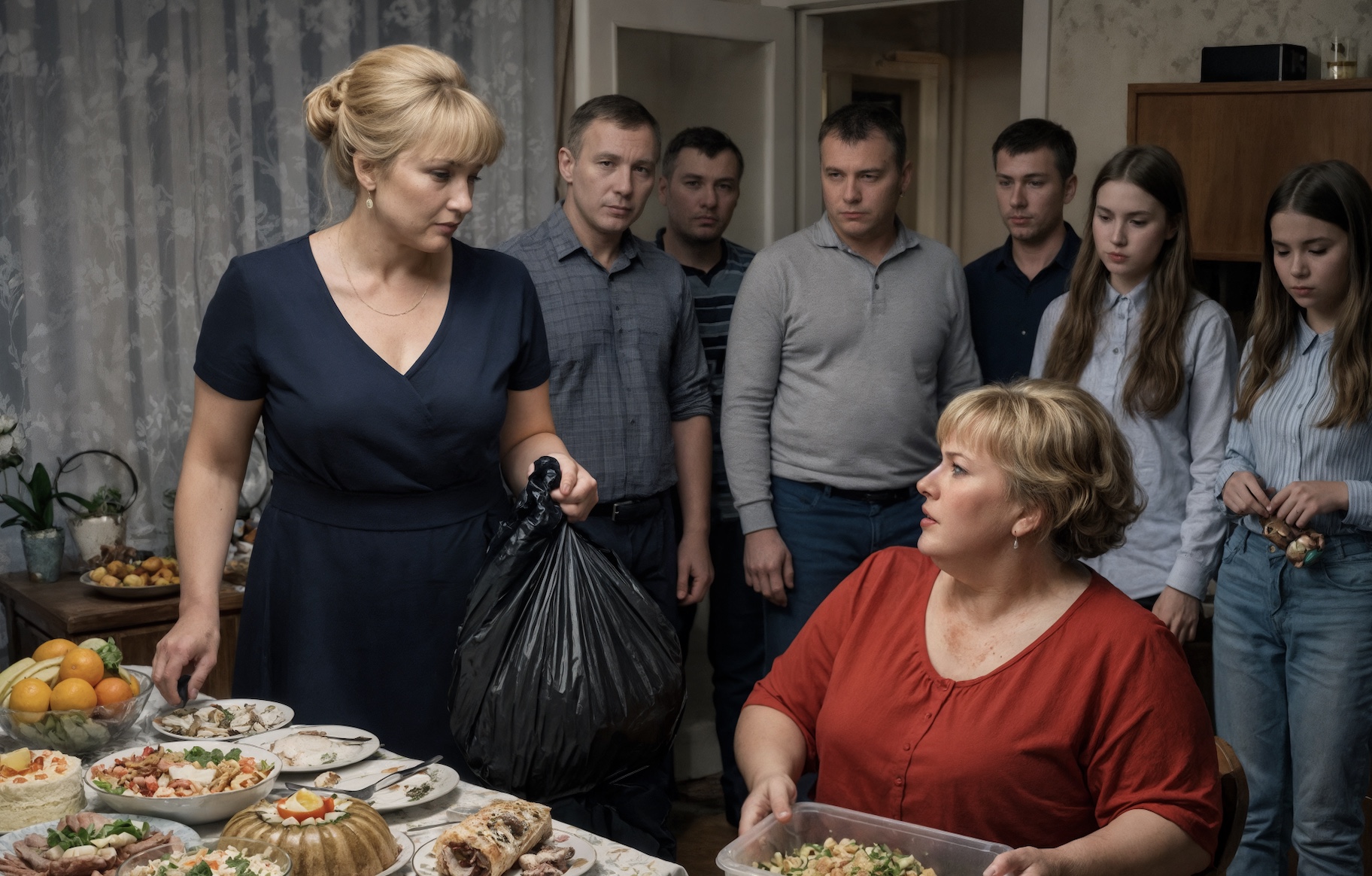
When my sister-in-law pulled a fifth plastic container from her bag and reached toward my stuffed pike, I understood: it was now or never. I’d been silent for twenty-five years. Enough.
A famous writer once claimed that all happy families are alike. But in real life, if you look closely—at how people set a table, at how they divide up the cutlets—you can glimpse entire abysses.
“Serge, did you look at the shopping list?” Nina tapped a notebook page covered in her neat, teacherly handwriting. “I ran the numbers: if we buy caviar like you want, and that salmon for slicing, we’re over budget.”
Sergei, still glued to the TV, waved a hand.
“Nin, you turn fifty once. What, we’re going to put sprats in tomato sauce in front of our guests? People are coming who matter: the guys from work, the Petroviches, Lena and her husband. Don’t make me look cheap.”
“I’m not making you look cheap. I’m counting,” Nina sighed, pushed up her glasses, and went back to her calculator.
She loved accuracy. She’d worked her whole life as an accountant at a small construction company and believed one iron rule: if something increases somewhere, something decreases somewhere else. In this case, it was coming out of their “vacation stash.” Sergei—a driver with thirty years behind the wheel—had a big heart and very narrow financial planning.
“And your Sveta and her family—are they coming?” Nina asked, though she already knew the answer.
“Of course!” Sergei even sat up. “She’s my sister. My nephew and nieces—Danya and Ksyusha. How could I not invite them?”
Nina pressed her lips together. She didn’t like Svetlana, to put it mildly. Not because the woman was sharp-tongued—Nina could handle that—but because Sveta had a kind of bottomless, pathological greed. She worked in a warehouse, and it seemed the habit of “counting and saving” had turned into a real obsession.
“Serge, I’m not against family. But you remember last time, on the May holidays?” Nina took off her glasses and looked at her husband. “She carried off half a bucket of shashlik. ‘For the dog.’ And later I saw your brother-in-law Kolya finishing it for lunch.”
“Oh, here we go,” Sergei groaned. “What, you begrudge my own sister a piece of meat? Maybe she miscalculated, maybe it really was for the dog and they changed their minds. Forget it. We’re family.”
Nina stayed quiet. Arguing with Sergei when it came to his “blood relatives” was pointless. She silently crossed out the expensive dry-cured sausage and wrote in plain bologna instead. There still wasn’t enough for caviar—unless she raided the cash they’d put away for winter tires.
“Fine,” she said at last. “But I’m warning you: I’m cooking for exactly twelve people. Plus a small buffer. No ‘to-go’ and no ‘for tomorrow.’”
“Oh, come on, Nin!” Sergei laughed, walking over and hugging her shoulders. “Who steals food from a birthday banquet? This isn’t the hungry nineties.”
Preparing for the anniversary dinner felt like a military campaign. Nina spent two days stuck in the kitchen. In the oven, pork roast slowly baked, studded with garlic and carrot. On the stove, aspic bubbled—Sergei adored jellied meat, even though Nina grumbled it was “winter food.”
The star of the table was meant to be her signature dish: stuffed pike. She sacrificed an entire weekend for it—and three thousand rubles at the market. She chose the fish like an expert: checked the gills, haggled until she was hoarse, and came home with a real trophy—nearly four kilograms.
On the day of the celebration, the apartment gleamed. The table stretched across the living room sagged under platters and bowls. Nina, tired but pleased, wore a new dusty-rose dress and arranged plates.
“Look at this!” her friend Lena said, coming early to help with slicing. “Nina, you’re a hero. The pike—wow. The salads—wow. And is that julienne?”
“Julienne,” Nina nodded, straightening a napkin. “With porcini mushrooms, by the way. Serge asked for it.”
Guests started arriving around five. First came Sergei’s coworkers—loud, cheerful men with envelopes and flowers. Then neighbors joined in. The apartment filled with voices, perfume, and the warm smell of baked meat.
Svetlana arrived forty minutes late—with her husband Kolya and two teenage kids.
“Oh, traffic, traffic! Moscow is completely stuck!” Sveta boomed as she barged into the hallway.
She was large and noisy, wearing a bright blouse with glitter thread stretched across her impressive chest. In her hands: a huge Auchan shopping bag.
“Happy birthday, little brother!” she kissed Sergei’s cheek. “Here—this is from us.”
She handed him a tiny gift bag. Nina, taking the presents, glanced inside: a supermarket shaving kit, clearly a discount special. Well, at least it’s not socks, she thought, but aloud she said:
“Come in, dear guests. Everything’s on the table—it’s getting cold.”
“And we’ll just put our bag in the corner, okay?” Sveta said, tucking the tote behind the coat rack like she owned the place. “The kids’ spare shoes and… little things.”
Nina noticed the bag looked suspiciously empty for “spare shoes.” But she said nothing.
The evening rolled on as usual—toast after toast, glasses clinking, laughter rising and falling. Sergei, rosy-cheeked and happy, accepted congratulations. Nina ran to the kitchen, swapped plates, brought out hot dishes.
Svetlana ate almost nothing. She sat like a commander on a hill, calmly surveying the battlefield. Her eyes slid over the cold cuts, lingered on the fruit bowl, assessed what remained of the tongue salad.
“Nina, did you chop the Olivier yourself or buy it?” she suddenly asked loudly during a lull.
“Of course I did it myself, Sveta. Who serves store-bought on a big birthday?”
“Mmm,” the sister-in-law hummed. “Tasty. Too much mayonnaise, though. Not healthy. Sergei at his age should watch his cholesterol.”
She pushed her plate away theatrically—there was only a lonely slice of cucumber on it. Meanwhile her husband Kolya devoured the pork roast, and the kids, Danya and Ksyusha, had already set their sights on the julienne.
“Eat, eat,” Nina encouraged, spooning seconds onto plates. “Everything’s fresh. Homemade.”
When the hot course arrived—the famous pike and rosemary potatoes—Sveta suddenly came alive.
“Oh my, what a fish!” she clapped her hands. “Nina, are you crazy? That thing must’ve cost a fortune!”
“For my husband, it’s worth it,” Nina smiled as she served portions.
Sveta took her piece, poked it with a fork, ate a tiny bite, and set her utensils down.
“Too greasy,” she declared. “And probably full of bones. I won’t give it to the kids—they’ll choke.”
Nina only sighed. She knew there wasn’t a single bone in that fish—she’d ground the fillets three times herself. But she didn’t argue. She didn’t want to ruin Sergei’s mood.
The storm broke when the guests stepped outside for a smoke before tea. Only the women and kids remained at the table. Nina cleared dirty dishes, getting ready to bring out the cake.
Then she heard that unmistakable crackle of plastic. She turned—and froze, plates in her hands.
Svetlana had pulled out a whole stack of plastic containers from her Auchan bag and was working briskly with a spoon.
“Sveta… what are you doing?” Nina asked quietly.
“Oh, Nina, I’m just looking—there’s no way you’ll eat all this!” Sveta chirped, not stopping. “There’s so much roast left. The fish is nearly untouched. It’ll spoil! What a waste. I’ll pack some up—Kolya can take it to work tomorrow, the kids can bring it to school.”
With practiced speed, she scraped the leftovers of the expensive cured meats—things the guests barely got to taste—into a container. Then she reached for the pike platter.
“Sveta, wait,” Nina said, setting the plates on the edge of the table. Her voice shook. “The guests haven’t left. The men will be back—they’ll want to snack. We haven’t even cut the cake!”
“Oh, stop it,” Sveta waved her off. “The men are already tipsy, they don’t care what they snack on. They’ll crunch a pickle. And the pike will dry out. What, you’re stingy with your own nieces and nephew?”
As she spoke, she hooked a huge piece of the stuffed fish—the one with the head that Nina had saved for a pretty presentation—and dropped it into the largest container.
“Danya, Ksyusha—help your mother!” she ordered.
The teens, clearly used to these operations, obediently reached for candy bowls and fruit, stuffing pockets and bags.
Nina watched with a strange, distant horror. It wasn’t just rude. It was looting.
“Put it back,” she said.
“What?” Sveta froze midair with a chunk of pork.
“Put the meat back. And return the fish,” Nina stepped closer. Inside her, something cold and hard was rising.
“What’s wrong with you, Nina?” Sveta’s eyes bulged. “You’re stingy over scraps? You were going to throw it away! I saw you clearing the table!”
“These aren’t scraps,” Nina said sharply. “This is a holiday table. And people are still sitting at it.”
“What people?” Sveta snorted. “Your Lena’s already half drunk, the Petroviches are about to leave. And we need to eat. Kolya’s paycheck got delayed—there’s nothing to feed the kids. We’re family! You’re supposed to help!”
And she started piling tongue salad into another container even faster.
“We gave a present, by the way!” she added, offended. “You could at least show some respect to your relatives.”
At that moment Sergei returned with the men. Seeing the half-emptied table, his wife’s stone face, and his sister packing food like she was running a factory line, he blinked in confusion.
“What’s going on here? Girls—what are you doing?”
“Serge!” Sveta wailed immediately. “Your Nina has gone completely crazy! She begrudged your own sister a bite of bread! I’m saying, let me take some so it won’t go to waste—and she’s acting like a dog guarding hay! ‘Put it back,’ she says!”
Sergei looked at his wife.
“Nin… honestly… why are you doing this? Let them take it. What are we going to do with so much?”
Nina stared at her husband—at his kind, slightly foggy face. At Sveta, already triumphantly snapping the lid closed over the container with the pike. At the guests, who suddenly found the wallpaper fascinating.
And something inside Nina finally snapped—the thin thread of patience that had held up twenty-five years of marriage, endless saving, endless “understanding,” endless “family ties.”
Without a word, Nina walked up to Sveta. With one sharp motion, she yanked the fish container out of her hands.
“Hey! What do you think you’re doing?!” Sveta shrieked.
Nina didn’t answer. She opened the lid and flipped the container back over the serving platter. The pike slapped down in ugly broken chunks.
“Nina!” Sergei gasped.
Nina grabbed a second container—tongue salad—and dumped it back into the bowl. Mayonnaise splattered the tablecloth and Sveta’s glittery blouse.
“Are you insane?!” Sveta screamed, jumping back. “You ruined my blouse!”
Nina swept up the remaining empty containers and threw them into the Auchan bag. Then she went into the kitchen.
The room went dead silent. You could hear the clock ticking and Sveta’s heavy breathing.
Nina came back a minute later holding a thick black trash bag.
“Here,” she said, pressing it into Sveta’s stunned hands.
“What is this?” Sveta asked automatically.
“What’s meant to be thrown away,” Nina replied in a calm, even voice. “Chicken bones. Sausage skins. Used napkins. Take it. You said it was ‘all going to be tossed anyway.’ So I packed it up—for you. So nothing gets wasted.”
Sveta turned purple. She gulped air like the very fish on a market stall.
“You… you… Sergei! Do you see what she’s doing? She’s feeding me garbage! In your own home!”
Sergei finally shook himself out of his stupor.
“Nin… that’s too much,” he started uncertainly.
“Too much, Serge,” Nina cut in, looking straight into his eyes, “is when your relatives steal food out of guests’ plates. Too much is when I set a table with my last money and then get told I’m being stingy with ‘scraps.’”
She turned to Sveta.
“Out.”
“What?” Sveta didn’t understand.
“Out of my home. With your containers, your husband, your kids. And take your trash,” Nina nodded toward the black bag. “Wasn’t it for the dog? The dog will be thrilled.”
“My foot will never step in here again!” Sveta screeched, yanking her tote and grabbing her husband by the sleeve. “Kolya, let’s go! We’re not staying one more second in this snake pit! Choke on your pike!”
They shot out of the apartment like a cork from a bottle. The door slammed. Only dirty footprints from their shoes remained in the hallway.
The guests were silent. Lena carefully picked up her fork and speared a piece of cucumber.
“Well,” she said softly, “the salad really is delicious, Nin. And yes—you can taste it’s homemade.”
Bit by bit, the tension eased. The men, clearing their throats, reached for the vodka. Conversation slowly restarted, though the carefree mood was gone.
When the last guest had left and the dishes were washed, Nina sat at the kitchen table with a mug of tea gone cold. Sergei paced the hallway, hesitating to enter. Finally he appeared in the doorway.
“You really did it,” he said, trying to sound upbeat, but avoiding her eyes. “That was… something. With my sister—so harsh. She already called, crying. Says you humiliated her.”
Nina lifted her gaze slowly.
“Serge… do you honestly not get it?”
“What’s there to get? Yeah, she’s greedy, she’s clueless. But throwing her out? And that trash bag… it was embarrassing in front of everyone.”
“Embarrassing, Serge,” Nina said evenly, “is when you don’t feel like the mistress of your own home. When your work, your money, your effort—your soul—gets stomped into cheap plastic containers.”
She stood and went to the window. Outside it was dark; streetlights threw yellow stains onto the wet asphalt.
“Here’s what I’ve decided, Serge. I’ll keep visiting your mother. She’s elderly—she needs help. But Sveta? I don’t want to see her here again. Ever. Not on holidays, not for ‘just a visit.’”
“But, Nin…” Sergei began.
“That’s how it is. Either she doesn’t show up here, or I file for divorce and we split the apartment. And then you can live with your Sveta and her containers in a one-room place. Separately. Because I’m done.”
She spoke calmly, without shouting. And that calmness was what truly scared Sergei. He suddenly understood: this wasn’t a threat. It was a decision—final, like the bottom line in her ledger.
“All right,” he said, shoulders dropping. “All right. You’re right. She went too far today. I’ll talk to her.”
Nina nodded. She knew he would talk. And she knew Sveta would smear her to every relative for months. But she didn’t care.
She opened the refrigerator. On the shelf sat a plate with a neat, beautiful piece of pike—the one she’d managed to hide before the raid.
“Tomorrow I’ll eat it for breakfast,” Nina thought. “With white bread and butter. I earned it.”
And for the first time all evening, she smiled—genuinely, lightly.