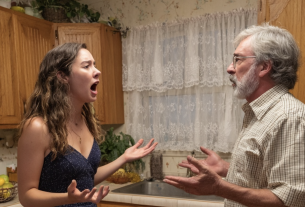
“And this slab of meat,” the voice remarked, “isn’t even cooked properly. Blood on the plate is a straight path to parasites, Jeanne. Or have you decided that since you don’t cook at home, you can poison yourself with anything here, too?”
Jeanne froze with her fork halfway to her mouth. She would’ve recognized that voice even over the scream of a fighter jet—so the steady din of a business-center cafeteria was nothing. Slowly, she looked up.
Standing in the aisle, blocking the way and hanging over Jeanne’s small window table like a dark storm cloud, was Veronika Evgenyevna. Her mother-in-law looked, as always, flawless and threatening: a gray cashmere coat, hair arranged with surgical precision, and on her face the kind of disgusted pity usually reserved for a crushed bug.
“Good afternoon, Veronika Evgenyevna,” Jeanne said, carefully placing her fork down on the edge of the plate. Her appetite vanished instantly, as if a draft had blown it away. “I didn’t know you came to this neighborhood. I’m on my lunch break—I only have thirty minutes.”
“I know exactly where you work and when your break is,” the older woman replied. “Unlike you, I have a flexible schedule—and I know how to manage my time.”
Without waiting to be invited, she pulled out the chair across from Jeanne and sat.
She did it with the easy authority of a person who believed the café belonged to her. Veronika Evgenyevna slid off her leather gloves slowly, finger by finger, and placed them beside Jeanne’s plate, nearly brushing the untouched edge of the steak. A heavy, expensive perfume clung to her and immediately overpowered the smell of coffee and food—cold metal and old powder wrapped into one.
“Did you need something?” Jeanne asked, feeling a slow, muffled irritation begin to rise. This had been her time—her earned half hour of quiet between reports and client calls. And now someone had barged into her only refuge without shame.
“I wanted to see what the woman eats who feeds my son frozen convenience food,” Veronika Evgenyevna said, scanning the table and lingering on the coffee and the plate. “You know, Jeanne, I stopped by your place yesterday while you were at work. I have my own keys—if you’ve forgotten. I opened the refrigerator… and it nearly made me ill.”
She paused, waiting for Jeanne to squirm. Jeanne didn’t. She stared straight back. Annoyed, the mother-in-law clicked her tongue and raised her voice slightly so the men in suits at the neighboring table could hear.
“Nothing. Empty. A mouse would hang itself in there. Two dried chunks of cheese and a jar of some pickled cucumbers. Oh, and dumplings in the freezer. Store-bought. Do you even understand what you’re doing to Denis’s stomach? He’s had gastritis since childhood—he needs light food, steamed food, home cooking. And you’re stuffing him with chemicals.”
“Denis is an adult man, Veronika Evgenyevna,” Jeanne answered calmly, though her fingers tightened into a fist beneath the table. “If he wants steamed cutlets, he can buy ground meat and ask me to make them. Or make them himself. We both work until eight.”
“‘We both work,’” her mother-in-law echoed with a mocking curl of her dark burgundy lips. “That’s the problem right there. You’re far too absorbed in your… career—if pushing papers around an office deserves that title. You’re a woman, Jeanne. Your main job is your home and your husband. And you look…”
Veronika Evgenyevna leaned forward and examined Jeanne’s face with the bluntness of a doctor inspecting skin under bright light.
“…You look awful. Bags under your eyes. Gray complexion. Makeup slapped on in a hurry. No wonder Denis has been staying late lately. It’s hard to want to come home when what’s waiting there is a tired, permanently dissatisfied wife who thinks only about debits and credits—and serves thawed dough filled with meat of questionable origin for dinner.”
Heat rushed to Jeanne’s cheeks—not from shame, but from anger. Cutlery clinked, people laughed and talked business, waiters moved between tables, but for Jeanne the world shrank to this one table and the woman across from her, radiating poison like a radioactive source.
“Veronika Evgenyevna, let’s not cause a scene,” Jeanne said tightly. “I didn’t ask you to inspect my refrigerator, and I certainly didn’t ask you to judge my appearance. If Denis is unhappy, he’ll tell me himself.”
“He won’t!” her mother-in-law snapped, a shrill note slicing through her voice. “He’s too well-bred. I raised him to be a gentleman. He’ll endure. He’ll stay quiet. He’ll choke down your dumplings and smile because he’s noble. But I’m his mother. I see him suffering. I see how drawn he’s gotten. His shirts aren’t even ironed! I saw him last week—his collar was wrinkled! That’s disgraceful, Jeanne. Disgraceful for a wife.”
Her voice kept rising. People began turning in their seats. Someone stopped chewing to listen. If anything, the attention energized Veronika Evgenyevna. She straightened her shoulders, like an actress stepping into the spotlight.
“So you came here to talk about collars?” Jeanne leaned back. Her steak had gone completely cold and now looked as unappealing as the conversation itself. “You could have called.”
“On the phone you hang up and claim you’re busy. Here, you can’t run,” the older woman said with a mean little smile. “I came to open your eyes, sweetheart. You’re living in the illusion that everything is fine. It isn’t. You think bringing a paycheck home is enough? A man doesn’t need your pennies. He needs comfort. Care. Admiration. And you? You come home and collapse on the couch.”
With a disdainful flick, she pushed the napkin holder aside as if it were in her way, and her gaze sharpened into something needling.
“Do you know what the neighbor told me yesterday? She saw you taking out the trash. In sweatpants. In a stretched-out tank top. In public! You’re embarrassing not only yourself—you’re embarrassing my son’s family name. How do you think he feels knowing his wife looks like a ragged mess?”
“I was at home, and I stepped out to the trash chute,” Jeanne tried to keep logic alive in the middle of this madness. “Veronika Evgenyevna, this is ridiculous. My clothes are my business.”
“Your business ended the day you put a ring on your finger!” her mother-in-law snapped, slamming her palm on the table. The sound was sharp and ugly. “Now you represent the family. And that face—sorry—looks completely unpresentable. I won’t let you drag Denis down. I put too much time, money, and soul into him for some… office mouse to turn his life into domestic sludge.”
Jeanne glanced at her watch. Only five minutes had passed, but it felt like an eternity. She understood there would be no peaceful lunch. Veronika Evgenyevna hadn’t come to talk—she’d come to destroy. This was a planned intimidation stunt: a public execution where the victim, in the executioner’s imagination, would be too embarrassed to fight back.
“Listen,” Jeanne leaned forward, her voice harder now. “I respect you as my husband’s mother. But you’re crossing the line. I’m not your employee, and this isn’t a meeting.”
“Don’t you dare lecture me about lines,” Veronika Evgenyevna hissed, eyes narrowing. “You don’t even know where the line is. You think you’re in charge? You think a stamp in a passport gives you guarantees? Silly, naïve girl. Let me explain what happens to smug little empties like you. I came prepared, Jeanne. I have a long list.”
She reached into her expensive handbag—but didn’t pull out papers. She pulled out months of accumulated hatred and prepared to pour it right here over the café’s snowy white tablecloth.
She began counting on her fingers. Her immaculate French manicure looked like little blades.
“First item: the bathroom. I went to wash my hands and was horrified. Toothpaste splattered on the mirror. Limescale on the faucet. Do you even know what household cleaners are, or are you waiting for filth to fall off by itself? When my son comes home from work, he should step into a sterile space to wash off stress—not a pigsty where it’s disgusting to touch the door handle.”
Jeanne clenched her jaw. She had scrubbed the bathroom on Saturday. But for Veronika Evgenyevna, cleanliness apparently meant laboratory standards—unreachable for actual human beings.
“Second,” the older woman continued, folding down another finger, steel ringing in her voice. “Clothes. I went through Denis’s wardrobe. Why are his winter sweaters mixed with T-shirts? Where are the moth sachets? Where are the perfect color-sorted stacks? You shoved everything in and slammed the door. That’s disrespect. Clothes have energy, Jeanne. When you treat your husband’s things like rags, you treat him the same way. You diminish his status.”
“I don’t rearrange Denis’s things because it’s his personal space,” Jeanne shot back, her tone turning cool and sharp as a wire tightening. “He asked me not to touch his shelves so he can find what he needs.”
“Don’t lie to me!” Veronika Evgenyevna roared so loudly the barista behind the counter startled and spilled coffee outside the cup. “Denis is a neat freak! He grew up in a home where everything was perfect. If he’s living in chaos now, it’s only because you broke him. You trained him into your laziness. You’re like mold—spreading through his life and infecting everything with your carelessness.”
She leaned closer, eyes gleaming with a fanatical shine. Now she sounded less like a disgruntled relative and more like a prosecutor reading out a death sentence.
“You think I don’t notice how he looks at normal women? Well-groomed women. Obedient women. Domestic women? Yesterday we ran into my friend’s daughter, little Lena. Smart, beautiful, bakes pies, worships her man. Denis looked at her…” She savored the cruelty. “With longing, Jeanne. Like a hunted animal trapped with a woman who can’t do anything right.”
“Are you finished?” Jeanne asked, her pulse pounding in her temples. She wanted to get up and leave, but something kept her in place—maybe the need to see how deep the pit really went.
“Oh no, sweetheart—I’m only getting started,” Veronika Evgenyevna said with a predatory smile. “The most important thing is your attitude. Your arrogance. You’ve started thinking you’re too important. ‘I work.’ ‘I’m tired.’ ‘I have a career.’ Please. Who cares about your career if you can’t provide your husband basic comfort? You should greet him at the door with a smile, slippers, and a hot dinner. You should ask how his day went and listen quietly, not unload your office gossip on him. You should be a shadow—convenient and invisible—creating the backdrop for his success. And you?” Her eyes narrowed. “You try to be his equal.”
She paused for breath and swept the room with a triumphant glance, making sure the audience was still there. They were. People were listening. Someone shook their head at Jeanne with judgment. Someone else filmed discreetly from behind a phone.
“And do you know how this ends?” Her voice dropped lower, softer—and that made it worse, not better. A chilling, prophetic note slid into her tone. “Denis tolerates a lot. He’s gentle—soft. But everyone has a breaking point. One day he’ll come home, see more store-bought dumplings, see your dissatisfied face, see dust along the baseboards… and he won’t hold back.”
She leaned across the table until her suffocating perfume swallowed the air between them.
“He’ll start teaching you, Jeanne. Like a man. With his fist. And I won’t condemn him—on the contrary, I’ll tell him, ‘Son, you’re right.’ Because women like you need to be trained with force when words don’t work. One good smack can do wonders for defective wives. It puts their brains back in place and teaches humility. And if you still don’t understand…”
She leaned back, pleased with the effect.
“…then he’ll throw you out onto the street. Like a kitten that soils shoes. The divorce will be fast and brutal. You’ll be left with nothing—back in your rented hole, an aging, unwanted divorcée. And Denis will find a proper woman—maybe that same Lena—who will appreciate him and dust him like a treasure. I promise you that. I’ll do everything to make him see clearly. I’ll drip poison into his ear every day until he finally understands what kind of miserable nobody he’s living with.”
Jeanne stared at the woman across from her and no longer saw her husband’s mother—only a creature made of complexes and hunger for control. The talk of beatings was the final straw. This wasn’t criticism about cleaning; it was open incitement to violence, cruelty dressed up as “motherly concern.”
“You truly believe Denis is capable of hitting me?” Jeanne asked quietly, her voice deceptively calm—like water before a storm.
“I believe you’d deserve it,” Veronika Evgenyevna said flatly, not blinking. “A man has the right to demand respect. If a woman won’t understand nicely, a man uses force. It’s nature’s law. And if you think I’d protect you, you’re mistaken. I’d hand him the belt myself.”
A taut silence fell over the café. The espresso machine sounded absurdly loud. Veronika Evgenyevna sat like a victor, certain she had crushed Jeanne completely. She expected tears, excuses, trembling apologies—promises to do better.
But Jeanne didn’t cry.
She slid the cold steak plate away, smoothed a napkin on her lap, and straightened her spine. In her eyes—where confusion had been moments ago—burned a cold, calculating fire. Fear drained out, leaving only disgust and a crystal-clear sense of what came next. This was no longer a family squabble. This was war. And Jeanne was ready to fire first.
“Are you done fantasizing about your son beating me,” Jeanne said softly, “or do you have more ideas straight out of the criminal code?”
The icy tone made Veronika Evgenyevna—already opening her mouth for another lecture—stop mid-breath.
She blinked. She’d expected hysteria, shouting, emotional defenses that would “prove” Jeanne unstable. She hadn’t expected Jeanne to look at her like a pathologist studying a fascinating—but already dead—specimen.
“What did you just say?” Veronika Evgenyevna demanded, sitting straighter. “You dare call my words fantasies? I’m talking about real life! About how normal families function!”
“You’re talking about violence, Veronika Evgenyevna. About your son being a sadist—and you being his accomplice,” Jeanne replied, calmly pushing her coffee cup aside, clearing space on the table as if preparing for surgery. “But let me disappoint you. Denis will never lay a hand on me. Not because I’m ‘good’ or ‘bad,’ but because unlike you, he’s mentally healthy. And if you keep dripping your poison into him, trying to turn him into a domestic tyrant, you’ll achieve only one thing.”
Jeanne paused, watching red blotches spread across her mother-in-law’s face.
“And what will I achieve?” the woman hissed.
“You’ll lose your son. Permanently.”
Veronika Evgenyevna snorted and tugged at her coat collar, the movement suddenly jerky, uncertain.
“Don’t be ridiculous. A mother is sacred. Wives can be replaced; a mother can’t. He’ll never abandon me for some—”
“Listen to me, Veronika Evgenyevna,” Jeanne cut in, her voice rising just enough to carry. “If you ever again poison my husband against me, then believe me—we’ll move so far away you won’t even know where we are. I’m promising you that.”
The café fell silent. Even the men at the next table stopped discussing stock prices and turned. Jeanne didn’t look away. Her gaze locked on the bridge of her mother-in-law’s nose—heavy as a slap.
“We’ll sell the apartment,” Jeanne continued evenly, not allowing her a single word in. “Yes, the very one you love to enter with your spare keys and your inspections. We’ll move to another region. Maybe the Far East. Maybe Kaliningrad. Somewhere your long arms and your toxic tongue can’t reach us. And you will never see Denis again. Not on holidays. Not on birthdays. You’ll become a voice on the phone he hears once a year—if I allow it.”
“You… you’re blackmailing me?” Veronika Evgenyevna went pale, lips trembling—not with pity, but with powerless fury. “You wouldn’t dare! Denis won’t agree! This is his home city!”
“Denis will agree,” Jeanne said, nodding with absolute certainty. “Because he’s tired. Tired of your endless calls, your criticism, your attempts to control his life like he’s a puppet. He loves me, Veronika Evgenyevna. And he’ll choose peace with me over neurosis with you. You think he doesn’t see it? He sees everything. He’s just too polite to send you where you belong. I’m not that polite.”
Jeanne leaned forward, lowering her voice so only her mother-in-law could hear—making it even more terrifying.
“And forget grandchildren. If we decide to have children, you won’t see them. Ever. No grandma pies, no park strolls. They’ll know only this: somewhere there’s a cruel woman who hated their mother. Is that the old age you want—an empty apartment with a perfectly scrubbed bathroom and total isolation?”
Veronika Evgenyevna’s eyes widened. The blow landed exactly where it hurt most. The power she had spent years cultivating crumbled under a few sentences from this “office mouse.” She was used to being feared, to being obeyed, to having her opinion treated as law. Now she wasn’t merely being challenged—she was being erased from the equation.
“You’re vile,” she breathed, face twisting with hatred. “Cold, calculating vile. I knew it from day one. You want to steal my son.”
“I want you out of our bedroom, our kitchen, and our life,” Jeanne shot back. “The keys. Now.”
“What?” Veronika Evgenyevna clutched her handbag to her chest.
“The keys to our apartment. Put them on the table. Right now. Or tonight I call a locksmith and change the locks. Then the next time you come to inspect my pots and pans, you’ll be kissing a metal door. Choose: you hand them over voluntarily and we keep the thin illusion of ‘civil relations,’ or we go to war—and you lose everything.”
Jeanne extended her open palm. It wasn’t a request. It was a demand for surrender.
Veronika Evgenyevna stared at that hand as if it were a gun barrel. Her mind couldn’t accept how fast the world had flipped. She had arrived as a queen ready to judge and execute, and now she was trapped. She felt the eyes of the café on her. She felt her authority collapsing. Panic rose in her—then melted instantly into something uncontrolled and hysterical. She couldn’t lose. Not to this upstart. Not now.
“You think you’ve won?” her voice quivered and jumped into a shriek that grabbed the entire room. “You think you can set terms for me? For me?! For the woman who gave her life to turn her son into a real man?!”
“The keys,” Jeanne repeated flatly, hand still outstretched.
That calmness was the final spark. Something inside Veronika Evgenyevna snapped. The mask of the dignified lady slid off, revealing the furious face of a street-market brawler fighting over her last scrap of control.
“Keys?!” she screeched, the sound like a knife on glass. “You’re demanding the keys to my son’s apartment? Who do you think you are, you barren mattress-warming nobody, to throw me out?!”
She shot up so abruptly her chair crashed backward into a nearby table. An elderly couple there flinched. But Veronika Evgenyevna saw no one now. Madness churned in her eyes—the panic of a person losing her purpose: total control.
“You think I’ll let you take him from me?” she spat, leaning over Jeanne, saliva flying. “You think I’ll hand you my boy? Never! Do you hear me—never! I’ll die before I let it happen, but I will divorce you! I’ll make him unable to look at you without disgust! I’ll hire people, I’ll fabricate an affair, I’ll ruin you!”
Jeanne didn’t move an inch. She sat upright, palm still extended, as if waiting for alms from someone spiritually poor. That composure enraged her mother-in-law like a red cloth to a bull. It humiliated her more than any shouting could.
“Put your stump away!” Veronika Evgenyevna screamed and slapped Jeanne’s hand.
The blow was clumsy and glancing—but enough to hit a tall cup of half-finished latte near the edge of the table. The heavy ceramic tipped. Hot brown liquid poured like a river over the spotless tablecloth, dripping onto Jeanne’s pants and splattering Veronika Evgenyevna’s expensive cashmere coat.
The crash of the cup shattering on the floor was the starting gun for chaos.
“You nasty little snake!” the mother-in-law howled, staring at the stains on her coat as if they were acid. “You did this on purpose! You set me up! You ruined my coat! This coat costs more than your pathetic life!”
Whatever was left of her composure evaporated. Veronika Evgenyevna lunged across the table, clawing for Jeanne’s hair. Her manicured hands turned into talons.
“I’ll scratch your eyes out! I’ll destroy you!” she shrieked, grabbing Jeanne by the blazer lapels and shaking her with unnatural strength.
Jeanne caught her wrists and squeezed, hard. There was no fear in her movements—only cold revulsion, like restraining a violent patient.
“Take your hands off me,” Jeanne said icily, staring straight into the dilated pupils of the hysterical woman.
“Security!” the administrator’s shout cut through the screaming.
Two large men in black uniforms were already rushing toward them. A young manager, pale with panic, scurried behind them, waving helplessly at the stunned customers who had jumped to their feet and were filming on their phones.
“Ma’am, calm down!” one guard barked, gripping Veronika Evgenyevna by the elbows and yanking her away from Jeanne.
“Don’t touch me!” she thrashed in his hold, trying to kick him with the sharp heel of her boot. “You have no right! I’ll complain! Do you know who I am?! Let me go! She attacked me! Look—she spilled coffee on me! That girl is a psycho!”
Her hair had come undone, strands stuck to her sweaty forehead, lipstick smeared down her chin. Not a trace remained of the “aristocratic” image she prized. In front of the whole café she was simply a shrieking, scandalous woman causing a scene.
“Take her out,” the guard said curtly to his partner.
They hauled Veronika Evgenyevna toward the exit. Her feet dragged, but she kept twisting, craning her head back toward the table where Jeanne remained seated.
“Curse you!” she screamed for the entire café to hear. “May you die! Denis will hear about this! I’ll tell him how you humiliated me! You’ll regret it! You’ll wash your face in blood, you filthy tramp!”
People stepped aside with grimaces of disgust. Some laughed. Someone openly tapped a finger to their temple. Veronika Evgenyevna—who had always lived for “what will people say”—was now being tossed out like a drunk troublemaker, and those very people looked at her like dirt.
The café doors flew open and a blast of cold street air hit everyone nearby. The guards practically deposited her onto the sidewalk. She kept yelling, pounding a fist against the glass, shaking a finger, but her voice was quickly swallowed by the noise outside. A moment later, realizing it was useless—and catching the stares of passersby—she spun sharply and hurried away on her high heels, wobbling as she went, frantically rubbing at the coffee stain on her coat.
Inside, a ringing silence settled. Only the background music remained, suddenly absurdly cheerful.
The administrator approached Jeanne, nervously adjusting his tie.
“I’m terribly sorry about the incident,” he murmured, glancing at the coffee puddle. “We’ll clean everything up right away. Can I bring you something—water, perhaps? We’ll void your bill, of course.”
Jeanne slowly shifted her gaze from the door—beyond which her old life of endless criticism and lectures had just been dragged out—back to the administrator. There wasn’t a tear on her face. No trembling lips. Only the calm of someone who had just closed a difficult deal.
“No water,” she said evenly. “Please bring me another espresso. And a couple of napkins.”
She took a paper napkin from the surviving stack and methodically dabbed latte droplets from her sleeve. She still didn’t have the keys—but it no longer mattered. Tonight the locks would be changed. Denis would be shocked when he saw the security footage or heard his mother’s version, but facts would be facts: his mother had staged a public meltdown.
Jeanne finished blotting the stain, crumpled the dirty napkin, and tossed it into the puddle on the table—right where, moments ago, her mother-in-law’s hate-twisted face had been reflected.
The waiter set down a cup of steaming black coffee. Jeanne nodded her thanks and took a small sip. It was bitter, strong, and hot—exactly how she liked it.
For the first time in three years of marriage, she felt completely free. War had been declared, the first battle had been won, and Jeanne knew one thing with absolute clarity: she would not be taking prisoners. She looked out the window at the restless street, and a faint, hard smile played at her lips—a victor’s smile.