Valentina stood motionless at the kitchen window, both hands wrapped around a mug of tea that had long gone cold. Beyond the glass, the snow was slowly dissolving into grimy puddles in the courtyard. Her old life was melting away just as quietly, just as steadily.
“Valya, I’m leaving,” Yuri said from the doorway, a suitcase in his hand. “I’m going to Sveta.”
The mug slipped from her fingers and smashed against the tiled floor. Pieces scattered across the kitchen like her remaining hopes.
“What did you say?” she whispered, not turning around.
“You already know about her. We… we love each other. I’m sorry.”
Thirty years of marriage. Thirty years. Valentina turned—slowly. Yuri looked uncomfortable, like a boy admitting he’d broken a neighbor’s window.
“Svetlana from your office? The one who’s younger than our daughter?”
Yuri nodded, refusing to meet her eyes.
“Valya… what can I say? It happened. I didn’t mean for it to, but…”
“But what, Yura?” Her voice shook. “But she’s young? But she’s more interesting? But I’ve become old and dull?”
“Don’t talk like that,” he said, setting the suitcase down and stepping toward her. “You’re a good wife, a good mother…”
“I was,” Valentina cut him off sharply. “I was a good wife.”
She sank into a chair, suddenly realizing her legs could barely hold her. Fifty-eight years old. What did she know how to do? Cook borscht, wash shirts, wait for her husband to come home from work. Who was she without that?
“I’ll leave you money,” Yuri mumbled, rummaging through his wallet. “For now. The apartment is yours, of course…”
“Get out,” Valentina said quietly.
“What?”
“Get out!” she shouted, springing up. “Right now! And don’t you dare tell me I’m ‘good’! Men don’t abandon good wives for some girl!”
Yuri grabbed his suitcase and hurried for the door.
“Valya, I’ll call…”
The door slammed. Valentina was left alone among the shards of porcelain and the ruins of her marriage.
The first days passed in a haze. She wandered through the empty rooms, cleaning without thinking, cooking for one, and crying. Crying over soup. Crying when she saw his empty side of the bed. Crying from sheer self-pity.
“Mom, come stay with us,” her daughter Alyona pleaded on the phone. “Why are you suffering there alone?”
“I can’t, sweetheart. I’m not ready for people yet.”
“Mom… what are you going to do? How will you live?”
A fair question. Her pension was tiny. Yuri had promised to help, but could she really count on him? For the first time in thirty years, Valentina began to think about work.
A month later she ran into her neighbor Tanya in the store.
“Valya!” Tanya exclaimed. “How are you? I heard that you two…”
“I’m fine,” Valentina lied, forcing brightness into her voice.
“Listen, would you want a little job? Our school needs a hall monitor—someone on the front desk. Marya Ivanovna just retired.”
A hall monitor. At fifty-eight. Valentina almost refused, but then she remembered the emptiness of her wallet.
“And… how much does it pay?”
The job became her lifeline. Every morning her alarm went off at six-thirty, and she hurried to the school. Children, teachers, parents—life buzzed around her, leaving her no room to drown in grief.
“Valentina Mikhailovna, what did you do before?” the art teacher, Vera Sergeyevna, asked one day.
“Nothing,” Valentina admitted. “I was a homemaker my whole life.”
“And what did you study?”
“Economics. But I married early, had children…”
Vera Sergeyevna looked at her thoughtfully.
“Would you like to come to our club? I teach evening drawing classes for adults. Free—just for the soul.”
Drawing? Valentina couldn’t even remember the last time she’d held a paintbrush. Maybe in college during technical drawing…
“I don’t know… I can’t draw.”
“You’ll learn,” Vera Sergeyevna smiled. “Come tomorrow at six.”
The first lesson was a disaster. Valentina dragged her brush uncertainly across the paper, trying to paint a simple still life with an apple. What emerged was something lumpy and pathetic.
“I’m getting nowhere,” she said, upset.
“Don’t rush,” Vera Sergeyevna replied gently. “Feel the color, the shape. Don’t think about the result.”
But Valentina kept coming back—first out of courtesy, then stubbornness, and a month later out of genuine curiosity.
The paints enchanted her. When she mixed yellow with blue, she discovered dozens of greens. There was something almost magical in it, some secret of life hidden inside color.
“Look how wonderful this is turning out!” Vera Sergeyevna exclaimed over Valentina’s third piece. “You have talent, Valentina Mikhailovna!”
Talent? At fifty-eight? Valentina stared at her landscape in disbelief. Had she really painted that?
“Vera Sergeyevna… can I paint at home too?”
“Of course! I’ll make you a list of paints and brushes.”
At home, Valentina set up a studio in what used to be her husband’s office. She packed his economics books into boxes and placed an easel on the desk. Her evenings changed completely. Instead of watching TV and sinking into thoughts, she disappeared into a world of color and form.
“Mom, you’ve changed so much,” Alyona said, amazed when she visited. “You look better—and you even talk differently.”
Her daughter was right. Valentina joined a gym and started taking care of herself. At first it was spite—she refused to let Yuri think she’d fallen apart. Then she grew to enjoy it. Swimming relaxed her, and sessions with a trainer made her feel powerful again.
“Why do you need all that?” her old friend Galya asked, baffled. “At our age it’s too late to remake yourself.”
“It doesn’t feel late,” Valentina answered, studying her slimmer figure in the mirror. “It feels like I’m only beginning.”
Yuri called rarely. At first he asked about her health; later their conversations became formal and shallow. Valentina no longer cried at the sound of his voice. Strangely, she barely thought of him anymore. Her life had become full.
The studio gave her new friends: Lidiya Ivanovna, a retiree learning to paint portraits at seventy; young mother Nastya, who found relief from daily stress in art; and Boris Petrovich, a retired architect who created breathtaking cityscapes.
“Valya, do you realize you have a true gift?” Boris Petrovich said one day, examining her latest work. “That feeling for light—you don’t see it in every painter.”
“Oh, come on,” Valentina waved him off. “What kind of painter am I?”
“A real one!” Lidiya Ivanovna jumped in. “Remember six months ago? You were afraid to even hold the brush!”
And it was true—the change was dramatic. Now Valentina experimented boldly, built her own compositions, and even had her pieces displayed in the school corridors, where children stopped to study them.
“Valentina Mikhailovna, do you sell your paintings?” a student’s mother asked one day. “I love that birch landscape so much.”
Sell? Valentina had never thought about it. Painting was for joy, for herself. Yet the idea lingered.
“And… how much do paintings like that cost?”
It turned out her work really could be sold. At first she did it shyly—mostly to acquaintances and coworkers—then with growing confidence. Boris Petrovich helped her register on an artists’ website, and soon orders began to arrive one after another.
“I can’t believe what I’m seeing,” Alyona said, flipping through an album of her mother’s paintings. “Mom, you’re a real artist! Do you remember how you were crying a year ago?”
Valentina remembered. But the woman sobbing among broken porcelain felt like someone else. Was that really her—obedient, dependent, living only for her family?
“You know, sweetheart,” she said thoughtfully, “sometimes I think your father leaving was the best thing that ever happened to me.”
“Mom!” Alyona protested. “How can you say that?”
“What’s so terrible about it?” Valentina shrugged. “For the first time in thirty years, I’m living for myself. I do what I want. I earn my own money. I feel needed. Interesting.”
Alyona went quiet.
“And if Dad comes back?” she asked.
Valentina only shrugged. She hadn’t thought about it for a long time. She had too many plans. Vera Sergeyevna had offered to arrange her first solo exhibit in the school auditorium. Boris Petrovich was inviting her on a plein-air trip to Suzdal. And she’d signed up for computer classes—she wanted to build her own website to sell her work.
Then the doorbell rang, unexpectedly.
Valentina was finishing a new landscape—a spring garden in soft pink-and-white apple blossoms. Her brush froze midair when she heard a familiar voice from the hallway.
“Valya, it’s me. Please open the door.”
Yuri.
Her heart gave a jolt—not from joy or pain, but from simple surprise. She’d almost forgotten what his voice sounded like in person.
Valentina glanced at herself in the entryway mirror. A light house dress outlined her slimmer figure, her short haircut suited her, and her eyes held a confidence she hadn’t possessed a year ago. Interesting. What would he say now?
“Valya?” His voice wavered.
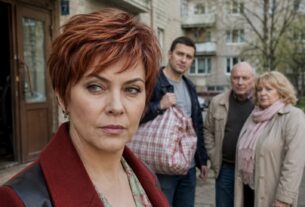
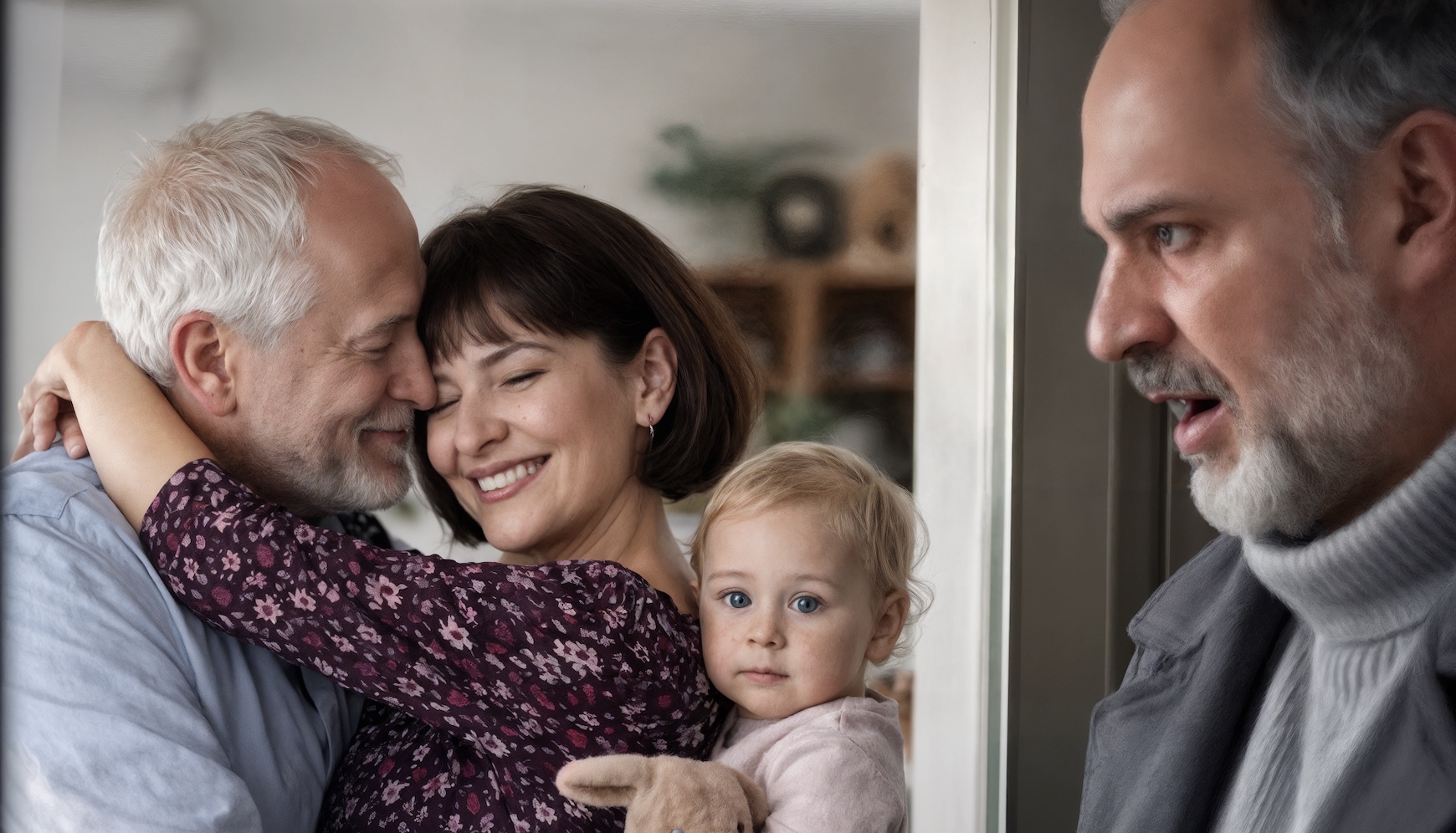
She opened the door. Her former husband stood there with a bouquet of roses and a guilty expression. Yuri looked older, thinner, with noticeable gray at his temples.
“Hi,” he said quietly. “Can I come in?”
“Come in,” she replied calmly, as if he hadn’t vanished from her life for an entire year.
Yuri stepped into the living room—and stopped dead. The space had changed beyond recognition. Paintings covered the walls—her paintings. Easels stood in corners. Art books and sketchpads lay on the table. The scent of oil paint made the room feel alive with creativity.
“This… what is all this?” he asked, disoriented.
“My studio,” Valentina said, setting her brushes aside. “Do you want tea?”
“Valya… who painted these?” Yuri walked up to one of the canvases.
“I did.”
“You?” He stared at her as if she’d said she’d learned to fly. “Seriously?”
“What’s so shocking about it?” she said lightly. “Turns out I have ability. Who would’ve guessed?”
A faint edge of irony rang in her voice. Yuri caught it and looked even more uneasy.
“Valya, I came to talk to you. Really talk.”
“I’m listening,” she said, sitting in an armchair and crossing her legs. The movement was graceful, confident.
“I… Sveta and I split up. Two months ago.”
“I’m sorry to hear that,” Valentina replied, without much feeling.
“Valya, you have to understand… I was an idiot. A complete idiot!” Yuri began pacing the room. “That girl—she only wanted money from me. Restaurants, gifts, trips. And the moment she realized I wasn’t some rich tycoon, she found herself another sponsor.”
“And what do you want me to say?” Valentina asked. “That I warned you?”
“No! I mean—yes, you were right, but… Valya, I want to come home. To you. We lived thirty years together. That has to mean something!”
Valentina stayed quiet, studying him. Strange—this man who had once felt like her entire world now looked small, almost pitiful. Had she really been in love with him?
“Valya, say something,” he pleaded.
“What should I say, Yura? That I forgive you? That I’m happy to see you?”
“Well… yes. I understand you’re hurt, but we’re adults. People make mistakes. The important thing is I realized mine and I came back.”
“How noble of you,” she said dryly.
Only then did Yuri fully hear the sarcasm.
“Valya… are you angry with me?”
“No, Yura. I’m not angry. I’m indifferent.”
The words landed like a verdict. Yuri sank onto the couch.
“Indifferent? How can you be indifferent? We’re family. We have children—grandkids someday…”
“We had children,” Valentina corrected softly. “And our family ended a year ago, the moment you picked up that suitcase.”
“But I’m telling you—I was wrong! I came back!”
Valentina stood and walked to the window. Outside, young grass was pushing through, lilac bushes were starting to bloom. Spring. Renewal. A new life.
“You know, Yura,” she said without turning, “a year ago I would’ve given anything in the world to hear you say that. I would’ve forgiven you on my knees if it meant you’d stay. But now…”
“Now what?”
“Now I have my own life,” Valentina said. “A job I enjoy. A passion that inspires me. Friends who respect me. And I’m okay. I’m truly okay, do you understand?”
Yuri stared, confused and speechless.
“And with you, I wasn’t okay,” she continued. “I just didn’t realize it then. I was a servant in my own home. Cooking, washing, cleaning—then waiting in the evenings for the ‘master’ of the house to notice me.”
“Valya, that’s not true…”
“It is true,” she snapped, turning to face him. “When was the last time you cared about my thoughts? My dreams? When did we ever talk about anything besides your job, the kids, or household problems—just talk, like people?”
Yuri opened his mouth, but no words came out.
“Exactly,” Valentina said with a thin smile. “You can’t even remember. And do you know what I understood this year? I don’t need a man who only sees a function in me. A cook. A cleaner. A warm body beside him.”
“But I love you,” he insisted.
“Love me?” She laughed. “Yura, you don’t even know who I am. You’ve been living with a ghost—with the convenient picture of an obedient little wife. But I’m right here. The real me. An artist. An independent woman who can earn money and make her own decisions.”
Yuri got up and hesitantly stepped closer.
“Valya… we could start over. I changed, you changed… maybe it could be different now.”
Valentina shook her head.
“Here’s the truth,” she said quietly. “You didn’t come because you missed me. You came because you don’t have anyone to live with. That’s not the same thing.”
“That’s not true! I realized what I did, I realized what I lost…”
“What you lost?” Her voice hardened. “A housekeeper? A live-in cook?” Valentina’s eyes narrowed. “Yura, you didn’t even ask how I lived this year. How I managed without your money. How I handled the loneliness. You just showed up and announced you want to come back—like I’m some museum exhibit that’s been waiting patiently for your return.”
Yuri tried to respond, but at that moment her phone rang.
“Hello, Valentina Mikhailovna?” Boris Petrovich’s cheerful voice came through. “How’s the exhibition preparation going? You haven’t forgotten the opening is tomorrow evening?”
“Of course I haven’t forgotten,” Valentina smiled. “I’m nervous, to be honest.”
“You don’t need to be! Your work is wonderful. By the way, the journalist from City News confirmed she’ll come. She might even write a little feature about our talented artist.”
“Thank you, Boris Petrovich. See you tomorrow.”
She ended the call and turned back to Yuri. He was staring at her, baffled.
“What exhibition?” he asked.
“My solo exhibition,” Valentina replied. “The opening is tomorrow in the school auditorium. Twenty of my pieces from the last six months will be displayed.”
“Your pieces?” He looked as if his brain couldn’t process it. “Seriously?”
“What did you expect?” Valentina laughed. “That I spent the whole year sitting and aching for you? Yura, I’ve done so much. I learned to paint. I lost eight kilos. I learned to use a computer. I made new friends. I have commissions, plans. In a month I’m going with a group of artists on a plein-air trip to Crimea. And in the fall I’m thinking about taking interior design courses.”
Yuri stayed silent, absorbing it all.
“And do you know what’s the most surprising part?” she added. “I’m happy. Truly happy. Maybe for the first time in my life.”
“And what about me?” he asked softly.
“What about you?” Valentina replied. “You’re a grown man. You’ll take care of yourself. You managed to live with your mistress for a whole year, didn’t you?”
“Valya… you can’t be this cruel.”
“Cruel?” She lifted an eyebrow. “Yura, cruelty is abandoning your wife after thirty years for a young lover. I’m simply telling you the truth: my life has changed.”
Her phone rang again—this time it was Alyona.
“Mom, how are you? Ready for tomorrow’s exhibition?”
“I’m ready, sweetheart. Are you coming?”
“Of course! I’m so proud of you! Can you imagine—I tell everyone my mom became an artist at fifty-eight!”
“Thank you, love. By the way, I have a guest. Dad came by.”
“Dad?” Alyona’s voice shifted. “Why?”
“He wants to come back.”
“And what did you say?”
Valentina glanced at Yuri, who was listening tensely.
“I haven’t answered yet. I’m thinking.”
“Mom, it’s your decision. But remember—you’re not the same anymore. You’re strong. Independent. Don’t let anyone drag you back into the past.”
When the call ended, silence filled the room. Yuri sat with his head lowered.
“Even the kids are against me,” he muttered.
“They’re not against you,” Valentina said calmly. “They just see that I’ve changed for the better.”
“So… it’s final?”
Valentina sat down beside him.
“Yura, understand this: I’m not punishing you. I’m not even hurt anymore. I’m simply different. And I don’t want the life we had. I don’t want to become your shadow again.”
“What if I change too?”
“That would take years,” she said gently. “And I don’t want to spend my time on experiments. I have my own road now, and I’m walking it.”
Yuri stood up and straightened his shoulders.
“Well… I guess I earned this,” he said with a sad smile. “You’re probably right. I really didn’t know who you were.”
“There you go,” Valentina replied. “Now you do.”
“Can I… can I come tomorrow to your exhibition?”
Valentina paused.
“You can,” she said. “But only as a visitor. Nothing more.”
When the door closed behind Yuri, Valentina returned to her painting. The spring garden still needed a few final strokes. She picked up her brush and smiled. Tomorrow would be special—her first solo exhibition. A new chapter in a life she had built herself, with her own hands.
And a year later, when the journalist wrote an article titled “The Artist Who Bloomed at Fifty-Eight,” Valentina would feel grateful for that March day when a mug shattered and her old life ended—because sometimes a loss becomes the most precious gift of all.