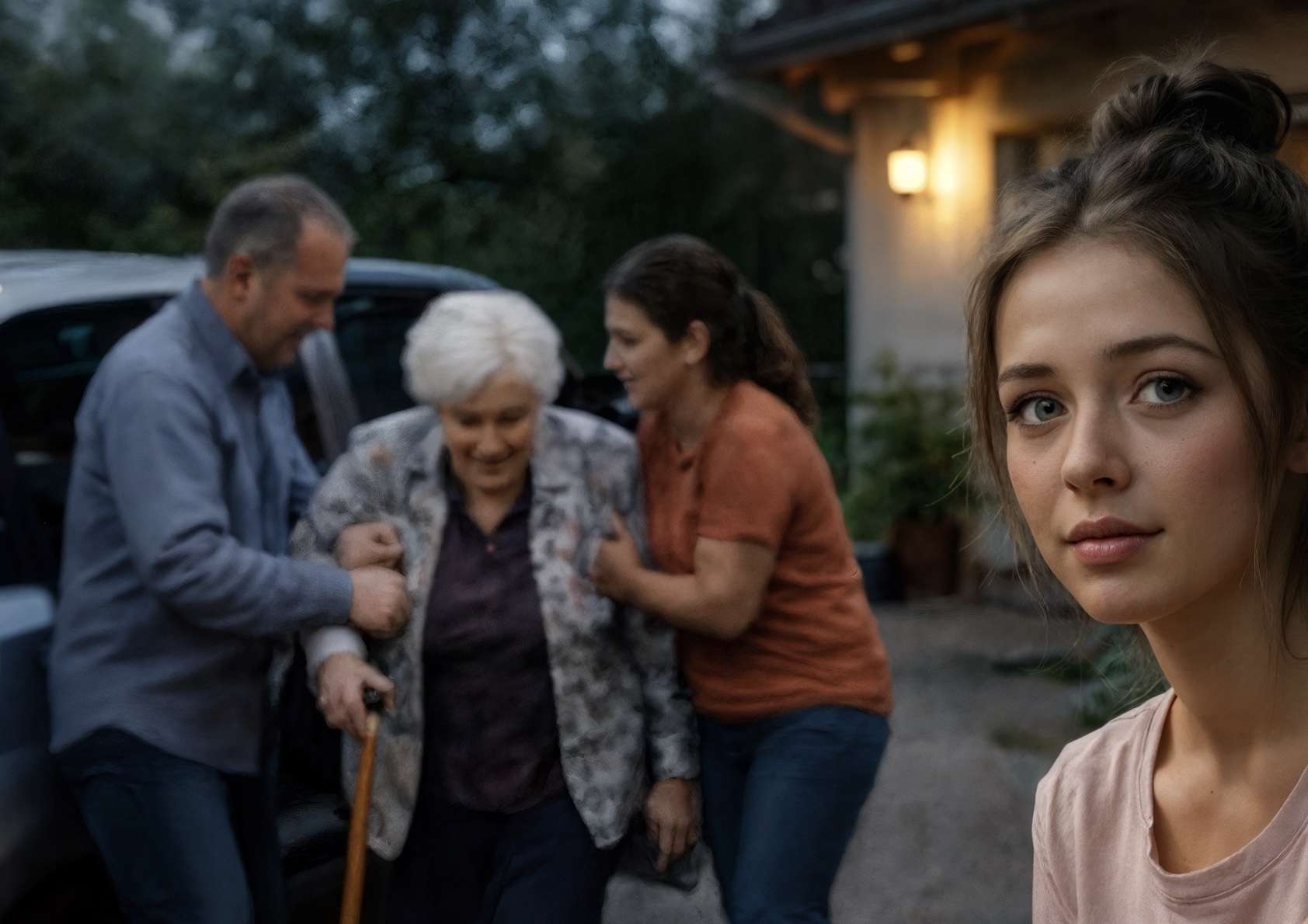
“DAUGHTER, TOMORROW—BE READY FOR GRANDMA”
The phone rang on Sunday evening, just as Sveta was pulling on her warm reindeer pajamas and anticipating tea and a few quiet chapters of her book. The screen said “Dad.” She blinked in surprise. They usually called on Saturdays in the afternoon—always the same routine: a formal five minutes about “health, weather, everything’s fine.”
“Dad… what’s going on?”
She heard her father’s breathing before he answered.
“Sveta, hello. Tomorrow, clear your schedule. Be home by lunch. We’re bringing my mother to you.” He paused, like he was checking whether she’d understood. “Your grandma, I mean.”
Sveta’s mind jumped to one thought: a visit? But Grandma Anna Petrovna hadn’t really gotten out of bed for the last two years after her stroke. Speaking was hard for her. Why would they drag her three hundred kilometers just to “come over”?
“You’re bringing her… for good?” Sveta asked, barely believing she was saying it out loud.
“For good. There’s nowhere else for her, Sveta.”
“Hold on. How is there nowhere? She has her own three-room apartment in the city center, a dacha… She lives with you, but it’s still her property. And my brother—Kolya—he’s in the same city!”
Then another voice broke in—sharp, piercing, unmistakably her mother. Her mother always put calls on speaker, as if she needed to supervise the conversation.
“Sveta, don’t turn this into drama. Grandma left the apartment and the dacha to your brother. It’s official. The papers were signed a month ago. And your brother,” her mother’s tone turned sugary and cruel, “is renovating that apartment right now—making it ‘European-style,’ you know. Dust everywhere, workers in and out. He’s got a young family and a small child. They’ve moved in with us for now. And the bedridden old woman goes to you.”
Sveta felt as if the ground slipped out from under her. She lowered herself onto the edge of the bed.
“So… you’re saying Grandma gave everything to Kolya, and the job of taking care of her goes to me?” she forced out.
“Well, you’ve always been the caring one,” her mother continued, completely unbothered. “And you’re alone—no family. You have your own place, a one-room apartment. It’s small, sure, but there’s enough space for you and Grandma. Kolya needs support now more than ever—his own home. He’s a man, he carries the family name. And Grandma decided it herself. Maybe she thinks you deserve attention more than some… piece of property.”
“Some piece of property…” Sveta repeated, stunned. “Mom, do you even hear yourself?”
“Sveta, that’s enough!” her father snapped, apparently taking the phone back. “It’s decided. We’re already on the road—we’re sleeping overnight somewhere. Tomorrow we’ll be there by two. Get a couch or a bed ready. That’s it. Be ready.”
Click. The line went dead.
Sveta sat there with the phone clenched in her hand, staring at the wall. Her mouth literally fell open from the mix of shock, disbelief, and raw humiliation. Memories from childhood and adolescence flickered through her mind.
Grandma Anna Petrovna—strong, strict, smelling of pies and lavender. The center of the family, the unquestioned matriarch. Sveta, the eldest grandchild, spent every summer at Grandma’s dacha. Together they weeded the garden, made jam, and Grandma taught her cross-stitch while telling endless stories about the war and her youth. Grandma would always say, “Sveta, you’re my golden girl. Patient. Kind.”
Kolya, five years younger, was the spoiled favorite. He showed up at the dacha in short bursts, broke things, complained he was bored, and hurried back to his friends. Grandma would shake her head: “What can you do with a boy… modern times.” Yet there was always a special indulgence in her voice when it came to him—the “carrier of the family name.”
Then came school, work, and Sveta’s move to another city. Sveta called Grandma every week, visited on holidays, brought medicine, warm blankets, and good tea. Kolya barely called, but on Grandma’s birthday he always gave showy, expensive gifts—a pricey phone she didn’t know how to use, a spa certificate she never used. Grandma would show the gifts to the neighbors: “My grandson doesn’t forget me!”
And now this: She left everything to my brother.
Why would Grandma do that to her? The question slammed around in Sveta’s head like a bird trapped against glass. What had she done wrong? Loved less? Cared the wrong way? Or was it not really Grandma at all… but her parents?
Sveta knew how her mother idolized Kolya, how she always dropped the same comments: “It’s easier for you—you’re a girl,” “Kolya needs help—he’s a man, it’s harder for him,” “An apartment matters more for Kolya—he’ll have a family.” Maybe that chant had seeped into Anna Petrovna’s mind over the years. Or maybe her parents had “helped” Grandma sign those papers when she was weak after the stroke. The thought was ugly, but Sveta couldn’t push it away.
She cried—cried from the hurt she felt toward Grandma, from powerless rage at her parents and brother, and from fear of what was coming. Tomorrow, someone else’s decisions would crash into her quiet, orderly life—along with Grandma’s helpless body. Her life would be over. She would become a caregiver. With no right to expect gratitude, because “Kolya got the apartment.” They had chosen her because she was reliable. Because she was convenient. Because she was the easiest to use.
The next day, around three, the doorbell rang. On the landing stood her father, her mother… and a small hunched figure in a wheelchair, which they had struggled to squeeze into the narrow elevator.
Anna Petrovna.
She looked even smaller and more defenseless than Sveta remembered. The eyes that had once been so sharp and alive were now cloudy and frightened. She recognized Sveta; her lips trembled, trying to form a smile, but it came out as a weak, pitiful grimace.
“There,” her mother said, unloading bags filled with medications and adult diapers. “Set her up. We’ll write everything down for you—the pills, the meals, the schedule. Here.” She shoved a sheet toward Sveta. “We have to hurry. It’s a long drive back, and Kolya needs help at the renovation.”
They stayed less than an hour. They kissed Grandma’s forehead, gave Sveta a dry, quick hug. Her father avoided Sveta’s eyes. Her mother pressed an envelope into Sveta’s hand. “This is for the first expenses.”
And then they left—as if they’d dropped off unwanted luggage at a storage facility.
A heavy silence settled over the apartment, broken only by Anna Petrovna’s harsh, labored breathing. Sveta stepped closer to the wheelchair. She wanted to scream, “Why?!”—but then she saw a tear slide slowly down the old woman’s wrinkled cheek, and the scream stuck in her throat.
Life split into “before” and “after.”
Days turned into an endless loop: morning care routines, porridge, medication, changing sheets, a short roll outside to the bench in the courtyard, lunch, reading aloud, television, dinner, waking up at night. Sveta left her job and switched to remote work, taking a huge pay cut. Her personal life—which had never been rich to begin with—fell apart completely.
Sometimes Kolya called: “How’s it going? You managing? Thanks, sis—you’re a hero. Oh, sorry, the crew is calling!” And he’d hang up, upbeat and busy.
Anna Petrovna hardly spoke. She mostly watched.
Her gaze often rested on Sveta—when Sveta, exhausted, fell asleep in a chair with a book in her lap, or when she washed the floors, or when she made pureed soup. In that stare there was pain, shame, and something else Sveta couldn’t read.
Then one late-autumn day, with cold rain pouring outside, everything worsened. Grandma developed a fever; her breathing turned wheezy and broken. The ambulance crew arrived and spoke grimly:
“Double pneumonia. In her condition… be prepared.”
They took her to the hospital.
In intensive care, where the air smelled of antiseptic and death, Sveta stayed for days and nights. Her parents called once a day. Kolya showed up once for ten minutes, said, “Hang in there,” and disappeared again.
And then, in one of those endless nights—monitors softly beeping, Grandma seeming half absent already—Sveta laid her head against the edge of the bed and whispered through tears:
“Grandma… I’m so tired. And it hurts so much. Why did you love him more? Why did you do this to me?”
She wasn’t expecting an answer.
But then she felt a faint movement.
Grandma opened her eyes—clear eyes. The same sharp eyes Sveta remembered from childhood. With immense effort, Anna Petrovna shifted her hand. Sveta took it—cold and light as an autumn leaf.
Grandma’s lips moved. Sveta leaned close.
“Not… I…” Grandma breathed out, and tears ran from her eyes. “Couldn’t… do otherwise… They… would take… everything… and you… they’d throw you out… You… kind… He… will take… but… won’t give… even… to you…”
She went still again, exhausted. Sveta froze, trying to assemble the fragments:
Couldn’t otherwise… They would take… He will take, but won’t give…
And suddenly, like lightning, it made sense.
Grandma hadn’t favored Kolya—she had feared him. Feared his greed, and the way Sveta’s parents enabled him. She knew that if she left the inheritance to Sveta, Kolya and Sveta’s parents would destroy her life—drive her out, contest the will, tear apart the apartment, the dacha, and Sveta herself.
But this way…
They got what they wanted. They were full, satisfied, not looking for more. And Grandma—Grandma got a quiet corner, care, and peace with the person she truly loved. At the cost of a brutal injustice and deep emotional pain for the very person she was trying to protect.
It was a sacrifice—cruel, cynical, and heartbreaking. But perhaps it was the only plan Anna Petrovna, trapped in helplessness, could come up with to save someone… and to not be alone.
“Grandma…” Sveta whispered, pressing the old hand to her cheek. “I understand. I understand everything. Forgive me for not seeing it sooner.”
Anna Petrovna closed her eyes. An expression of enormous relief softened her face.
Two days later she was gone.
She died quietly in her sleep, holding Sveta’s hand.