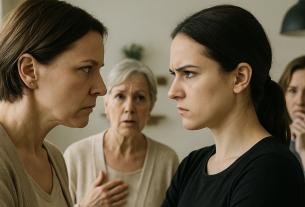
Karina slowly turned in front of the mirror, studying her reflection. The new suit fit perfectly—its clean, structured lines flattered her figure, and the deep emerald shade brought out the warmth in her face. She had saved for it for three months, setting money aside from every paycheck. As chief technologist at a confectionery plant, she earned a solid salary, and for the first time in a long while she could finally afford well-made, decent things.
“Wasting money again?” Viktor’s voice came from the bedroom doorway.
Karina turned. Her husband stood in the frame, leaning against it, looking her over with open disapproval.
“It’s my money, Vitya. I earned it,” she answered calmly, smoothing the collar of her jacket.
“Our money,” Viktor corrected. “We’re a family—forgot? And family helps each other.”
“And what exactly does that mean?” Karina frowned, already anticipating where this was headed.
“Mom called. She saw you at the shopping center yesterday when you bought that suit. She says you could’ve helped her instead—her refrigerator is acting up, and her washing machine is barely holding on…”
“Your mother gets a pension and tutors on the side. She has money for appliances,” Karina said evenly, though irritation was starting to boil inside her.
“She does NOT have money!” Viktor raised his voice. “She’s a lonely woman, she raised me alone, and now she needs our support!”
“Viktor, I’m not against helping. But your mother doesn’t want help—she wants full sponsorship. Last week she ‘needed’ money for medicine—I gave it. The week before that—groceries. I paid for that too. But buying her appliances when I saved for three months for a work suit…”
“A work suit?” Viktor scoffed. “Who do you think you are? Technologists wear lab coats!”
Karina felt her cheeks burn with humiliation. She drew a deep breath, forcing herself to stay composed.
“I go to meetings with suppliers. I meet partners. I need to look professional.”
“Professional,” Viktor mocked. “Mom’s right—you’ve gotten… full of yourself. Forgot where you came from.”
“What do you mean?”
“I mean if it weren’t for me, you’d still be stuck in that cramped communal apartment with your parents. I pulled you out, gave you a normal life, and you…”
“STOP.” Karina lifted her hand sharply. “Let’s refresh your memory. My parents bought this apartment. Mine. They sold their dacha and poured every last ruble into this place so their daughter would have a home. And what did your precious mommy contribute? Remind me.”
Viktor’s face reddened, but he stubbornly clenched his jaw.
“She gave me a upbringing. An education…”
“To you. Not to me. And that still isn’t an answer.”
“Oh, go to hell!” Viktor spat, and stormed out, slamming the door.
A week passed after that fight. Viktor made a show of not speaking to his wife, and Karina pretended she didn’t notice his silence. She came home from work, cooked dinner, did the chores—everything as usual, just without unnecessary words.
On Friday evening, Karina was scrolling through used-car listings on her tablet. After her promotion and raise, she could finally afford a car. Not a brand-new one, of course, but a respectable foreign make with low mileage.
“What’s that?” Viktor leaned over her shoulder.
“I’m choosing a car.”
“A car?” He whistled. “Since when do you have money for a car?”
“Since I work and save. I’ve put together the down payment. I’ll finance the rest through the dealership.”
Viktor stared at the screen while Karina flipped through photos of a silver Mazda.
“One hundred and fifty thousand for the down payment,” he read out loud. “You actually have that kind of cash?”
“I do.”
“And you want to spend it on a car?”
“What’s wrong with that? I’m tired of spending two hours getting to work in a packed bus. With a car, it’ll be forty minutes at most.”
Viktor sat down across from her and interlocked his fingers.
“Karina, let’s talk seriously. Mom really does have problems. She needs eye surgery—her cataract is progressing. The surgery costs about one hundred and forty thousand.”
Karina looked up from the tablet.
“Your mother has insurance. She can get it done for free.”
“The waiting list is two years! She could go blind by then!”
“Don’t dramatize. Cataracts don’t move that fast.”
“How would you know? Are you a doctor?” Viktor started to work himself up. “My mother needs help and all you think about is your wants!”
“My wants?” Karina set the tablet aside. “I work twelve-hour days! I have the right to spend what I earn the way I decide!”
“Selfish! You only think about yourself!”
“And you?” Karina’s voice sharpened. “What have you done for my parents in all the years we’ve been married? They put three million into our apartment, and you’ve never even bought my mom flowers for her birthday. Not once.”
“Your parents don’t need anything!”
“And does yours?” Karina shot back. “She has a three-room place downtown she could rent out. But she prefers living large and begging us for money!”
“DON’T you dare talk about my mother like that!” Viktor shouted.
“And DON’T you dare tell me what to do with my money!” Karina shouted back.
Viktor jumped up, knocking over his chair.
“You know what? Live however you want! But when my mother goes blind, that’ll be on your conscience!”
He disappeared into the bedroom, slamming the door. Karina stayed at the kitchen table, staring into the darkening window. She felt awful. She didn’t want to fight—but she wasn’t going to give in again. How much longer was she supposed to swallow this?
Her mother-in-law’s birthday was getting closer. Elena Petrovna was celebrating her sixty-fifth in grand style—a restaurant booked, a long list of relatives and friends invited. Over the last two weeks Karina and Viktor had barely spoken, trading only the essentials.
“What are we getting Mom?” Viktor asked the day before the party.
“I’ll buy her a spa gift certificate,” Karina answered without looking up from the stove. “She likes those treatments.”
“A certificate?” Viktor grimaced. “Maybe something more substantial? A TV, for example?”
“I don’t have money for a TV. I’m buying the car next week.”
“So you really decided?” His voice carried barely restrained anger.
“Yes. I arranged it with the seller. We’re signing the papers on Tuesday.”
Viktor said nothing, but Karina could see his jaw tighten.
On the day of the celebration, Karina wore her new emerald suit and only simple jewelry. She looked composed and stylish. Elena Petrovna greeted them at the restaurant entrance.
“Oh, Karinochka, a new outfit!” her voice dripped with barely disguised sarcasm. “That little suit must’ve cost you a fortune, right?”
“Good evening, Elena Petrovna. Happy birthday,” Karina said, handing her a gift envelope.
Her mother-in-law took it without thanking her and immediately turned to her son.
“Vitenka, come on in—sit by me!”
There were around thirty people at the table: Viktor’s relatives, Elena Petrovna’s friends, a couple of neighbors. Karina was seated at the far end, well away from the birthday woman.
The evening flowed on—toast after toast, congratulations, laughter. Elena Petrovna accepted gifts and compliments graciously. But when the main course arrived, she suddenly let out a loud sigh.
“Oh, forgive me for such a modest table. Of course I’d have loved to make it richer, but what can I do—I’m a pensioner, I have to save.”
“Oh, Elena Petrovna, everything is wonderful!” the guests protested.
“No, no, I can see it. At Nina Sergeyevna’s anniversary there were oysters, salmon, meat baked French-style… and here…” She sighed again. “Chicken and salads. I’m ashamed in front of you!”
“Mom, don’t…” Viktor tried to stop her.
“What—don’t tell the truth?” Elena Petrovna raised her voice so everyone could hear. “I lived my whole life for my son, gave him everything. And now in my old age I have to count every penny. I can’t even afford eye surgery—I’m slowly going blind. And my daughter-in-law…” She pointedly looked down the table to where Karina sat. “My daughter-in-law buys new suits and shops for cars. A one hundred and fifty thousand down payment, by the way!”
A heavy silence fell. Everyone turned to look at Karina.
“How shameless!” one of Elena Petrovna’s friends said loudly. “Your mother-in-law is going blind and she—”
“Yes, I heard she bought a suit for thirty thousand recently,” another woman chimed in.
“Young people these days have no conscience,” someone from the relatives added.
Karina felt anger surge up inside her like a wave. She looked at her mother-in-law’s smug face, at Viktor sitting with his eyes lowered, and realized: enough. ENOUGH.
Karina slowly stood. Every pair of eyes locked onto her.
“You know what, dear guests,” she began, her voice hard as steel. “Since Elena Petrovna decided to air private matters in public, let’s tell the whole truth.”
“Karina…” Viktor started, warning in his tone.
“QUIET!” Karina barked so sharply Viktor flinched. “You’ll be quiet and you’ll listen! I’ve had enough of your lies!”
She walked along the table and stopped in front of her mother-in-law.
“Elena Petrovna is going blind, you say? The surgery is one hundred forty thousand? Wonderful. Then why not sell one of the THREE apartments she owns? Yes—don’t look so surprised, dear guests. Our ‘poor pensioner’ has three apartments: this one where she lives, and two more one-bedroom flats she inherited from relatives!”
“That’s not true!” Elena Petrovna shrieked.
“It is true! And it’s all in the property registry—anyone can verify it! But Elena Petrovna prefers playing helpless and squeezing money out of her daughter-in-law—who, by the way, works twelve-hour days!”
“How dare you!” her mother-in-law leapt to her feet.
“Oh, I dare,” Karina planted her hands on the table. “Want to know how much I’ve given this ‘needy’ woman over the last year? Two hundred thousand rubles. Two hundred thousand! For medicine, groceries, repairs, clothes! And what did I get in return? Humiliation and lectures!”
“Vitya! Control your wife!” Elena Petrovna screeched.
“And Vitya won’t say a word,” Karina continued. “Because Vitya is a spineless rag who lets his mother bully his wife! Vitya, who in five years of marriage hasn’t given my parents a single kopek, even though he lives in an apartment they paid for!”
“It’s our apartment!” Viktor tried to object.
“No. It’s an apartment registered in my name, bought with my parents’ money. Three million rubles, if anyone’s curious. And your precious mommy didn’t put in a single ruble.”
The guests sat stunned. Some began glancing at each other.
“And that’s not all,” Karina couldn’t stop now. “Elena Petrovna gets a pension of twenty-five thousand, plus extra benefits as a labor veteran. Plus tutoring—at least thirty thousand more. Plus she rents out one apartment for thirty-five thousand. Ninety thousand a month, dear guests! And that’s your ‘poor pensioner’!”
“Throw her out, Vitya! THROW HER OUT!” her mother-in-law shrieked.
“To hell with both of you!” Karina shouted. “I’ll leave myself! But first—one last thing: starting tomorrow, forget about my money. Not a single kopek more! I’m buying a car because I earned it. I’ll spend my money the way I want. And if you don’t like it—go to hell!”
She grabbed her purse and headed for the door.
“Stop!” Viktor jumped up and rushed after her. “Karina, stop! You can’t just walk out!”
“Oh, I absolutely can.” She turned back. “And here’s the deal: you choose—me or your mother. Right now. Because I’m not living like this anymore!”
“You’re giving me ultimatums?”
“Yes. Exactly. An ultimatum. Either we live separately and your mother stays out of our marriage, or you pack your things and move in with her for good.”
“Karina, you’re going to regret what you’re saying…”
“I’ve said everything I needed to say. You have until morning.”
She walked out of the restaurant, leaving Viktor standing in the doorway, stunned.
Karina came home by taxi. The anger slowly drained away, replaced by a strange feeling of release. She had finally said out loud everything she’d been carrying for years. She changed into comfortable clothes, made herself tea, and sat by the window.
Her phone wouldn’t stop ringing—Viktor called every five minutes. Karina rejected every call. Then messages started coming:
“Karina, let’s talk.”
“You were wrong.”
“Mom’s hysterical.”
“Come back and apologize.”
“We’re family.”
She deleted the messages without reading them to the end.
Around midnight the front door slammed. Viktor walked in—rumpled, eyes red.
“Happy now?” he asked from the doorway. “You caused a scene in front of the whole restaurant! Mom cried all evening! People left early!”
“Good,” Karina didn’t even turn toward him. “Maybe now your mother will learn that lying and manipulating isn’t the best strategy.”
“She wasn’t lying! She really has health problems!”
“Viktor.” Karina finally looked at him. “Your mother has money for ten surgeries. She just prefers hoarding it and begging from everyone else. That’s her choice. But I’m done being part of it.”
“So you choose money over family?”
“I choose myself—my dignity, and my right to decide what happens to what I earn. And what do you choose?”
Viktor stood in silence, staring at the floor.
“I can’t abandon my mother…”
“No one is asking you to abandon her. Then live with her—not with me.”
“Karina, think! We’ve been together five years!”
“Five years I swallowed your mother’s humiliation and your silence. Enough!”
“If I leave, I’m not coming back.”
“Then don’t.”
He stood there a moment longer, then went into the bedroom. Karina heard him packing, muttering under his breath. An hour later he came out with a large bag.
“You’ll regret this,” he said at the door.
“Just go,” she waved him off.
The door slammed. Karina was alone. Strangely, she didn’t feel sad—she felt light. Finally she could live her own life, without a greedy mother-in-law and a husband who refused to stand up for her.
Three months passed. Karina bought her Mazda, and every morning she happily slid behind the wheel. Work was going brilliantly—she was promoted to deputy director of production. The divorce from Viktor went quickly. There was nothing to divide: the apartment was registered in Karina’s name.
One evening, the doorbell rang. Viktor stood on the threshold—gaunt, in wrinkled clothes.
“Can I come in?” he asked quietly.
“Why?” Karina blocked the doorway.
“To talk… Mom… she’s in the hospital.”
“And?”
“A stroke. The doctors say it’s from stress. She’s partially paralyzed now—she needs constant care.”
“I’m sorry, but that’s not my problem.”
“Karina, I… I was wrong. Mom really lied about the apartments. I found out when I started filing documents for the hospital. She has almost two million in her accounts.”
“And what now?”
“Maybe we could start over. I understand my mistakes…”
“No.” Karina laughed. “You didn’t come because you understood. You came because you need a free caregiver for your mother. Get out.”
“Karina, please!”
“Go to hell. And let your mother enjoy her millions alone—she can hire ten nurses with that money.”
She shut the door in his face.
Through the window Karina watched Viktor trudge toward an old Zhiguli—apparently the best he could afford. And Karina climbed into her silver Mazda and drove to her parents’ house for dinner. They had always supported her and never demanded a thing—though now she helped them regularly, by choice.
Elena Petrovna remained partially paralyzed. Her apartments had to be sold to pay for caregivers and treatment. Viktor took a second job, trying to stay afloat. And Karina lived her own life—free and happy. She had learned the most important thing: no one has the right to dictate how she spends what she earns. Not a husband, not a mother-in-law—no one.
Sometimes she ran into mutual acquaintances who said Viktor complained about life and cursed his ex-wife. Karina didn’t care. She bought not only a car, but also a small cottage outside the city, where she spent weekends with her parents. Life finally belonged to her.
And Elena Petrovna, confined to a wheelchair, could do nothing now but watch her savings melt away into medical bills. Greed and manipulation had turned against her. She wanted other people’s money—and in the end she lost her health and her hoarded fortune.
Viktor still lives with his mother, torn between jobs. He never remarried—what woman would agree to endure what Karina endured? And Karina recently met an interesting man named Pavel, the owner of a small bakery. They share similar work and common interests. And most importantly—Pavel doesn’t have a greedy mother demanding money.
In the end, life put everything in its place. The people who tried to feed off someone else’s labor got what they deserved. And the woman who wasn’t afraid to fight back and protect her right to her own life finally gained freedom and happiness.