“Where’s the money we’ve been saving for the New Year’s table?” Olga asked, peering into the tin tea can that sat on the very top shelf of the kitchen cabinet.
She rose onto her toes and stretched her arm as far as it would go, but her fingers met only the cold metal bottom. Her heart skipped. There were just two days left until New Year’s. That can had held thirty thousand rubles—money she and her husband had painstakingly put aside over the last two months, tucking away a little from every paycheck and advance. It was supposed to cover groceries, gifts for each other, and a small bit of fun during the holiday break.
Andrey, sitting at the kitchen table and mindlessly scrolling the news on his phone, didn’t even lift his head. He only shrugged, as if brushing off an annoying fly.
“Andrey, I’m asking you,” Olga’s voice sharpened. “The tin is empty. Where is the money?”
Only then did her husband finally tear his eyes away from the screen. He looked at her with the expression of a schoolboy caught with a cigarette—an uneasy blend of guilt, defiance, and a desperate wish to change the subject.
“Olya, why are you starting?” he grimaced. “I took it. Mom needed it.”
Olga lowered herself into the chair opposite him, slowly, as if her legs had turned to cotton. Her head buzzed like an empty seashell.
“Your mom?” she echoed quietly. “And what happened to Antonina Pavlovna this time? A leaky roof? A broken TV? Or did she urgently need massage therapy for her beloved cat?”
“Don’t get smart,” Andrey snapped, locking his phone and placing it face-down on the table. “She has a problem. A real one. Her washing machine died. Completely. A repairman came, took one look, and said it’d be cheaper to buy a new one than fix that ancient thing. And how is she supposed to manage without a machine? She’s sixty-five, Olya! Are you suggesting she rinse bed sheets by hand in the bathtub? Her back hurts.”
Olga took a deep breath and let it out slowly, trying to steady the tremor in her hands.
“Andrey,” she began, forcing calm into her voice, “your mother is sixty-five, not helpless. And her machine was fine—an Indesit. We bought it ourselves five years ago. But even if it broke… why now? Two days before the holiday? And why did you have to give her all our savings?”
“Because there are discounts right now!” Andrey threw his hands up like he was explaining something obvious to a stubborn child. “Pre–New Year sales. We found a great one—dryer function, tons of programs. Mom’s been dreaming of a machine like that forever. She can’t save up on a pension. What was I supposed to say to my own mother—‘No, Mom, wash by hand, Olya and I want to eat caviar’?”
“Caviar?” Olga gave a short, humorless laugh. “Andrey, that money wasn’t ‘caviar.’ It was everything—meat, vegetables, drinks, gifts. We planned to invite people. Your friends, by the way. Sergey and his wife. Kostik. What are we supposed to feed them?”
Andrey waved her off and stood, heading toward the kettle.
“Oh, stop being dramatic. You’re the хозяйка—you always have something tucked away. Pull out some pickles, we’ll boil potatoes. We’ll buy chicken—it’s cheap. You’ll figure something out. Chop some salads from whatever’s in the fridge. The main thing is the company, not the food. Don’t make a religion out of eating.”
“Buy chicken?” Olga stared at his broad back. “With what? I have fifteen hundred rubles in my wallet until my advance on January tenth. And I’m guessing you’re broke too, since you went digging in the tin.”
“Well…” Andrey hesitated. “We’ll borrow from someone. Or take it off the credit card. We’ll pay it back later. But Mom has a new machine now—she was so happy, Olya. You should’ve seen her. She baked pies right away, said she’d send some over.”
“Wonderful,” Olga said flatly. “Pies are just what you need when they’re replacing a holiday table.”
She got up and left the kitchen, refusing to continue this pointless conversation. Andrey didn’t understand. Or didn’t want to. To him, the family budget was some elastic, abstract thing you could dip into whenever his mother demanded it—and his wife would “manage” afterward.
In the bedroom, Olga sat on the bed and covered her face with her hands. She wanted to cry—not even because of the money, but because of the attitude. All December she’d planned the menu, searched recipes, made lists. She wanted a real celebration: beautiful and delicious, the house smelling like pine needles and roasted goose. And now…
“You’ll figure something out.” The phrase spun in her head, feeding a cold fury. How many times had she heard it? “Olya, Mom needs money for seedlings for the dacha—figure it out.” “Olya, I scratched the car, it needs paint—figure out where we can cut costs.” And Olga always did. She trimmed and patched and went without—no new makeup, no extra pair of tights.
But today, the cup finally overflowed.
That evening Andrey acted like nothing had happened. He watched TV, laughed at a comedy show. He was sure the issue was settled: his wife had grumbled, then calmed down. Now she’d wave her magic ladle and somehow the fridge would fill with food.
The next day, December thirtieth, Olga went to work. The office was buzzing with holiday chaos. Colleagues chatted about where they were shopping and traded recipes for herring under a fur coat and aspic.
“Olya, are you roasting goose with apples or oranges?” Sveta from accounting asked, stirring her tea.
“With air,” Olga replied darkly—then forced a smile. “We’re doing an experiment this year. Minimalism.”
After work she didn’t go to the hypermarket like she’d planned. She stopped at a tiny shop near home and bought a packet of the cheapest salt, a loaf of rye bread, and a tin of sprats. After a moment she added three potatoes. At the register she paid with loose coins she scraped from her pocket.
At home Andrey greeted her with a question:
“So, did you stock up? I called Mom—she said she’s coming tomorrow. Wants to celebrate New Year’s with us, sort of ‘christen’ the washing machine, you know.”
Olga froze in the hallway, still wearing her boots.
“Your mom is coming?” she repeated.
“Yeah. Why should she sit alone? She said she’ll come around nine, to see out the old year. Don’t worry, she’s not picky. She just wants attention.”
“Perfect,” Olga nodded. “Just perfect.”
Something clicked inside her. The final piece fell into place. So Mom was coming—this same Mom who had just received a thirty-thousand-ruble washing machine bought with Olga’s holiday savings. And of course she expected a loaded table. Because Olga would “figure it out.”
Olga took off her coat, went into the kitchen, and started cooking. She boiled three potatoes in their skins. She opened a jar of pickles she’d canned in summer (thank God—homemade, “free”). She sliced the rye bread into careful, neat thin pieces.
Then she pulled out the prettiest tablecloth—the ceremonial one. Snow-white with embroidered golden snowflakes. She’d saved it for special occasions. She set the table with their best china—plates with gold trim, crystal glasses, and silverware inherited from her grandmother.
In the center she placed a serving dish. On it lay three lonely boiled potatoes. Beside it, in a crystal bowl, three pickles sat miserably in little circles. On a small plate—slices of rye bread. And a tin of sprats. Unopened. A can opener lay next to it.
“That’s it,” Olga whispered, surveying her work. “Just like you ordered.”
On December thirty-first Andrey woke up late, stretching as he anticipated a pleasant day.
“Olyusya!” he called. “Is there breakfast?”
“In the fridge,” Olga answered from the bathroom.
Andrey found a pot of yesterday’s buckwheat.
“Why so modest?” he grumbled, but ate it anyway. “Are you cooking already? Smells… weird.”
“I’ve already cooked everything,” Olga said, coming out in her robe with a towel on her head. “The table is set. Don’t go into the living room—it’s a surprise. Let it all ‘settle’ until evening.”
Andrey rubbed his hands together.
“A surprise! I love surprises. You’re gold, you know that? I knew you’d manage.”
All day Olga took care of herself. A face mask, a manicure, hair styled. She put on her best dress—dark blue velvet. Andrey strutted around, clearly pleased.
“Stunning,” he said. “Mom will love it. By the way, she called—said she’s bringing a gift. Probably something for the house.”
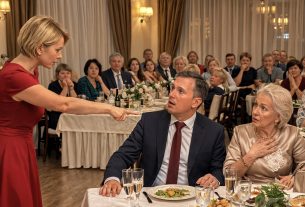
Closer to nine in the evening the doorbell rang. Antonina Pavlovna stood in the doorway, cheeks flushed from the cold, wearing a new mink hat (apparently the old washer hadn’t stopped her from buying expensive things). She carried a small bag.
“Happy almost-New Year, my dears!” she announced, sweeping into the apartment like an icebreaker. “What weather! Snow, frost! But it’s warm and cozy here. What’s that smell? Pine? And where are the smells of baking?”
“Everything’s on the table, Mom, everything!” Andrey said gallantly, helping her out of her coat. “Olya worked magic today—made a surprise.”
Olga stepped into the hallway and smiled politely.
“Hello, Antonina Pavlovna. Come in.”
“Hello, dear, hello. Let’s see how you live. Andrey says you’re planning renovations? Oh—and my washing machine is a miracle! So quiet. I pull laundry out almost dry. Thank you, kids—you made an old woman happy. Though of course you could’ve chosen a more expensive model—one had a steam function—but fine. Don’t look a gift horse in the mouth.”
Olga said nothing; she only pressed her lips tighter and walked them into the living room.
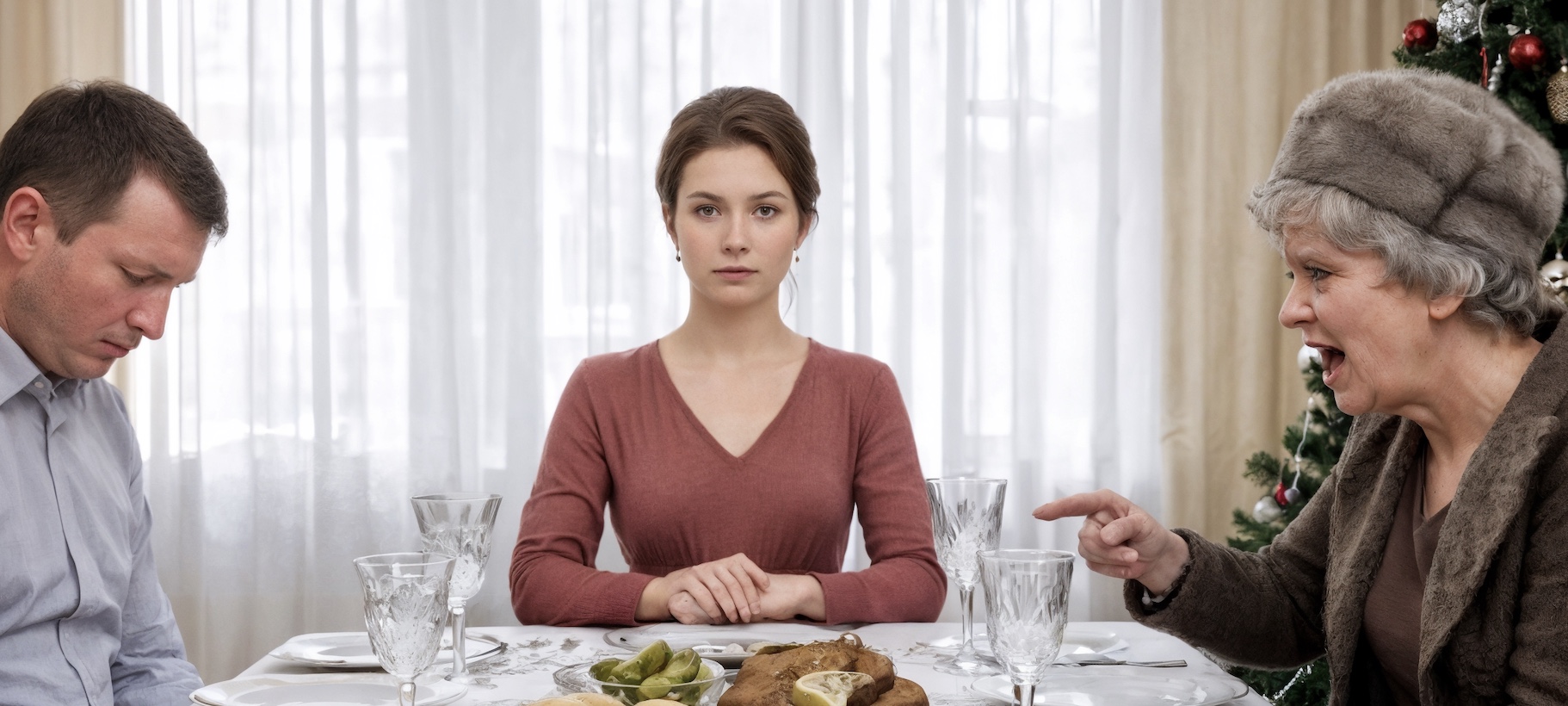
In the center stood the table: elegant tablecloth, glittering crystal, polished silver. And against all that splendor—three potatoes, pickles, and bread.
Antonina Pavlovna stopped dead in the doorway. Andrey, following behind, bumped into her back.
“Olya?” Andrey’s voice shook. “This… what is this?”
“This is a holiday dinner,” Olga replied calmly as she walked to her seat and sat with graceful composure. “Please, sit. Salads, hot dishes, delicacies—everything is here.”
Her mother-in-law stared from the potatoes to Olga, then to her son.
“This is a joke, right?” she asked with a nervous little giggle. “A prank? You’ll bring out the goose any second?”
“Unfortunately, no,” Olga said, unfolding a starched napkin onto her lap. “There is no goose. No Olivier salad. No caviar. You see, Antonina Pavlovna, our New Year’s table budget was exactly thirty thousand rubles. Two days ago that money magically transformed into your new washing machine. The quiet one.”
The room fell silent. The only sound was the wall clock, ticking away the last hours of the year.
“But…” Andrey blinked, lost. “You said… you said you’d figure something out!”
“And I did,” Olga nodded. “I figured out I won’t go into debt. I figured out I won’t take a high-interest loan for one night. I figured out I’d set the table with the money we actually have left. And we have exactly one hundred and fifty rubles. So here it is. Potatoes and bread, the pickles are homemade. Oh—and sprats. Andrey, please open the tin. The opener is right there.”
Antonina Pavlovna’s face began to blotch red.
“This… this is rude!” she shrieked. “Are you saying I ate you out of house and home? That it’s my fault? A son gave his mother a gift from the heart! And you’re shaming me over a piece of bread?”
“I’m not shaming you,” Olga’s voice stayed even and cold as ice. “I’m stating a fact. Andrey gave you the money we saved for the holiday. He made a choice. He chose your comfort over our celebration. I respect his choice. But miracles don’t exist, Antonina Pavlovna. Money doesn’t appear out of thin air. If it leaves one place, it disappears from another.”
“Andrey!” his mother spun to him. “Are you going to let her talk to me like that? We came to celebrate, I got ready, I did my hair! And she’s shoving jacket potatoes at us!”
Andrey looked from his mother to his wife. He was red as a lobster—ashamed, offended, and frightened all at once. He knew Olga was right, but admitting it in front of his mother was more than he could handle.
“Olya, come on… this is too much,” he muttered. “You could’ve at least bought a chicken…”
“With what money, Andrey?” Olga snapped, turning to him. “The bus fare to get to work? Should I walk for a month? Skip lunch? I already save on everything. And you make a grand gesture with everything we have—then demand a banquet? No, my dear. If you want to be a generous son, do it on your own dime. Earn more. Get a side job. Don’t take the last thing your family has.”
“Family?!” Antonina Pavlovna threw up her hands. “What family? Family means supporting each other! Sharing the last shirt off your back! And you… you’re selfish! I knew you weren’t right for my son. Stingy, petty!”
“Fine,” Olga stood up. “If I’m so terrible, I won’t ruin your evening with my presence. Eat the potatoes—they’re fluffy. Sprats are fine too. Happy New Year.”
She left the room, went into the bedroom, and locked the door. Her heart hammered. With shaking hands she pulled a chocolate bar and a small bottle of sparkling wine from the nightstand—bought with her own “pocket” money.
In the living room the argument raged. She heard her mother-in-law’s shrill voice:
“Let’s go! I won’t set foot here again! We’ll go to Aunt Lena—she’s poor but at least she won’t let people starve! And this one…”
“Mom, wait…” Andrey mumbled. “Where are we going at ten at night? Mom, calm down…”
“No! I won’t tolerate this! Are you a man or a rag? She humiliated you! Humiliated me! A washing machine, you see, she’s sorry for it! I’ll return that machine—yes, I will! Let her wash in it herself!”
The front door slammed. Silence followed.
Olga opened the sparkling wine. The cork popped softly into her palm. She poured the drink into a regular mug and took a bite of chocolate.
Ten minutes later, someone knocked on the bedroom door.
“Olya…” Andrey’s voice was dull. “Olya, open up. They left.”
Olga stayed silent.
“Olya, enough. I get it. I’m an idiot. Please open the door. I’m hungry.”
Olga got up, turned the lock, and opened. Andrey stood there with slumped shoulders, looking pitiful.
“Did your mom leave?” Olga asked.
“She did. Took a taxi. Screamed all the way to the elevator. Said she’ll send movers tomorrow and return the washing machine.”
“Don’t return it,” Olga sighed. “It’s not about the machine, Andrey.”
“I know,” he said, entering and sitting on the edge of the bed. “It’s about me. I just… I got used to you always fixing everything. Like money always somehow appears. I didn’t think. I swear.”
“Think next time,” Olga sat down beside him. “Because next time might not happen. I’m tired of being the one who ‘figures it out.’ I want to be the one someone takes care of, too.”
“I’m sorry,” he took her hand. “So… was it really only potatoes?”
“Really,” Olga smirked. “But if you dig in the freezer, you might find a bag of dumplings. Emergency stash for a black day.”
Andrey looked hopeful.
“Dumplings? Seriously? Olya, I adore you. Let’s boil them. I’ve been on buckwheat since morning.”
They went into the kitchen. The “holiday table,” with crystal and jacket potatoes, looked surreal—like a piece of modern art. Andrey scooped the potatoes into one plate.
“And later we can fry them with butter and onions,” he said, suddenly very practical. “That’s a meal too.”
While the water came to a boil, Andrey stepped behind Olga and wrapped his arms around her.
“I promise,” he whispered into her hair. “With my next paycheck we start saving again. And not a penny to anyone. And I’ll buy the groceries myself. Honestly.”
“We’ll see,” Olga answered—without anger now.
They greeted the New Year to the chime of midnight, eating dumplings with sour cream at a lavishly set table. They never opened the sprats—saved them for Christmas. Andrey found a bottle of vodka in the bar (the one thing he hadn’t managed to give away or drink earlier). Olga finished her little champagne.
It was the strangest, quietest, and maybe the most honest New Year they’d ever had.
Antonina Pavlovna, of course, never returned the washing machine. But she stopped calling—she was offended. And for Olga, those two weeks of silence became the best gift anyone could’ve given her. She finally rested.
A month later Andrey really did come home with a full bag of groceries—good fish, cheese, fruit.
“This is for us,” he said, unloading everything onto the table. “And I bought Mom a cake. A small one. I stopped by and wished her happy belated holidays.”
Olga smiled. Looks like the lesson with the potatoes had landed. Harshly, with a fight—but sometimes an empty plate speaks louder than any words.
Thanks for reading to the end! If you enjoyed this story, leave a like and subscribe so you don’t miss new real-life stories.