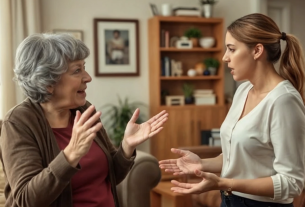
Anya placed a large platter of roast chicken on the table. The skin was golden, and the air smelled of garlic and herbs. Svetlana Markovna, her mother-in-law, immediately gave an approving little snort.
“Now that’s what I call a proper homemaker! The smell fills the whole apartment! Not like our Marina—hers is always either burnt porridge or store-bought dumplings.”
The praise was loud, but Anya heard the false note in it. It was a prelude to a conversation.
She sat down, glancing at her husband. Sergey was avoiding her—pouring his mother a glass of cherry compote, laughing loudly at her jokes. He already knew where this was going. He wasn’t just a witness to what was coming—he was an accomplice.
“So, how’s Marina?” Anya asked, to speed up the inevitable.
Svetlana Markovna immediately set down her fork. The main act of the performance began.
“Oh, Anyechka, don’t even ask! My heart bleeds… that little room of hers—tiny, in an old building, mold has started in the corner, and the landlord won’t even hear of repairs. The kitchen is scary to step into—neighbors there drink from morning till night, smoke hanging like fog. And Vitya, her boy, is coughing all the time from the damp; she’s afraid to leave him alone even for a minute. She called yesterday, crying, saying, ‘Mom, I’m sitting here like in prison, I don’t see the light of day.’ She got divorced, silly thing, thought she’d manage on her own…”
She went on and on, painting “poor Marina’s hard fate” in the smallest, heart-wrenching details. Anya didn’t doubt it was true—she genuinely felt sorry for Marina and her son. But she also knew this story wasn’t a plea for sympathy.
Finally the monologue reached its climax. Svetlana Markovna dabbed her dry eyes with a napkin, looked at her son, and then at Anya.
“We need to decide something, Seryozhenka. You can’t leave a person like this. Anyechka has her apartment—left from her grandmother—almost empty, and you rent it out for pennies. If only you could exchange it for two little studio flats… Marina would get a corner, and Anya would still have one, and everyone keeps something.”
Sergey immediately put down his fork and looked at Anya seriously, as if delivering a speech he’d rehearsed.
“Mom’s right, Anya. My sister needs help—it’s our family duty. We can’t just watch her suffer. We have to exchange your apartment.”
He said “we have to,” talking about her personal, pre-marital apartment—the one she grew up in. And somehow no one suggested selling Sergey’s car, or Svetlana Markovna’s dacha.
But Anya didn’t explode. She took a small sip of water. She gave herself a few seconds to steady her breathing, and when she spoke, her voice was calm.
“Alright.”
Sergey and Svetlana Markovna exchanged surprised looks. They expected an argument—tears, accusations. Anya looked at them with a polite smile.
“This is a serious financial step. And since we’re talking about family duty and fairness, let’s handle it like adults. For everything to be honest, we need a full, independent valuation of all our joint and personal assets: your car, Sergey; this three-room apartment we live in, which is registered to your mother; my one-room apartment, of course; and my hobby too—since we’re counting all the family’s assets.”
The mention of her “hobby”—sewing designer clothing—made them both smile condescendingly. They considered it cute, but completely useless.
“Of course, dear, we’ll include your hobby too—your little rags. We’ll count everything, right down to the last thread.”
They were sure they’d won an easy victory. They didn’t understand Anya hadn’t lost—she’d simply changed tactics.
All the next week her husband and mother-in-law were in high spirits. The energy that used to go into complaining and persuasion now found a “constructive” outlet. In their minds, they’d already exchanged the apartment, bought two studios, and were even choosing furniture for Marina. Svetlana Markovna called several times a day, loudly announcing yet another “gorgeous option in Biryulyovo.” Sergey, feeling like a man in charge, walked around the apartment with the air of a responsible, generous decision-maker.
“I called a realtor—he says we can sell your apartment really profitably right now, the market’s rising,” he told Anya on Tuesday evening.
Anya nodded silently without looking up from her work.
“You could at least listen. This is serious business, not your little rags. You’ll show the appraiser your dresses too?” he smirked. “Maybe they’re worth a couple thousand—just enough to cover the notary’s fee.”
She didn’t argue. She prepared.
The next day, eager to speed things up and show off his business savvy, Sergey called an appraiser himself.
A middle-aged man arrived, quickly walked through their three-room apartment, glanced at the documents. Then they went to Anya’s apartment—same procedure. He only gave Anya’s workshop, which took up part of the living room, a cursory look.
“So, what’ve we got here…” He swept his gaze over shelves of fabric and mannequins. “A Janome sewing machine, an overlock… well, maybe twenty thousand for everything if you get lucky selling it on Avito.”
Sergey and Svetlana Markovna—who’d come specifically to “control the process”—shared a triumphant look. Everything was going according to plan.
That evening Sergey placed a sheet with numbers—written in the appraiser’s hand—on the table in front of Anya.
“Well, see? Everything’s counted: the apartments, the car—transparent. Now we can start the exchange.”
He expected the game to be over.
“That was your expert,” Anya said calmly, sliding the paper aside. “He valued what he understands. Now mine will come.”
They reacted with indignation.
“Why?” Svetlana Markovna protested. “Why waste extra money on those loafers? What else can he value? The walls won’t get thicker!”
“He’ll value my work—since we agreed to value all assets.”
Sergey sighed.
“Anya, don’t be a child. We all understand. Want me to just give you money for your… fabrics? So you don’t feel slighted.”
“I don’t want you to ‘just give me money.’ I want a full, objective valuation—like we agreed. My specialist will come Friday at three.”
On Friday, the doorbell rang. On the threshold stood Valentin—an elegant man in his fifties. He stepped inside, and the entryway filled with expensive cologne and confidence.
Sergey and Svetlana Markovna met him warily.
Valentin greeted them politely. To their immense disappointment, he only gave their “valuable” 1990s furniture set, old TV, and wall carpet a brief, disdainful glance.
“Standard furnishings, economy segment, ninety percent depreciation,” he murmured into his phone’s диктофон.
Then he walked to the part of the room where Anya’s workshop was set up.
“Anyechka, dear—is this from the new capsule?” he asked with professional excitement, touching the sleeve of a silk dress on the mannequin. “What hardware! That’s vintage, isn’t it? French buttons, 1930s? Where did you find them?”
“At a flea market in Lyon—I sent you photos.”
“I remember, I remember. Do you have sales analytics for last quarter? I want to see the dynamics and the reach metrics from your professional socials over the last six months.”
Sergey and Svetlana Markovna stood silently in the doorway. To them it sounded like Chinese. Analytics? Metrics? They saw only a woman sewing dresses at home.
Valentin examined Anya’s sketches laid out on the table with reverence, photographed shelves where bolts of fabric lay in neat rows.
“Is this Japanese silk?” he asked, carefully touching one roll. “And this—Italian wool?”
“Yes, I order directly from suppliers.”
“The quality is incredible. Alright—let’s go through the contracts. Did the boutique in Milan renew? And what about the Parisians?”
They talked about things completely incomprehensible to her relatives. Svetlana Markovna tried to regain control and decided to butt in.
“Back in our day we sewed from calico and it was still beautiful! And now paying that kind of money for rags…”
Valentin slowly turned his head to her, measuring her with a look that contained not a drop of rudeness—only cold, polite bewilderment—then turned back to Anya as if nothing had happened.
“So—what about the Parisians?”
Sergey tried to wedge himself into the conversation.
“And you… pay taxes on this?” he asked, thinking he sounded clever.
Valentin looked at him.
“Of course. Anna is registered as an individual entrepreneur and works under the simplified tax system; all reporting is perfectly in order. Anya, please show Sergey your most recent declaration.”
Silently, Anya took a document from a folder and handed it to her husband. He looked at the numbers, at the tax office stamp. He was seeing only the tip of the iceberg—and even that was far bigger than he’d ever imagined.
The confidence on his face and his mother’s slowly shifted into complete bewilderment, which gradually grew into an unconscious fear. They’d come to appraise “little rags” and ended up in an audit of a serious, operating business they hadn’t even known existed.
Valentin’s official conclusion arrived three days later. It was a report printed on thick paper and fastened into a folder. Anya signed for it with the courier and put it on a shelf without opening it—she didn’t show it to her husband right away. Instead, that evening she said, in the same tone she’d picked up from Valentin:
“I received the final report. I suggest we hold a family meeting on Saturday at eleven a.m. and discuss the financial results of our audit. I invited your mother too—she’ll find it interesting.”
That formal tone threw Sergey off. He was used to emotional fights, offense, concessions. This felt like an office—where he wasn’t the head of the family, but a junior manager being called onto the carpet.
“Why all these complications? Just show me.”
“No. This is serious—it concerns our family’s future. Let’s discuss it together, calmly, with the documents in hand.”
On Saturday at exactly eleven they sat at the kitchen table, the atmosphere tense. Svetlana Markovna arrived early, ready for battle.
Anya came out of the room holding the folder, placed it on the table, and sat opposite them.
“So that we have a full and objective picture, I combined the data from both assessments into one final document. According to the expert commission’s conclusion, we’ll start with real estate and movable property.”
She paused briefly, watching their tight faces.
“The market value of the three-room apartment where we live, at 5 Stroiteley Street, is six million three hundred thousand rubles.”
Svetlana Markovna nodded with satisfaction. It was a good number.
“The market value of the 2014 Ford Focus, considering mileage and condition—seven hundred fifty thousand rubles.”
Sergey nodded too. This part was clear and familiar.
“The market value of my apartment at 12 Prospekt Mira is four million one hundred thousand rubles.”
They exchanged looks again. Their plan was close. They could already see that amount being split, exchanged, turning into keys to a studio for Marina.
“And now we move on to the assets you asked to value additionally: the conclusion on intangible assets and intellectual property connected to my professional activity.”
She paused again, savoring the effect.
“The value of the ‘AnnaV’ brand, calculated based on analysis of the client base, frequency of mentions in specialized European publications, and recognition in professional circles, is… one million eight hundred thousand rubles.”
Svetlana Markovna’s face began to lengthen. Sergey frowned, trying to understand what these numbers even meant.
“What nonsense is this? What brand? That’s just your last name!”
“A brand, Sergey, is reputation. The value of the finished handmade ‘Spring–Summer’ collection consisting of twenty-four items, based on current contracts with partner boutiques—two million four hundred thousand rubles.”
“What contracts? What boutiques?” Sergey muttered, lost.
Anya ignored him and moved to the final, most important point.
“The appraised value of the portfolio of sketches, proprietary patterns, and unique technological developments over the last five years—intellectual property—is three million seven hundred thousand rubles.”
She looked up from the document.
“The total market value of the business asset called ‘AnnaV,’ which belongs to me, is… seven million nine hundred thousand rubles.”
She closed the folder. Silence hung in the room. Svetlana Markovna stared from Anya to her son with her mouth open—her world, where her daughter-in-law was a modest housewife with a useless hobby, had just crumbled to dust.
“So when are we dividing things fairly, Sergey? We can sell my apartment and your car—that’s four million eight hundred fifty thousand. Or we can sell my business—then it’s almost eight million, much more profitable. Enough not only for a studio for Marina, but for a good one-bedroom too.”
Slowly Sergey reached out and took the folder, opened it. His eyes slid over graphs, tables, photographs of her dresses in glossy magazines he’d never read. He saw the official seal with ornate initials of the appraisal company and the final number. Then he looked up at his wife as if seeing her for the first time. Not just Anya—his wife who roasts chicken and sews at home “for fun”—but a stranger: successful, accomplished, financially independent. The myth that he was the provider and she was a modest accessory to his life collapsed.
The conversation about exchanging the apartment was never brought up again. Svetlana Markovna sat through the rest of the “family meeting” in silence, stone-faced, drank her now-cold compote, and left, claiming a headache.
That evening Sergey went into Anya’s workshop and stopped in the doorway. Anya sat at her desk, sketching in an album. He stood for a minute, then walked to the mannequin where the shimmering silk dress hung.
“I… I never understood. I thought you were just sewing for fun—like Mom grows flowers.”
In that short sentence there was more remorse than in a hundred grand apologies. It was an admission of his own blindness.
“I sew for the soul too,” Anya replied calmly, without looking up from her sketch.
And a week later Marina called. Anya braced herself for reproaches or icy silence—but heard an uncertain voice.
“Anya, hi… it’s Marina.”
“Hi.”
“I was thinking… your things are so beautiful… I looked online. Could you teach me? At least the simplest things—how to sew on a machine, make a straight stitch. I want… to do something of my own too. Not depend on anyone.”
A month passed. Anya and Marina sat in the workshop. Anya showed her how to work with flowing silk—how it slips and how you have to “feel” it with your fingers. Sergey came into the room, set two cups of tea and a plate of cookies on the table.
“Girls, want me to help with the website? I can build a good online store—with payment processing, a gallery, so you can show the work properly.”
The conflict didn’t just end—it became the starting point for something new