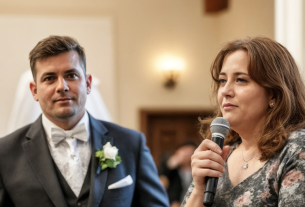
“You’re not a wife — you’re a burden! Move out tomorrow!” Igor declared.
And there it was. It had always hung in the air like dusty, nasty smog, but hearing it out loud—well, you know, it’s like getting slapped. A sharp one. In the cold.
Natasha stood in the middle of their living room—the living room where, three years ago, she’d glued up that stupid wallpaper, where she’d scrubbed tile for hours so Tamara Petrovna, her mother-in-law, wouldn’t find a single speck of dust. She was holding a plate of dinner. Dinner she’d cooked while Igor, her husband, decided she was nothing more than extra luggage that needed tossing off the platform.
“Say that again, please,” Natasha’s voice was quiet, almost inaudible. That’s how it goes when your inner world collapses: silence on the outside, catastrophe on the inside.
Igor—this three-year-old child in the suit of a thirty-year-old man—puffed himself up importantly like a turkey. He didn’t even look her in the eyes, just prodded his steak—cooked by her—with his fork.
“What’s there to repeat?” he mumbled. “Mom decided. We talked. The apartment, you see, is needed for him. My brother’s getting married. And you… you’ll manage somewhere for now.”
Manage somewhere. As if she were an old pair of skis on the balcony—no big loss to toss out.
“This apartment is ours, Igor. We’ve lived here for three years!” At last Natasha felt her cheeks burn. Rage—pure, unfiltered—began forcing its way through the layers of hurt.
“Ours? Wake up, Natasha! It’s Mom’s!” Igor rolled his eyes theatrically, like he was talking to a stupid schoolgirl. “She sold her dacha to make the down payment. That’s her money. And you—what did you put in? You sat on maternity leave, then worked that penny job. A burden, I’m telling you. For me and for Mom.”
Hear that? A burden. She’d shelved her red diploma so she could first give him a son, then carry a household that turned out not to belong to her at all. And now—a burden.
Igor came over, took her plate, set it in the sink. He did it with such brisk carelessness, like he wasn’t breaking her life—just moving a vase.
“I already told Mom everything. She’s coming tomorrow—you’ll hand over the keys. And you know…” He paused. “…you need to move out. Tomorrow.”
Something like an internal hazard light clicked on inside Natasha. The fear disappeared; only a cold, burning resentment remained. And suddenly she remembered—by accident, absurdly. Five minutes before this conversation, she’d been digging through old papers looking for their son’s vaccination certificate and stumbled on that folder.
“Do you remember,” Natasha stepped back, away from his fake confidence, “when we took out that mortgage?”
“Yeah, I remember, so what?” Igor clearly didn’t like where this was going.
“Do you remember you had to fly off on an urgent business trip? And you asked me to go to the notary and sign the papers so we’d make it in time?”
He nodded, tense now.
“Well. Back then, to get better loan terms…” Natasha hesitated, pulling details back into focus—remembering what the manager had said. “To get ‘Young Family’ status and qualify for some program, you asked for me to be listed as the sole owner until you could re-register everything later. And the very first—the biggest—her payment, Tamara Petrovna’s down payment, was made when the documents named me as the first and only owner.”
Igor laughed. Loudly. Nervously.
“Are you out of your mind?! That was ages ago! What nonsense! That was Mom’s dacha! Mom’s money!”
“The money—yes. But the down payment was recorded as mine—because I had, remember, received a small but official inheritance from my grandmother? The bank begged to see at least some funds in my name. You put in your mother’s money, but it was оформлено as if it were mine. Temporarily. You said so yourself.”
Silence thickened in the air like concrete. Igor went white. Natasha, not knowing where the strength came from, pulled out a single sheet miraculously preserved—a copy of the first agreement with the bank.
She tossed it onto the table, right over the half-eaten steak.
“Check it. Title owner: Natalya Smirnova. Date of the down payment: after the registration.”
And then, like thunder out of a clear sky, her phone chimed with an incoming message. From her friend—a lawyer. Just a few words: “The transfer documents are at the notary’s—everything’s ready. Call me.”
Natasha looked at Igor. He was reading the paper; his lips moved, his eyes darted. Panic. Pure, unclouded panic. He had just kicked the “burden” out of his life—without knowing that an hour earlier that “burden” had legally re-registered the apartment in her own name…
“You’re the one moving out tomorrow, Igor,” Natasha whispered.
Morning came not with sunshine, but with the heavy, stifling smell of an approaching storm.
Natasha hadn’t slept. She sat in the kitchen drinking cold tea, staring at a stack of documents. No tears—just frozen determination. When bitterness hits boiling point, it stops being hot. It becomes steel.
Igor woke up late—rumpled, guilty, but still puffed-up. He was clearly expecting Natasha to fall at his feet, cry, and apologize for daring to contradict him.
“Well? Packed your things?” he spat instead of “good morning.” His voice grated like rusted iron.
“I’m packing,” Natasha nodded. “Yours.”
The doorbell rang. It was her. Tamara Petrovna, his mother. She walked in like a queen receiving petitions, dressed in her best coat, wearing a victorious smirk, already ready to savor the humiliation of the “burden daughter-in-law.”
“So, what do we have here?” Tamara Petrovna didn’t say hello—she went straight to business. She sized Natasha up with contempt. “I’ve come, so to speak, to collect the keys to my property. And don’t forget, girl—everything I ever gave you is mine. Spoons, forks, the tea set. I’m not your patron, you know.”
Igor, catching the scent of his mother’s authority, immediately clung to her like a puppy.
“Mom, I told her. She’s moving out this morning.”
“Good, son. Otherwise you’ll never get her out later.” The mother-in-law stepped up to Natasha and held out an empty hand. “The keys. And don’t let your foot—”
Natasha didn’t move. Slowly—very slowly—she placed the folder of documents in front of Tamara Petrovna. Across the folder, in big letters: CERTIFICATE OF OWNERSHIP. Smirnova N.I.
“You’re mistaken, Tamara Petrovna,” Natasha’s voice was ice. “This is my property.”
Her mother-in-law froze. Igor went even paler than the day before.
“W-what are you talking about?!” Tamara Petrovna snatched the folder, her fingers shaking as she hunted for the trick. “This is our apartment! My dacha sold for the down payment!”
“The dacha is yours, the money is yours,” Natasha nodded. “But on paper, to get those very favorable credit terms you value so much, Igor оформил the down payment as my contribution. And six months ago, while I was the sole title owner under the old agreement, I used my right and re-registered everything in my name—to protect myself from family fraud. My lawyer advised it.”
Tamara Petrovna choked. Her face turned the color of beet salad.
“Fraud?! I’ll— I’ll call the police! I’ll sue you!”
“Call them,” Natasha shrugged, feeling an indescribable freedom for the first time in her life. “But first, read this little document.”
She slid another sheet toward her. A contract. An interest-free loan agreement.
“Your down payment, Tamara Petrovna,” Natasha continued, “was оформлен by Igor as mine—I already said that. But six months ago I received my grandmother’s inheritance. And as a conscientious borrower”—Natasha emphasized every word—“I am returning that loan to you. With interest. Clean, legal money.”
Igor had tried to throw her out of an apartment bought with her own honestly acquired means. Here it was—the karmic boomerang.
“HERE’S YOUR MONEY!” Natasha flung a thick envelope onto the coffee table—stuffed with bundles of cash. Tamara Petrovna blinked, stunned. “Cash—so there can be no claims. Your dacha, your money. That’s it. Now you are nobody here. And I am the sole owner.”
Tamara Petrovna clutched her chest. Igor stood silent. He stared at the envelope, then at his mother, then at Natasha. He understood. He’d tried to evict a wife who had just become the legal owner of their home.
“And now, Igor,” Natasha looked at her husband, “I’m not a burden. I’m the owner. And you know what? You’re moving out. You. By three o’clock, so I can call a locksmith to change the locks.”
Tamara Petrovna didn’t call the police. Greed beat anger. She grabbed the envelope—her “loan”—and shot out of the apartment like a champagne cork. The slam of the door made the dishes ring.
Igor stayed. He stood in the living room where only yesterday he’d announced, with such self-importance, that she was a “burden.” He was pathetic—the humiliating sight of a mask slipping, revealing only emptiness and fear underneath.
“Natalya, listen—this is… this is a mistake! I didn’t know! Mom set me up!” he started whining, switching on his “poor son-victim” mode.
“A mistake, Igor?” Natasha went to the window. Down below in the parking lot stood the locksmith she’d called. “The mistake is that I married you. What’s happening now—you moving out—is justice.”
“Where am I supposed to go?!” His voice cracked into hysteria.
“To the same place Tamara Petrovna’s going tomorrow,” Natasha replied flatly. “I called your brother, Andrey. I told him everything—how you and your mother planned to toss me aside for his wedding. He didn’t appreciate your ‘nobility.’ You know what he said?” Natasha turned, her eyes flashing with cold fire. “He said: ‘Let Mom and Igor reap what they’ve sown. My marriage won’t start with a lie.’”
A blow. A second blow.
Andrey—the very person they were supposedly “freeing” the apartment for—refused their help. He saw it for what it was: not care, but nastiness. And there they were: Igor and his mother. Together. Homeless. Without allies. Because money and manipulation can’t buy human relationships.
At three o’clock Natasha stood in the doorway. Behind her—the locksmith. In front of her—Igor, dragging a travel bag. A small one, because she’d thrown most of his things into the hall so she wouldn’t waste time packing.
“I’ll come to see my son,” he whispered, staring at her new, unfamiliar eyes.
“We’ll see. Through the courts. And only when I decide,” Natasha answered. “I won’t be your burden anymore, Igor. But you? You’re not the хозяин here.”
She closed the door behind him. No screaming. No tears.
All the following week, their “shared” chat—no longer shared—flickered with messages about Igor and Tamara Petrovna looking for a place to live. Some distant relatives took them in, begrudgingly—where the mother-in-law couldn’t bark orders, and where Igor, deprived of his mother’s shield, turned into a perpetually irritated, broken man. Their relationship, built on power over Natasha, began to crumble, because the power was gone. Left alone with their spite and helplessness, they started eating each other alive.
And Natasha? She stood in the kitchen—her kitchen. Outside the window, snow fell softly. She watched the streetlights shimmer and held her sleeping son close.
For the first time in years, she felt not fear, but peace. She wasn’t enduring, serving, owing. She was living.
Natasha picked up her phone and texted the lawyer: “Thank you. Now I want to file for divorce and child support.”
She didn’t need to hide anymore. She didn’t need to earn approval anymore. She’d fought for her fortress.
Igor, who’d thrown her out with “Move out tomorrow!”, had no idea that the next day she would throw him out of her life—for good.