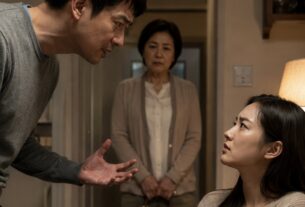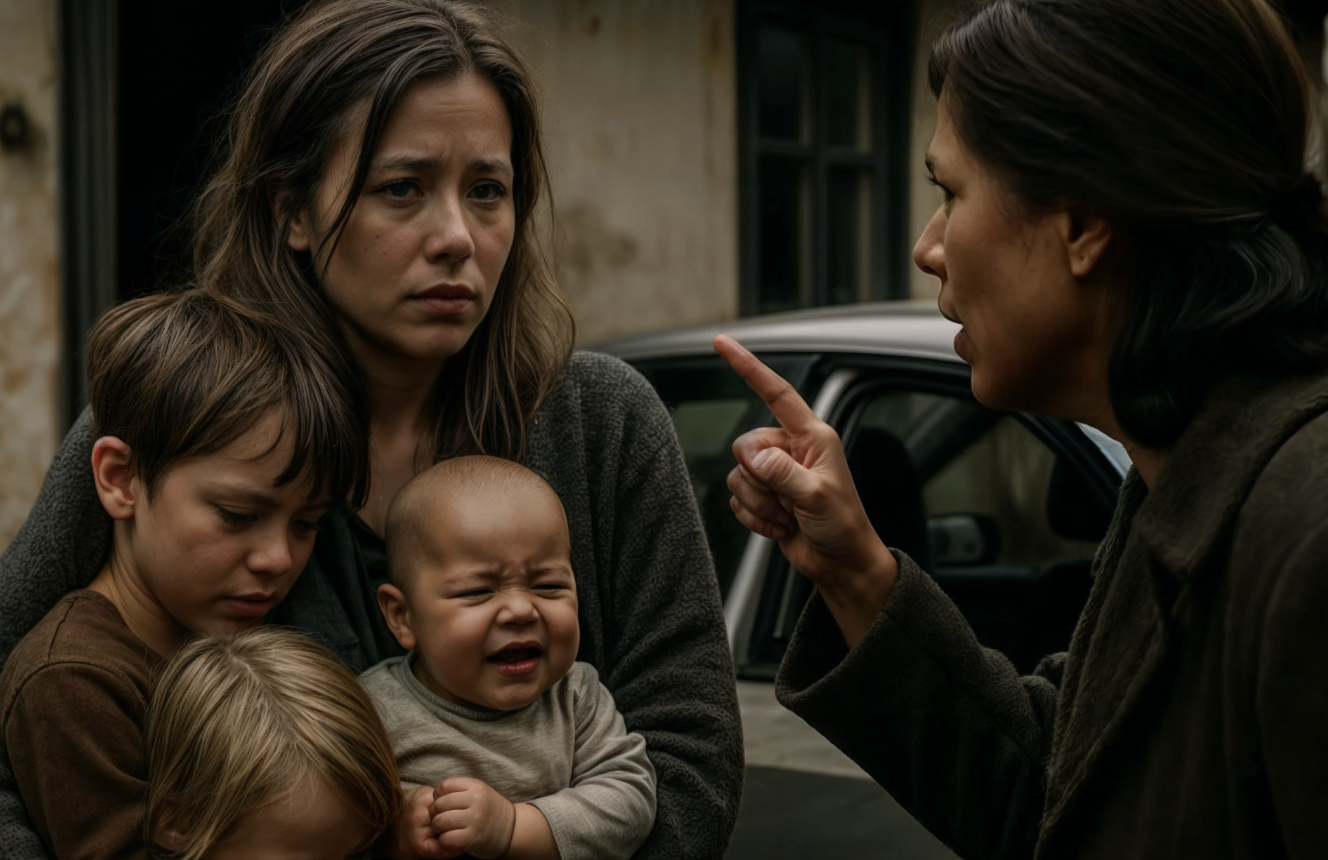
The words stabbed into Dasha like shards of glass. She stood by the living-room window, holding the younger one—little Kira wasn’t even a year old yet—while four-year-old Misha clung to her leg, sensing that something terrible was happening.
“Stay on your own with your litter!” her mother-in-law, Zinaida Petrovna, said as if she were spitting out something rotten. “And my son and I are leaving—and forget about the car too, you grey mouse!”
Her voice sliced through the room, where just yesterday it still smelled of baby soap and happiness. Yesterday… Yesterday, Dasha had woken up at five in the morning to her daughter’s crying, then got Misha ready for kindergarten, cooked porridge, ironed her husband’s shirt. An ordinary morning. And today Anton stood at the door with two bags, not even looking at her.
“Are you serious?” She didn’t recognize her own voice. “Anton, look at me!”
But he stared at the floor. His mother—dressed to the nines, in pearl earrings and wearing that particular smile Dasha had always called “the victory smile”—stepped forward.
“My son deserves better than this dreariness!” Zinaida Petrovna swept her hand around the room, and Dasha saw it through her eyes: wallpaper they hadn’t managed to replace, children’s toys everywhere, Dasha’s house robe stained with baby purée. “He’s a young man, his whole life is ahead of him! And you… you’ve turned into a housewife with a head that’s never washed.”
Anton picked up the bags. The car keys—their only car, a Lada bought on credit—he slipped into his pocket.
“Wait,” Dasha shifted Kira to her other arm; the baby began to whimper. “We can talk… I understand it’s hard for you, I know the last few months have been difficult, but the children…”
“The children, the children!” her mother-in-law cut in. “Always these children! And when are you going to think about a man? About his career? He became a shift supervisor at twenty-eight, and you’re dragging him down with your endless tantrums!”
The door slammed. Just like that—slam, and that was it. Ten years together, a wedding at the city registry office, two children, thousands of nights side by side—and the door closed, leaving the three of them in a rented two-bedroom on the outskirts of town.
Dasha sank onto the sofa. Kira cried louder. Misha pressed against her and whispered:
“Mom… will Dad come back?”
Would he? She didn’t know. She knew only one thing: there were three thousand rubles left on the card, rent was due in a week, and she hadn’t worked for two years—she’d stayed home with the kids, like they’d agreed. Anton had promised that after Kira turned three, Dasha would go back to accounting. Promised…
The next three days passed like fog. Anton didn’t answer his phone. Zinaida Petrovna rejected her calls. Dasha fed the children whatever was left in the fridge—pasta, porridge made with water. Misha kept asking about his dad, and she didn’t know what to say.
On the fourth day she wrapped Kira up warmer—October had turned vicious, with sharp wind—and pushed the stroller across the city to the center, to the factory where Anton worked. Misha trudged beside her in a jacket he’d already outgrown.
At the gate she waited two hours. Workers came out, smoking, glancing sideways at her—a disheveled woman with two kids, clearly out of place. Finally she saw him. Anton walked with a colleague, laughing at something, and that laugh stole Dasha’s breath.
“Anton!”
He turned, and his face went flat as stone.
“What are you doing here?”
“We need to talk. The kids need money—food…”
His colleague stepped aside but stayed close—curiosity won. Misha tugged at his father’s hand:
“Dad, let’s go home!”
Anton pulled his hand away.
“Dasha, I told you. We’re getting divorced. Mom thinks…”
“Mom thinks?!” Her voice cracked. “Is this your life—or hers?!”
“Don’t yell here!” he glanced at his colleague, and Dasha understood: he was ashamed. Not ashamed that he’d abandoned his family—ashamed of the scene.
He shoved five thousand into her hand—crumpled bills—turned around and walked away. Just walked away, without even looking at Kira in the stroller.
They rode back on the bus. Misha fell asleep on her lap, Kira snuffled in the stroller. Outside the window the city drifted by—alien, indifferent, with bright shop windows and happy people whose lives were normal. Dasha hugged her son tighter and thought: what now?
What does a woman do with two children, no job, no husband, no car—nothing?
A message arrived from an unknown number: “Your husband is with me. Stop calling and making scenes. Zinaida Petrovna.”
Dasha deleted it and stared out the window. Somewhere out there, in this city, there was an answer. There had to be.
The morning began with the hot water being shut off. Dasha boiled kettle after kettle and bathed the kids in a basin. Kira fussed; Misha stayed silent—his frightened child’s look broke her heart more than any words. As if he was afraid to speak, scared his mom might cry.
The five thousand melted away at a terrifying speed. Diapers, formula, bread. Dasha counted every kopek, setting some aside for rent, and realized: the money would last, at best, two weeks. And after that?
She pulled out her laptop—an old one, seven years at least—and started searching for vacancies. An accountant with a two-year gap… Everywhere demanded experience with new software she’d never even seen. She called companies, and they politely refused: “We’ll call you back.” No one called back.
On the sixth day she gathered her courage and went to the employment center. A grey building on Lenin Street greeted her with queues and the smell of bureaucratic hopelessness. Dasha stood in line for two hours with Kira in her arms—she’d left Misha at kindergarten; at least they fed him lunch there.
“Unemployment benefits will be fifteen thousand for the first three months,” the clerk said without looking up. “Bring your documents—work record book, certificate from your last workplace, passport…”
“I haven’t worked for two years. I’ve been at home with the children.”
“Then register, and in a month we’ll assign the payment.”
A month. So long.
That evening her mother called—from Novosibirsk, where she lived with her new husband.
“Dashenka… oh, honey…” Her voice was sympathetic but tired. “You know, Kolya had surgery, and his teeth—implants. So much money… I’d help, but right now I just can’t.”
She would, but she couldn’t. Dasha knew that song by heart. Her mother was always nearby—one phone call away—but at the crucial moment she always had reasons. New husband, new life, and her adult daughter’s problems didn’t fit into it.
“It’s okay, Mom. I’ll manage.”
I’ll manage. She repeated the words like a mantra as she put the kids to bed. Kira finally fell asleep, Misha lay with his face in the pillow, and Dasha sat in the kitchen with a cup of tea—the tea was running out, so she used one bag three times.
The phone buzzed. Unknown number.
“I saw your application on the job site. We need an office assistant—can you come in tomorrow? Ksenia.”
Dasha read the message three times. Office assistant… She didn’t even remember which vacancies she’d applied to—there had been dozens. But it was a chance.
In the morning she took the kids to her neighbor Lyudmila—an elderly woman next door who sometimes watched Kira.
“Three hours or so, okay? I have an interview.”
“Of course, dear. Just… do yourself up a bit. Comb your hair properly. Put on some lipstick.”
Dasha looked at herself in the mirror. When had she last worn makeup? When had she last looked at herself for more than a second? A thinner face, dark circles, hair twisted into a bun. Grey mouse—her mother-in-law had been right.
She dug out her only decent trousers and a blouse she’d worn to work three years earlier. The blouse hung loose—Dasha had lost eight kilos from stress. She put on makeup, fixed her hair, and another woman appeared in the mirror. Not the old Dasha yet—confident and smiling—but no longer the hunted one who’d been pacing the apartment these last days.
The address was in the business district—a glass building on the embankment, with guards and turnstiles. Dasha went up to the seventh floor and found the right office: “Vector Consulting Group.”
Ksenia turned out to be around forty, with a short haircut and a strict suit.
“Sit down. Do you have experience?”
“I worked as an accountant, but there was a two-year break…”
“Right. How many kids?”
Dasha tensed up. Usually the interview ended right there.
“Two. But I can—”
“I can too,” Ksenia interrupted. “I have three myself. I know how it is. Do you need a flexible schedule?”
Dasha nodded, not believing her ears.
“Good. The duties are simple: paperwork, meeting clients, coffee and tea, sorting mail. Hours are nine to six, but if a child gets sick you can work remotely. Salary thirty-five thousand, plus bonuses. Can you start the day after tomorrow?”
Thirty-five thousand. That was money. Real money you could live on.
“Yes,” Dasha breathed out. “Thank you.”
“No need. Bring your documents—we’ll sign the contract.”
Walking out of the office, Dasha felt something inside her thaw. For the first time in days she could breathe fully. Work. She would have work.
At the building’s exit she ran into Anton.
He was with a woman—young, in an expensive coat, hair styled at a salon. They were laughing, and the woman held his arm as naturally as if she’d always held it.
Time froze. Anton saw Dasha and his face twitched. The woman looked Dasha up and down—appraising—and asked him something. He gave a small shake of his head, and they walked past.
Past—as if she were nothing.
Dasha stood by the glass door and watched them go. So it wasn’t about the kids. Not about her exhaustion, not about her turning into a “housewife.” It was about another woman. All this time—another woman.
Her phone buzzed in her pocket. A voice message from Misha—Lyudmila had taught him how to use her phone:
“Mom, are you coming soon? Kira’s crying.”
Dasha wiped her eyes and headed for the bus stop. Soon, sweetheart. Mom’s coming.
And somewhere in that same city, Anton sat in a café with his new girlfriend, while his mother kept calling, demanding he come over—something had grabbed at her heart again. But he didn’t hurry. He had a different life now—pretty, without nightly baby cries and a perpetually tired wife. The life he deserved.
Only for some reason, emptiness scraped at him from the inside.
Four months passed.
Dasha worked from morning to night, picked the kids up from kindergarten, cooked dinners, put them to bed. On weekends she took Misha to the library—he’d fallen in love with dinosaur books—and Kira to the park, where she chased pigeons and laughed. Life was getting simpler. Not easier—simpler. Dasha learned not to think about Anton, not to wait for calls, not to hope.
Ksenia turned out to be more than a boss—she became almost a friend. She taught Dasha the new programs, sometimes invited her to lunch, listened when Dasha needed to talk.
“You know,” Ksenia said once over coffee, “my ex left too. For a twenty-five-year-old secretary. Thought life would suddenly become bright and new. And a year later he found me on social media, whining that she was milking him and the kids had turned away from him.”
“And what did you do?”
“Blocked him,” Ksenia smirked. “Why would I bring back something that left on its own?”
In February Dasha got a bonus—fifteen thousand. She bought Misha the construction set he’d been dreaming of for half a year, Kira a plush bear, and herself new boots. The first in three years. Standing in the shoe store mirror, she suddenly caught herself smiling. Just like that—no reason.
And meanwhile Anton’s life began to crumble.
That woman—Zhanna, as it turned out—really did drain his money. Restaurants, gifts, trips to the sea. Loan after loan. Zinaida Petrovna was thrilled at first: “Now that’s a woman! Not like your ex!” But when Zhanna asked him to buy her a car—not some Lada, but a proper foreign one—she started to grumble.
“Son, maybe she’s not your woman?”
“Mom, don’t start.”
But she did. Zinaida Petrovna couldn’t not start. She’d controlled her son all her life, and the thought that some “girl” had taken him from her was unbearable. Scandals, tears, accusations. Zhanna quickly realized that getting involved with a mama’s boy was a bad idea and left for a more promising man.
Anton was left alone. More precisely: with his mother, with half a million rubles in debt, and with the understanding that time can’t be turned back.
In March he wrote to Dasha: “Can we meet?”
She stared at the message for a long time. Before, her heart would have clenched—she would have run to him, forgiven everything. But now… she simply replied: “No.”
A week later another message came: “I need to see the kids.”
“Have you paid child support even once?”
He didn’t answer.
And in early April something happened that Dasha could never have imagined. A call from an unfamiliar number—a woman’s voice, worried:
“Is this Darya Sergeyevna? I’m calling from Hospital No. 7. Zinaida Petrovna Krylova has been admitted. She listed you as an emergency contact…”
“What? I’m not—”
“She’s had a stroke. Is Anton Viktorovich your husband? We can’t reach him—his phone isn’t answering.”
Dasha came to the hospital that evening after leaving the kids with Lyudmila. Zinaida Petrovna lay in intensive care—pale, with an IV, nothing like the domineering woman in pearl earrings.
“Where is Anton?” Dasha asked the duty nurse.
“We don’t know. A neighbor called the ambulance—said her son went somewhere.”
Somewhere. Of course. He had his own life now.
Dasha sat in the hospital corridor, drinking vending-machine coffee, thinking. This woman had destroyed her family, called her children “litter,” pushed her own son out of their lives… and now she lay alone because that son had simply vanished.
The doctor came out about two hours later.
“Are you a relative?”
“Ex-daughter-in-law.”
“I see. Her condition is stable, but she’ll need long rehabilitation. She’ll have trouble walking, and she’ll need constant care. Is there anyone?”
Dasha said nothing. Anton showed up only the next day—unshaven, red-eyed, in a wrinkled shirt. He saw Dasha in the corridor and stopped.
“You… how is she?”
“Ask the doctors.”
“Dasha, I didn’t know it was this… I was on a work trip, my phone died…”
“It doesn’t matter, Anton.”
She stood up and picked up her bag. He grabbed her wrist.
“Wait. I wanted to say… I’m sorry. For everything. I realized what I’ve done. Mom was right about you—but not in the way she thought. You’re strong. And I’m a weakling who…”
“Anton,” Dasha cut in softly. “Do you want me to feel sorry for you? Forgive you? Tell you it’s all okay?”
He was silent.
“I won’t. Because it wasn’t okay. You abandoned two children. You took the last car when I didn’t know how to feed them. You walked past me with another woman as if I were nothing.”
“I’ll pay child support, I swear…”
“You’ll pay it through the courts,” Dasha freed her hand. “And about your mother… hire a caregiver. I have my own family. Two children—the ones you called ‘litter.’”
She walked out into the April night. The city breathed spring—somewhere lilacs were blooming, somewhere young people were laughing by an entranceway. Dasha headed for the bus stop and suddenly laughed. Quietly, to herself.
Grey mouse—that’s what she was in her mother-in-law’s eyes. But mice are tough creatures. They survive where others don’t. They adapt, raise their young, build nests out of nothing.
At home, Misha and Kira were already asleep. Dasha kissed them both, brewed tea—real, good tea, not one bag used three times—and sat by the window. A message from Ksenia waited on her phone: “We need to talk. After work tomorrow, come by—I want to offer you the assistant manager position. With a raise.”
Dasha smiled and looked at her sleeping children. Her children. Her life. Grey, but honest. Simple, but real.
And somewhere in the hospital, Anton sat by his mother’s bed and, for the first time in many years, understood what it meant to be alone. Truly alone—when there is no wife who will forgive, no children who will run to you, no person who will always be there.
Only emptiness. And the bills for the loans.
Zinaida Petrovna came to around morning. She saw her son and whispered:
“Where… is Dasha?”
“Mom, she’s not here.”
“Call her… I was wrong…”
But there was no one to call. The grey mouse had gone to build her own nest—and she had no intention of coming back.