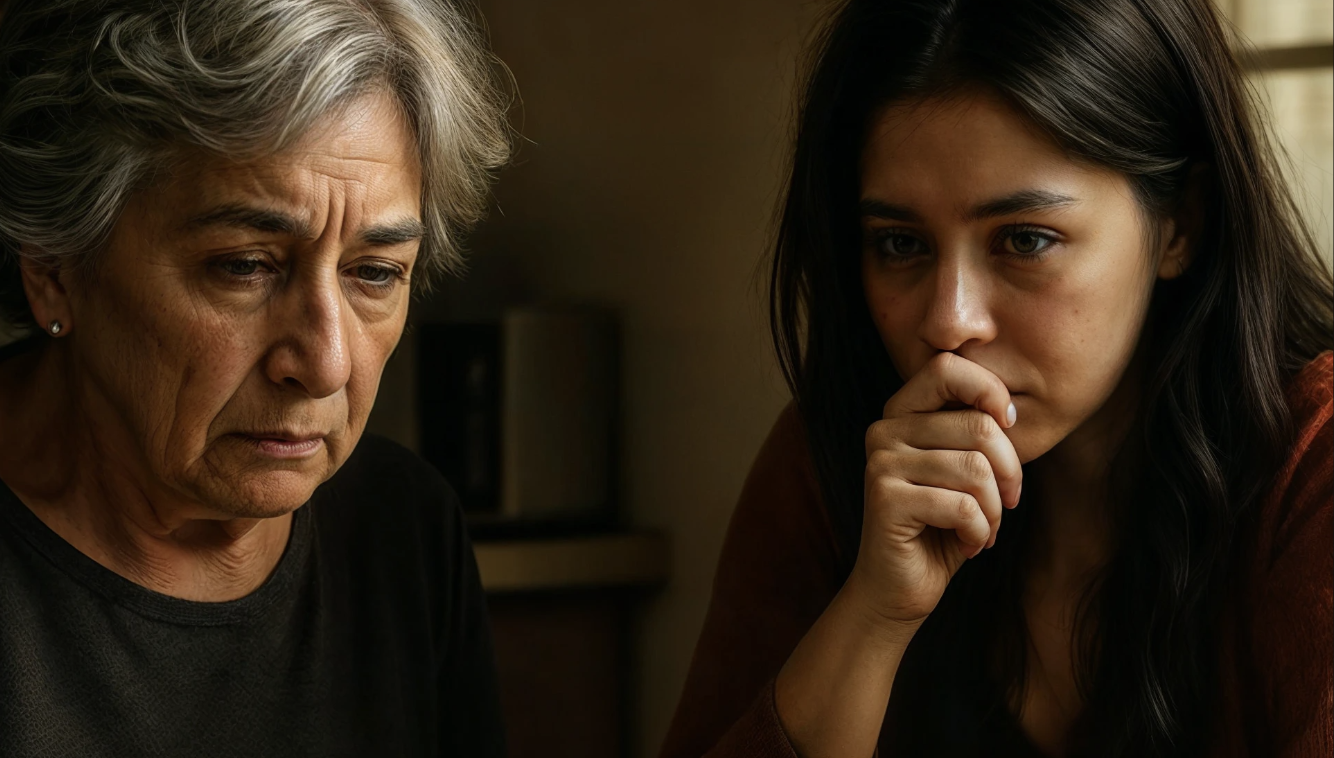
“Three thousand for utilities. Two and a half for groceries. A thousand for your medicines. Fifteen thousand for repairs, because you ‘accidentally’ flooded the neighbors downstairs…” Svetlana Petrovna’s voice was even, almost emotionless, but each figure landed on the kitchen table like a cold coin. She sat opposite her daughter-in-law, holding a battered checkered notebook filled with tiny, compact handwriting.
Oksana froze with her tea cup halfway to her lips. She hadn’t expected anything like this. She’d come by after work, exhausted, with one thought only: drink some tea and go home. And now… Slowly she set the cup back onto its saucer, trying not to clatter, and looked at the woman across from her. Svetlana Petrovna—gray-haired, trim, with perfect posture and a hard stare—was watching her with a kind of icy curiosity, as if studying a lab specimen.
“What is this?” Oksana finally forced out, nodding at the notebook—though she was already starting to guess, and the realization turned her insides to ice.
“Bookkeeping, my dear,” her mother-in-law said, flipping a page. “A systematization of our… what shall we call them… financial relations over the past four years. Since the very day you and Misha started living on your own. Remember? Back then I said, ‘Kids, live however you want—we’ll always help.’ Well, I helped. And now I’m calculating exactly how much.”
There was no anger in her tone—only the businesslike calm of an accountant closing out quarterly numbers. And that was scarier than any shouting. Oksana felt her fingers go numb as they gripped the edge of the table. She tried to collect her thoughts, to understand what was even happening. Five minutes ago she’d been sitting in this familiar kitchen, drinking familiar tea, listening to her mother-in-law’s usual complaints about her health. And now…
“Shall we continue?” Svetlana Petrovna went on without a pause. “Twenty-five thousand when Misha was laid off and you couldn’t afford rent for two months. Thirty thousand for your wedding—I paid half the banquet, remember? Ten thousand when your ‘phone broke’ and you urgently needed a new one because work calls. Eight thousand for doctors when Misha got sick. Seven and a half…”
“Enough!” Oksana’s voice cracked into a shout. She sprang up so abruptly she knocked the chair over. “What are you doing? We’re family! You’re Mikhail’s mother! You… you’re like a mom to me…”
The last words sounded pathetic, almost tearful. And she truly had once believed it. Oksana’s own mother had died when she was seventeen, and Svetlana Petrovna’s arrival in her life had felt like a gift from fate—attentive, caring, always ready to help. Only now, looking into this woman’s cold, calculating eyes, Oksana understood that every “helping hand” had been recorded, priced, and would now be presented as a bill.
Her mother-in-law didn’t flinch. She neatly closed the notebook and folded her hands on top of it, as if on a holy book.
“Like a mom?” she repeated, and something new entered her voice. Not anger—contempt. “Mothers don’t keep accounts, do they? Mothers just give. But you see, my dear Oksanochka, I’m not your mother. I’m Mikhail’s mother. And I wasn’t helping you. I was helping him. And for some reason he decided that all that money, all that care, was a gift to both of you—free and indefinite. But the only free cheese is in a mousetrap.”
She stood up. Svetlana Petrovna was a head shorter than Oksana, yet now it seemed she towered over her like an iceberg over a flimsy boat.
“Four hundred eighty-two thousand rubles. That’s the total for four years,” she said, tapping the notebook with a finger. “I’m not demanding it all back at once. I’m not a monster. Let’s do… say, twenty thousand a month. You both work. That’s manageable.”
“You… you’re joking?” Oksana clutched the back of the chair; her knees were buckling. “Twenty thousand a month? From where? We have a mortgage, utilities—food is barely enough as it is…”
“Food is enough because I regularly send groceries with Misha,” Svetlana Petrovna corrected icily. “Which, by the way, are included in that total too. Every jar of jam, every bag of potatoes from the dacha. The gasoline I spent bringing it all. I didn’t forget anything. I wrote everything down.”
Oksana fell silent. A lump rose in her throat. She felt cornered. All those years she’d thought they were a normal family: they visited, helped around the house, Misha was always fixing something for his mother. Svetlana Petrovna seemed caring—fussy, maybe, but caring. And now it turned out every “kind deed” had been an investment she planned to cash out—with interest.
“I’ll call Misha,” Oksana finally managed. “Let him deal with you himself. I… I don’t understand what’s happening.”
“Call him,” her mother-in-law nodded indifferently. “He already knows.”
Oksana froze. The words hit like an icy shower.
“What… what do you mean, ‘he knows’?”
Svetlana Petrovna sat back down, poured herself tea from the teapot, and took an unhurried sip. She was clearly savoring the moment.
“Yesterday I showed him this notebook. We spent two hours at this table discussing every line. He agreed the amount is correct. He agreed that four hundred eighty-two is a fair figure. And he agreed to the payment schedule. So, my dear, don’t try to turn my son against me. He’s on my side.”
Oksana’s world finally collapsed. It wasn’t the money—though the sum was terrifying. It was her husband’s betrayal. He knew. He’d known all day yesterday and said nothing. He’d come home, eaten dinner, gone to bed beside her—without a word. He chose his mother. He left his wife alone to face this nightmare.
“Why?” she whispered. “Why are you doing this?”
Her mother-in-law set her cup down. Her face softened—but that softness was worse than the earlier coldness. It was a mask of pity with triumph beneath it.
“Because it’s right. Because I want you to learn to value what you have. I’m not eternal. Soon I’ll be seventy. I have an apartment, a dacha, some savings. One day all of this will go to Misha. But here’s the question: will it go to you? Or only to him?”
There it was—the real reason. Oksana felt something inside her turn to ice and flare with anger at the same time. Inheritance. It always came down to inheritance. Her mother-in-law feared that after her death the apartment and dacha would become marital property. So she decided to move first.
“If you repay the debt,” Svetlana Petrovna continued, “I’ll know you’re worthy people. Responsible. And then, maybe, I’ll make changes to the will. But for now… for now I only see freeloaders who are used to living off someone else’s dime.”
The word “freeloaders” landed like a slap. Heat flooded Oksana’s cheeks. Hurt, rage, helplessness—everything mixed into a poisonous cocktail boiling inside her. She wanted to scream, to flip the table, to fling that cursed notebook into the woman’s face. But she knew it would only please her mother-in-law. It would give her a new trump card: “See, Misha? Look at your wife—hysterical, ungrateful.”
“I… I need to go,” Oksana turned toward the door. Her legs trembled; her vision wavered. She felt as if she’d been robbed—not of money, but of something far more important: the illusion of family, the illusion of love, the illusion that she wasn’t alone.
At home Mikhail was sitting on the couch watching soccer. An ordinary evening. An ordinary husband. Only now Oksana saw him with different eyes. When she walked in, he didn’t even turn around. He just said:
“Mom called. Said you were at her place. How did it go?”
A calm tone—as if it were a dentist appointment. Oksana walked over and stood between him and the TV. He had no choice but to look up. And what she saw in his eyes put everything in its place: guilt, fear, and submission.
“You knew,” she said. Not a question—a statement.
“I… yes. She showed me the notebook yesterday,” he looked away. “Listen, Oks—she’s not asking for it all at once. Twenty thousand a month isn’t that much. We can handle it.”
“Twenty thousand,” Oksana repeated, and something new appeared in her voice: steel. “For what, Misha? For your mother helping her own son? For sending you groceries? For giving us money when you were laid off? Was that her duty as a mother—or a paid service?”
He swallowed nervously.
“You don’t understand. She’s old. She needs reassurance that we… that we won’t forget her. That we won’t abandon her.”
“Blackmail,” Oksana said quietly. “That’s called blackmail, Misha. She’s blackmailing us with an inheritance. ‘Pay back the debt—maybe I’ll include you in the will.’ Do you hear yourself? We have to pay for the right to get something that, by law, would partly be ours anyway?”
“Not ours!” he suddenly snapped. “Hers! It’s her apartment, her dacha! She earned everything herself! And if she wants…”
He cut himself off, realizing he’d said too much. But it was too late. Oksana nodded slowly. Now everything made sense. Her husband wasn’t a victim of his mother’s manipulation. He was her accomplice—maybe even the initiator. They were acting together: mother and son against the wife.
“Got it,” she said and turned to leave the room.
“Where are you going?” Mikhail asked, alarmed.
“To the kitchen. I need to think.”
She sat at the kitchen table and took out her phone. Her fingers shook, but she forced herself to focus. She opened the calculator: 482,000. Twenty thousand a month. Two years of payments. Two years of living in a debt pit to her mother-in-law. Two years of humiliation. And then what—another notebook? New “debts”? Endless bondage?
No. She wouldn’t agree. But a direct refusal would mean a scandal, a break with her husband, divorce—losing everything. And that was exactly what Svetlana Petrovna was counting on. A trap: pay or leave. No third option.
“But there is,” Oksana thought—and began dialing.
Two days later Oksana was back in her mother-in-law’s kitchen. Only this time she hadn’t come empty-handed. A folder of documents lay on the table in front of her. Svetlana Petrovna watched with wary curiosity.
“You wanted to talk?” she asked coldly.
“I did,” Oksana nodded calmly. “About money. About your notebook. And about fairness.”
She opened the folder and laid several pages on the table. Her mother-in-law pulled them closer and began to read. Her face changed slowly—confusion turning into surprise, then anger.
“What is this?” she hissed through clenched teeth.
“Counter-bookkeeping,” Oksana explained. There was no triumph in her voice—only fatigue and resolve. “You counted your investments. I counted ours. Forty-two times Misha fixed plumbing, wiring, furniture in this apartment. Average cost of calling a handyman: one and a half thousand. Total: sixty-three thousand. Twenty-eight trips to the dacha over four years—digging, building, repairs. A day laborer’s rate: two and a half thousand per day. Seventy thousand. I spent three weeks with you in the hospital when you had a fracture. Took unpaid leave. Lost seventy-five thousand in wages. And dozens of smaller things—cleaning, cooking, help. I counted everything. At market rates, the way you like. Total: five hundred fifteen thousand.”
Svetlana Petrovna went pale. She stared at the numbers, at the handyman receipts, at printouts of cleaning company price lists. Oksana braced herself. She expected screaming, accusations, tears. But Svetlana Petrovna was silent. She slowly sorted through the pages, her face frozen in an expression Oksana couldn’t name.
“Minus your four hundred eighty-two,” Oksana continued, “leaves thirty-three thousand in your favor. I’m ready to pay it back. Right now. Here.” She put an envelope down on the table. “Cash. And we’re even. Forever.”
The silence stretched. Her mother-in-law didn’t touch the envelope; she just sat and looked at the documents. Then she slowly raised her eyes to Oksana.
“You counted,” she said quietly, and there was something strange in her voice. “You counted everything. Like I did.”
“Yes,” Oksana nodded. “You taught me. You showed me that in this family everything has a price. That love is measured in money. That help is an investment. I learned the lesson—and applied it.”
She stood up.
“The money’s on the table. We don’t owe you anything anymore. And you don’t owe us either. I don’t want your inheritance. I don’t want your apartment. I want only one thing: stop sticking your nose into our life. Stop counting every kopeck. Stop manipulating Misha. If you can’t—then just don’t call. We’ll manage on our own.”
She turned toward the door, then looked back from the threshold.
“You know what’s the saddest part? I truly loved you—like a mother. But you turned family into bookkeeping. And now I’m just your business partner closing out a deal. It’s a shame it turned out this way.”
The door closed softly. Svetlana Petrovna was left alone in the kitchen. In front of her lay two documents: her notebook and Oksana’s folder—two manifestos of cold calculation. Slowly she reached for the envelope and opened it. The money was there. Exactly thirty-three thousand.
And suddenly she felt something tighten in her chest. It wasn’t pain. It was emptiness. She’d won the financial argument—but lost something far more important. She’d lost her daughter-in-law. Not as a debtor—as someone who had loved her.
At home Oksana found Mikhail in a panic, pacing around with his phone in his hand.
“Mom called,” he began. “Said you brought money and…”
“And closed all accounts,” Oksana finished. “Yes. We don’t owe anything anymore. Not to her—and not to each other in that sense.”
She walked past him into the bedroom and started packing her things into a bag.
“You… what are you doing?” Mikhail asked, frightened.
“Packing. I’ll stay with a friend for a week. I need to think. About us. About whether I want to stay married to a man who silently watches his mother humiliate his wife. Who takes his mother’s side against his wife. Who can’t protect his family.”
“Oks, I—”
“No, Misha. Not now. I’m tired. I spent two days gathering every proof, every receipt, every calculation—just to prove to your mother that we’re not freeloaders, to defend our dignity. And what did you do? You just agreed with her. You betrayed me.”
She zipped the bag and looked at him. There was no hatred in her eyes—only endless exhaustion and disappointment.
“You have one week. Decide who matters more: a mother who counts every kopeck, or a wife who’s willing to fight for this family. But know this—if you choose the first, there won’t be a second anymore. I’m not going to spend my whole life proving I have the right to be part of this family.”
A week later Oksana returned. Mikhail met her in silence. But on the kitchen table lay a document. She unfolded it and read: an application to the registry office for divorce. Signed by only one person—him.
“I couldn’t,” he said softly. “I couldn’t choose. Mom… she’s my mom. And you’re right. I’m weak. A mama’s boy. You deserve better—someone who will be on your side. Always. And I’m not him.”
Oksana looked at the paper, then at her husband, and suddenly felt a strange relief. The end. Finally, the end of this drawn-out agony.
“Thank you,” she said. “For being honest. Better late than never.”
She took a pen and signed next to his name—two signatures on the death sentence of their marriage.
A year later Oksana accidentally ran into Svetlana Petrovna on the street. Her former mother-in-law had aged, grown gaunt. They stopped, looking at each other.
“How’s life?” Svetlana Petrovna finally asked.
“Good,” Oksana answered honestly. “I moved to another city. New job, new life—free of… debts. And you?”
The old woman was quiet, then said softly:
“Misha got married. To a girl who never asks for help. Very independent. They hardly even visit. They don’t need me.”
Oksana nodded. Justice—the kind Svetlana Petrovna loved to calculate.
“You know,” Oksana said, “there are things you can’t measure in money. Love. Trust. Family. When I understood that, it got easier. I hope you understand it one day too.”
She gave a sad smile and walked on—without looking back. She was free. And happy. And Svetlana Petrovna remained standing there, gripping her bag. In that bag, her notebook was probably still there. Only now there was no one left to present the bills to.