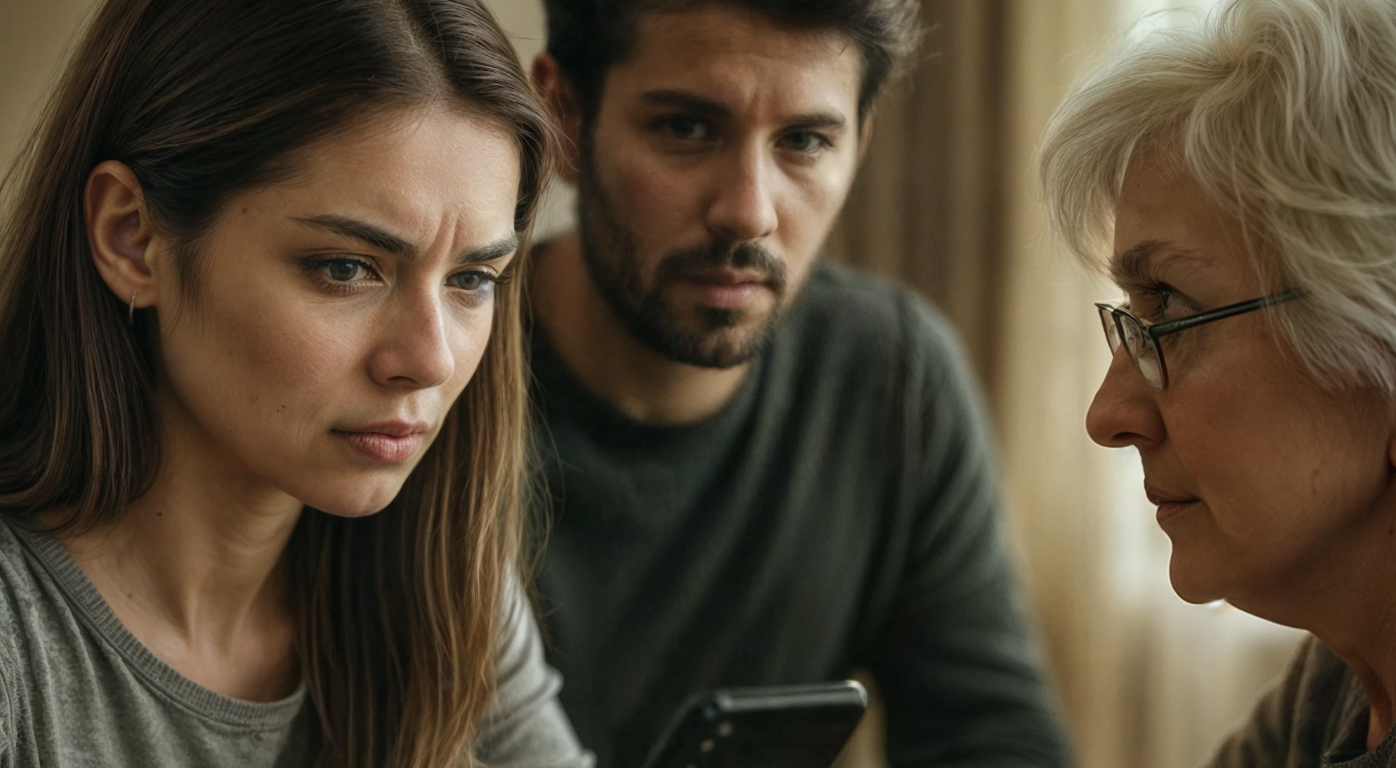
“Why do you need a separate account? We’re a family!”
Lyudmila Ivanovna said it softly, almost tenderly, but Polina—standing at the sink with a plate in her hands—felt a chill run down her spine. She froze without turning around. The water from the tap drummed against the porcelain, and that sound suddenly felt like the only real thing in this conversation.
How did her mother-in-law find out?
Just last night Polina had opened her banking app and stared for a long time at the blank page offering her a chance to get a card. She simply stared. She didn’t tap anything. And today, before she’d even worked two hours after lunch at the store, she received a text from her husband: “Mom wants to talk. Seriously.” It was a warning.
Polina slowly turned off the water and turned around. Lyudmila Ivanovna was sitting at the table with her hands folded neatly in front of her, like a teacher at a parent meeting. There was no anger on her face—only deep, maternal disappointment. That mask of care and hurt at the same time fit her perfectly, honed by years of practice.
“I don’t understand what you mean, Lyudmila Ivanovna,” Polina tried to keep her voice calm.
“Roman said you asked him how to open a card in your own name. Why, Polina dear? Are we living so badly?”
There it was. Her husband had reported her. Of course. Polina put the plate on the drying rack, wiped her hands, and sat down across from her. Three years ago, when she moved into this apartment after the wedding, she had been happy. Roman promised it would be temporary—that they’d find their own place soon. But temporary turned into permanent, and permanent turned into a cage.
“I just wanted to be able to manage part of my salary,” she answered quietly.
“Part?” her mother-in-law tilted her head, putting on a show of sincere confusion. “But darling, we share everything! I buy groceries, I pay for electricity, gas, water. You come home and there’s a hot dinner and a clean apartment. Do you even understand how much I save for our family?”
For our family. That phrase was constant. Lyudmila Ivanovna was a true master of manipulation. When Polina got a job as a cosmetics shop assistant three years earlier, it was her mother-in-law who first suggested a “shared pot.” The logic was ironclad: why waste money on two separate cards and two sets of groceries when you can combine everything? Polina agreed. Back then, it seemed reasonable.
Every month she transferred her entire paycheck to Lyudmila Ivanovna’s card. In return, she got “pocket money”—three thousand rubles for personal expenses. Makeup, clothes, meeting friends—everything came out of that amount. If it wasn’t enough, she had to ask. And asking her mother-in-law was humiliating. Every time, it turned into an interrogation: what for, why, isn’t it too expensive?
“It just seems to me that I could manage my money myself,” Polina tried to keep her tone even.
“Manage?” her mother-in-law smirked. “Polina dear, just look at yourself! Last month you spent four thousand on some lipstick and cream! Four thousand! If it weren’t for me, you and Roma would have been drowning in debt a long time ago.”
Polina lowered her eyes. Arguing was pointless. Lyudmila Ivanovna always found arguments. She wasn’t just a controlling mother-in-law. She was a financial dictator—who, behind the mask of caring, had built a system of total submission.
Footsteps sounded in the hallway, and Roman entered the kitchen. Polina looked at her husband with hope. Maybe he’d say something in her defense? But Roman avoided her gaze. He went to the fridge, took out juice, and poured himself a glass. The silence dragged on.
“Roma, explain to your wife that a family is one whole,” Lyudmila Ivanovna asked in a honeyed voice. “I’m tired of being the bad one.”
Roman set the glass on the table and finally looked at Polina. In his eyes she saw no support—only fatigue and a desire for this conversation to end as quickly as possible.
“Polya, why do you need a separate card? Mom’s right. It’s easier for everyone.”
Polina felt something inside her snap. Not for the first time. Not for the second. But every time, that snap became deeper, more final. She stood up from the table.
“Okay. I understand.”
She left the kitchen, went into the room she shared with Roman, and closed the door. She sat on the bed and stared at the wall. The tears wouldn’t come. Inside there was only emptiness and a strange, cold calm. Something had changed. She didn’t know what exactly—but something had broken for good.
For the next two weeks, Polina lived like a machine. She got up, went to work, came home, ate dinner, went to bed. She didn’t bring up the card. She didn’t argue. Lyudmila Ivanovna took it as a victory and relaxed. And Roman, as always, pretended nothing had happened.
But Polina thought. She thought a lot. She began noticing things she’d previously let slide. For instance, her mother-in-law constantly bought groceries in expensive stores while complaining about “saving.” Or that three new sweaters hung in Lyudmila Ivanovna’s closet that hadn’t been there a month earlier. Or how every evening her mother-in-law sat down at the computer and calculated something for a long time in spreadsheets.
One evening Polina pretended to be asleep when Roman was talking to his mother on the phone in the kitchen. She heard a phrase that made her go completely still:
“Mom, just a little more and it’ll be enough for the down payment. I promised I’d help Vit’ka.”
Vit’ka. Roman’s younger brother. Polina knew perfectly well that Lyudmila Ivanovna adored her younger son. Vitya studied in another city, and his mother regularly sent him money. But a down payment—for what? An apartment?
In the morning Polina claimed she was sick and didn’t go to work. She waited until Lyudmila Ivanovna left for her appointment at the clinic, and Roman drove to work. She was alone in the apartment. Her heart pounded as she stepped into her mother-in-law’s room. It was an intrusion into чужая territory, a violation of all the rules. But she had to know.
An open notebook lay on the table. Polina came closer. Her mother-in-law’s handwriting was neat, the numbers arranged in columns. “Family budget,” the title read at the top. Polina scanned the lines.
“Polina’s salary — 35,000.”
“Food expenses — 12,000.”
“Utilities — 6,000.”
“Pocket money for Polina — 3,000.”
Then came a line that made Polina’s hands go cold:
“Savings for Viktor’s apartment — 14,000.”
Fourteen thousand. Every month. From her salary. Polina quickly flipped back through the pages. The records had been kept for two years. Two years her mother-in-law had been setting aside Polina’s money for an apartment for her younger son—without saying a single word. Under the guise of a “shared pot” and “saving.”
Polina closed the notebook. Her hands were shaking. But it wasn’t anger. It was clarity—cold, absolute clarity.
She went back to her room, took out her phone, and opened the banking app. Her fingers flew across the screen. Opening a new card took fifteen minutes. Then she called the accounting office at her store and asked to change the details for her salary deposit. The accountant asked a couple of questions; Polina answered calmly and confidently. Done.
That evening, when Lyudmila Ivanovna came home, Polina was sitting in the kitchen drinking tea. She behaved as usual. Her mother-in-law suspected nothing. Roman didn’t either. Life went on normally for another week—until payday.
Polina got a notification from the bank: “Deposit credited: 35,000 rubles.” The money landed on her new card. She looked at her phone screen and felt a strange, unfamiliar feeling.
Freedom.
Two hours later Roman called.
“Polya, what’s going on? Mom says your salary didn’t come!”
Polina answered calmly:
“Everything’s fine, Rom. The salary came. Just now it’s on my card.”
A pause.
“What?”
“I opened my own account. Starting this month, I manage my money myself.”
“What are you doing?! Mom’s hysterical! She needs money for groceries, utilities!”
“I’ll pay my share of the utilities. And for groceries too. But I’ll decide myself how much and what to spend.”
“Polina, have you lost your mind?! Transfer the money to Mom right now!”
She silently hung up. The phone rang again immediately. She put it on silent. She finished her workday, closed the store, and went home. She knew there would be war there. And she was ready.
Lyudmila Ivanovna met her in the hallway. Her face was red with rage. The mask of the kind, caring mother slipped off. Only fury remained—fury at losing control.
“How dare you?! You stole the family money!”
“I didn’t steal anything. It’s my salary,” Polina walked into the room and took off her jacket. Her voice was steady. “I work. I earn the money. And I’ll decide what to do with it.”
“You ungrateful girl! I fed you and clothed you for three years!”
“For three years you saved my salary for Vitya’s apartment. I saw the notebook.”
Silence fell. Lyudmila Ivanovna froze. Roman, standing nearby, looked from his mother to his wife, confused.
“What notebook? Mom, what is she talking about?”
Her mother-in-law pulled herself together quickly.
“It’s our family business! Vitya is family too! We have to help each other!”
“Helping is when you ask for permission,” Polina looked at her husband. “Roma, your mother has been setting aside fourteen thousand a month from my salary for two years—for your brother’s apartment. Without my knowledge. Under the guise of a common budget.”
Roman was silent. Polina watched emotions flicker across his face: shock, confusion, then slow understanding. But she didn’t wait for him to speak. Because she already knew what he would say: Mom meant well. It’s for family. You should understand.
“I rented an apartment,” Polina said calmly. “Tomorrow I’m moving out. If you want to come with me, we’ll go together. If not, you’ll stay here.”
It wasn’t planned. The decision came right now, in this exact second. But it was right. She suddenly understood she couldn’t stay here anymore—not for a day, not for a week, not for a minute.
“You’re kidding,” Roman finally spoke. “What apartment? With what money?”
“With mine,” Polina opened the wardrobe, took out a bag, and started packing. “I have a salary. And I have a friend renting out a cheap one-bedroom. I’ll manage.”
Lyudmila Ivanovna grabbed her by the wrist.
“You’re destroying the family!”
Polina gently freed her hand.
“No, Lyudmila Ivanovna. I’m just leaving the family where I’m being used. Those are different things.”
She kept packing. Her mother-in-law tried to shout, but the words didn’t reach her anymore. Roman stood in the doorway, pale and lost. He didn’t follow her. He didn’t stop his mother. He simply stood there. And that was the answer.
An hour later Polina closed the apartment door behind her. Two bags in her hands. No tears, no smile on her face—only calm. She called a taxi and went to her friend’s place.
The first week was hard. Roman called and begged her to come back, promised to talk to his mother. Lyudmila Ivanovna sent messages calling her selfish and a traitor. Polina didn’t answer. She got used to her new life. A small rented apartment where she could turn the light on whenever she wanted, cook whatever she wanted, invite whoever she wanted. For the first time in three years, she controlled her time, her space, her money.
A month later the calls stopped. Roman didn’t come after her. He didn’t choose his wife over his mother. Polina wasn’t surprised. She had understood long ago that he’d made that choice years earlier.
Two months after that, she filed for divorce.
Now, half a year later, Polina sits in her small apartment. A cup of coffee on the table, an open laptop in front of her. She’s enrolled in professional development courses—she wants to become a senior sales assistant, then a manager. She has plans. Goals. A life that belongs only to her.
Sometimes she thinks about those three years—how she gradually lost herself trying to be a convenient daughter-in-law, a good wife. How she handed over control of her life piece by piece without even noticing.
But now she’s free. And that was worth every hard day.
Her phone vibrated. A message from her friend: “Movies tomorrow? My turn to pay!”
Polina smiled and replied: “Of course! Pick the movie.”
She finished her coffee, closed the laptop, and walked to the window. The city outside lived its life—lights, cars, people. Somewhere out there was her old life, her old fears, her old obedience. And here, in this small apartment, was her. Real. Free. Herself.
And that was enough