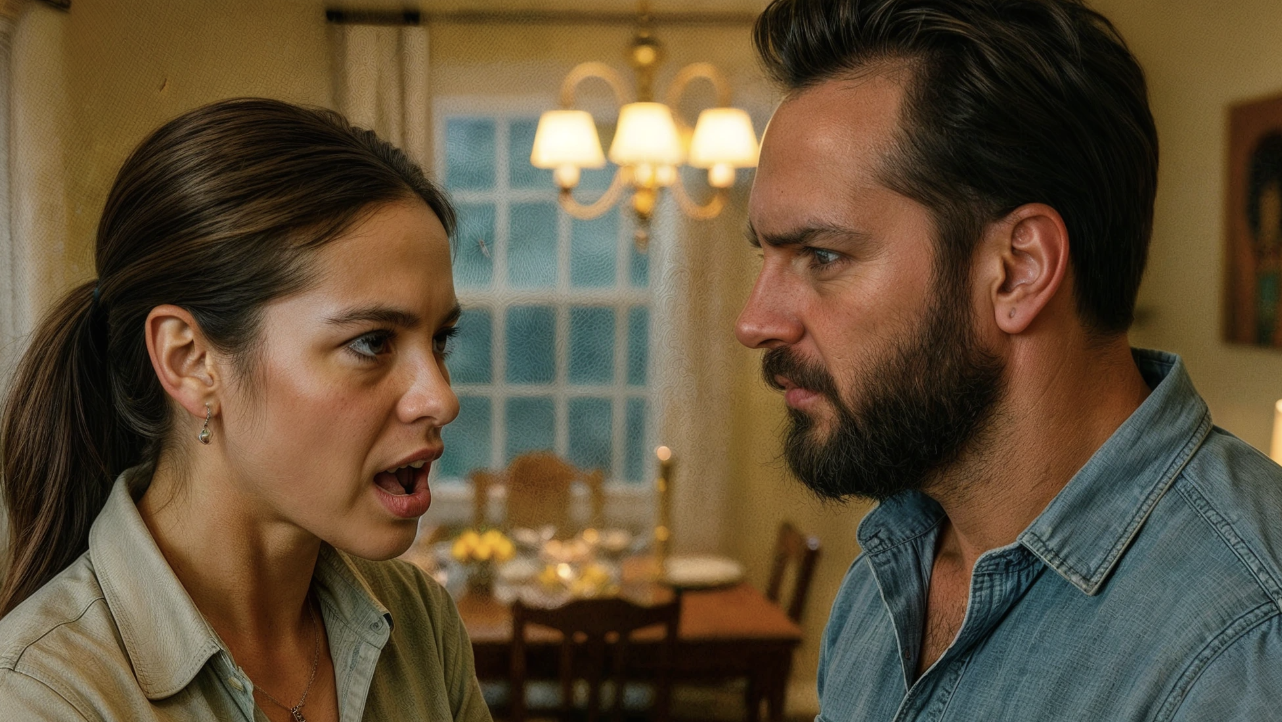
Because we’re a family! Or is that just words to you?” Igor slapped his palm on the table.
Elena flinched back, feeling everything inside her tighten into a hard knot. She looked at the man she’d been sharing a bed with for the past year and a half—and didn’t recognize him. Where was the Igor who had sworn he loved her, who had promised to support her after Andrey died? Where was the man who said he wasn’t claiming her past, only wanting to build a future?
“Family?” she repeated softly. “Igor, we’re not married. Your kids can’t stand me. And the apartment… it’s all I have left from Aunt Vera.”
“But my kids have nothing!” he shot up and began pacing the kitchen, agitated. “Liza’s turning eighteen soon—she needs somewhere to live when she goes to university. And in two years Maxim will be studying too. Their mother lives in a one-bedroom with her new husband—there’s zero space. We’re in a two-bedroom. And you’ve got a three-bedroom downtown! Empty!”
Elena stared at him in silence, trying to process what she was hearing. So that was it. Not love. Not support for a widow. Just calculation—cold, cynical calculation.
“It’s not empty,” she forced out. “My memories are there. I grew up there. Aunt Vera died there—and I was holding her hand.”
“You can’t pay utilities with memories!” Igor snapped. “Don’t you get it? I’m offering you a normal solution. Me and the kids move in with you, I rent out my place, and with that money we help Liza and Maxim. Everybody wins!”
“Except me,” Elena said quietly.
He stopped and turned to her. Something like irritation flashed in his eyes.
“Lena, why are you acting like a child? Adults compromise. Or do you want to end up alone in your three-bedroom—with your memories?”
It sounded almost like a threat. A chill ran down Elena’s spine.
“Are you blackmailing me?”
“I’m putting it plainly,” Igor replied harshly. “Either you’re with me or you’re not. There’s no halfway. My kids are part of me. If you love me, you have to accept them too.”
Elena lowered her gaze to her hands clutching the edge of the table. Her fingers had gone white with tension. Loneliness. That word had haunted her since Andrey’s funeral. Two years earlier, illness had taken her husband—kind, caring, loving. They’d been together ten years; they never had children, but they were happy. And then came the diagnosis, eight months of fighting, and emptiness.
Igor had appeared in her life six months after the funeral—a colleague of Andrey’s who came to offer condolences. Then there were chance meetings, conversations, support. He was there when she fell apart. He said all the right things. And she believed it was a new chance. That life could go on.
But now, looking at his tense face, at his clenched fists, she understood—she’d been wrong. He didn’t love her. He saw her as a solution to his problems.
“I need to think,” she said at last.
“Think,” Igor tossed over his shoulder as he headed for the door. “Just know—I don’t have time to wait forever. The kids need stability. Now.”
The door slammed, leaving Elena alone with silence and bitterness.
Aunt Vera’s apartment—now Elena’s—met her with its familiar quiet. She closed the door behind her and leaned against it, eyes shut.
Three rooms, eighty square meters in the very center of the city. High ceilings. Parquet flooring Aunt Vera guarded like a treasure. Windows facing the courtyard, where old linden trees grew. Elena had spent half her childhood here, while her parents worked late. Here Aunt Vera taught her to bake pies and told her stories about a grandfather who never came back from the war.
Aunt Vera had no children. Her husband died in a car crash when they were young; she never remarried. She poured all her love into her niece—Elena. And when she fell ill, it was Elena who cared for her. Her mother helped, of course, but most of the burden landed on Elena’s shoulders.
“Lena,” her aunt had whispered in her final days, “I’m leaving the apartment to you. Not to your mother, not to your brother. To you. You earned it. You love me not for the apartment.”
And it was true—in the will, only Elena’s name was written. Her mother didn’t object. Her brother stayed silent, though displeasure flickered in his eyes. But he stayed silent.
Elena walked into the living room. The sofa where she used to sleep as a child. The bookcase packed with worn volumes of classics. The old dresser that had belonged to Aunt Vera’s mother. Everything here breathed history, memory, love.
And she was supposed to let strangers in? Igor’s children, who looked at her like an annoying fly? Who pretended she didn’t exist every time they saw her?
Her phone buzzed. A message from Igor: “Talked to the kids. They’re happy about moving. Liza’s already picking which room will be hers.”
Elena clenched her teeth. Just like that. He didn’t even wait for her decision—already handing out rooms.
She dialed her mother.
“Mom, can I come by?”
“Of course, sweetheart. Did something happen?”
“I’ll tell you when I get there.”
Her mother lived in a small two-bedroom on the outskirts. After Elena’s father died five years earlier, her mother sold their old three-bedroom and bought something more modest; with the remaining money, she traveled. She always said you only get one life, and you have to manage to live it for yourself.
“So,” her mother said, setting a cup of tea in front of Elena and sitting across from her. “Tell me.”
Elena told her everything—about Igor, his demands, Aunt Vera’s apartment.
Her mother listened in silence, her expression darkening.
“And what are you going to do?” she asked at last.
“I don’t know.” Elena wrapped her hands around the cup, warming her chilled fingers. “On one hand, I’m scared of being alone again. On the other… Mom, this is outrageous. He didn’t even propose, didn’t talk about feelings. Straight to the apartment and the kids.”
“Do you love him?” her mother asked bluntly.
Elena thought. Did she? Or was she just afraid of loneliness? After Andrey, there had been such emptiness inside her that she wanted to fill it with anything. And Igor had been there at the right time.
“I don’t know,” she admitted honestly. “I’m good with him. But it’s not what I had with Andrey.”
“Andrey was your love,” her mother said gently. “And this one… Lena, forgive me, but I don’t like him. I’ve seen how he looks at you. Not like a man in love, but like… a convenient option.”
“You think so too?” desperation broke into Elena’s voice.
“Sweetheart,” her mother took her hand, “I understand you’re lonely. But loneliness isn’t a sentence. Better to be alone than with someone who doesn’t value you. Aunt Vera didn’t leave you that apartment so you could hand it over to the first man who came along.”
“But if I refuse him, he’ll leave,” Elena whispered.
“Then let him,” her mother said firmly. “A real man doesn’t issue ultimatums. Doesn’t blackmail. Doesn’t use people.”
Elena sat in silence, swallowing her mother’s words. Somewhere deep down she knew her mother was right. But fear of loneliness was stronger than reason.
A week passed in heavy silence. Igor called and texted, but Elena kept quiet. She needed time to figure herself out.
And then something unexpected happened.
On Saturday morning, the doorbell rang. Elena wasn’t expecting anyone. She opened—and froze. On the threshold stood Liza, Igor’s seventeen-year-old daughter. Tall, with long dark hair and a serious gaze.
“Can I come in?” Liza asked.
“Uh… yes, of course.” Elena stepped aside to let her in.
They went into the kitchen. Elena automatically put the kettle on.
“I know why you came,” Elena began, trying to keep her voice calm. “Your father sent you to persuade me.”
“No,” Liza shook her head. “Dad doesn’t know I’m here. I came myself.”
Elena stared at her, surprised.
“Why?”
Liza paused, choosing her words.
“I want to say… I’m ashamed of my father.”
That was the last thing Elena expected to hear.
“What?”
“He’s using you,” Liza said simply. “I’m not little—I understand everything. He didn’t meet you because he fell in love. He found out about the apartment right away from mutual acquaintances. And decided you were the solution to our problems.”
Elena lowered herself into a chair, stunned.
“You… you’re serious?”
“Completely,” Liza nodded. “I heard him talking to Mom. He said he’d ‘picked up a widow with property.’ His words.”
The world blurred around Elena. So it had all been a lie. All of it.
“Why are you telling me this?” she managed.
“Because it’s wrong,” Liza met her eyes. “I don’t want to live in an apartment someone tricked out of you. Yes, it’s hard for us. Yes, I need somewhere to live when I start university. But not like this. Not at the expense of someone else’s grief and loneliness.”
A lump rose in Elena’s throat. Tears stung her eyes.
“Thank you,” she whispered. “Thank you for telling me the truth.”
“You’re a good person,” Liza said unexpectedly. “I saw you trying to be friendly with us. Trying so hard. And Maxim and I… we acted like pigs. Dad told us you wanted to replace Mom, and we hated you immediately. But then I started thinking… you just wanted to be decent.”
“I didn’t want to replace your mom,” Elena said softly. “I just wanted us to be comfortable together.”
“I know,” Liza nodded. “Now I know.”
They sat in silence over tea. Elena looked at the girl and thought how much wiser she was than her father.
“What should I do?” Elena asked at last.
“Don’t give up the apartment,” Liza said firmly. “It’s yours—your memory, your life. Maxim and I will manage somehow. I’m already thinking about a dorm, or renting with a friend. Dad will figure it out too. And if not… then maybe it’s time he did something himself instead of hanging off other people.”
Elena smiled through tears.
“You’re very grown-up for your age.”
“When your parents divorce, you grow up whether you want to or not,” Liza said with a sad half-smile. “Maxim had it worse—he was little. But I remember everything. I remember Dad leaving for another woman. Mom crying. Us moving from our apartment into a tiny one-bedroom. Dad isn’t a bad man, but he’s… weak. He looks for the easy way.”
“And if I refuse him? He’ll leave.”
“Then let him,” Liza shrugged. “Honestly? You deserve better. Someone who’ll love you for real, not for an apartment.”
That evening, Elena met Igor in a café—neutral territory.
“So? Made your decision?” he asked the moment he sat down.
He didn’t even say hello.
“Yes,” Elena nodded. “I’m not sharing the apartment.”
Igor’s face darkened.
“What do you mean?”
“Exactly that.” Her voice stayed calm, though everything inside her trembled. “It’s my inheritance. My memory. And I’m not giving it away.”
“So you’re choosing the apartment over me?” The threat rang in his voice.
“I’m choosing myself,” Elena corrected. “And you… you never loved me, did you?”
He flinched; something like guilt flickered in his eyes.
“Where did you get that?”
“Liza told me about what you said to her mother,” Elena held his gaze. “About me being a ‘widow with property.’”
Igor went pale, then flushed.
“She… she had no right—”
“She did,” Elena cut him off sharply. “Because unlike you, she has a conscience. And honor. Something you’re clearly missing.”
“Lena, listen—”
“No, you listen.” Elena leaned in, steel entering her voice. “I lost my husband. A real husband—loving. I was in hell and barely crawled out. And you used that. You wormed your way into my trust, pretended to be my savior. But really you were just looking for an easy solution to your problems.”
“That’s not true—”
“Don’t lie,” she snapped. “It’s too late. I understand everything now. And you know what? I’m grateful I figured you out in time—before I did something I couldn’t take back.”
She stood to leave.
“Lena, wait.” Igor grabbed her wrist. “Fine, I admit it. Yes, I knew about the apartment. But that doesn’t mean I had no feelings for you!”
“What feelings?” Elena pulled her hand free. “Convenience? Benefit? That’s not feelings, Igor. That’s calculation.”
“But we were together! We were good!”
“It was convenient for me not to be alone,” Elena admitted. “And it was convenient for you to have a foolish widow with property at your side. But I’m not foolish anymore. And I’m not just a widow. I’m Elena. Just Elena. And that’s enough for me.”
She turned and walked out of the café without looking back. Her heart was pounding, but inside her spread a strange, unfamiliar feeling—relief.
A month passed. Elena lived alone in Aunt Vera’s apartment, slowly making it her own. She changed the curtains, repainted the living room walls, bought a new sofa—keeping her aunt’s memory, but adding herself.
Liza called once a week, talking about exams and plans. Once she admitted Igor tried to forbid her from talking to Elena, but she told him where to go.
“I like you,” the girl said. “Not because you were with my dad. But because you’re honest. And brave.”
“I’m not brave,” Elena argued. “I’m just tired of being afraid of loneliness.”
“That’s what bravery is,” Liza laughed.
And then something happened that Elena didn’t expect.
Liza got into university—and it turned out dorms weren’t given to all first-year students. She needed housing.
“I don’t know what to do,” Liza confessed over the phone. “Rooms are expensive, and Mom can’t help. Dad says it’s my fault for being friends with you.”
Elena fell silent, thinking.
“Listen,” she said at last. “Do you want to live with me?”
Silence on the line.
“What?” Liza breathed.
“I have three rooms,” Elena continued evenly. “One is mine. One is a guest room. And the third… I could rent it to you. For a symbolic amount, of course.”
“Lena, are you serious?”
“Completely,” Elena nodded, though Liza couldn’t see her. “I’d be glad if you lived here. You’re a good kid, Liz. Smart too. And I… I don’t want you to suffer because of your father’s stupidity.”
Liza sniffled.
“Thank you,” she whispered. “You can’t imagine how grateful I am.”
“I can,” Elena smiled. “Because you did the same for me—you opened my eyes to the truth.”
Liza moved in at the end of August. They set rules right away: each cleaned their own room; common areas—taking turns; groceries together or separate—as agreed. No loud parties, but friends were allowed.
The first weeks weren’t easy. They adjusted to each other, learned how to live side by side. But gradually a comfortable rhythm appeared. Liza was neat and responsible. She studied late, sometimes cooked dinner for both of them, often sat with Elena in the kitchen, chatting about nothing.
“You know,” Liza once said as she poured tea, “I’m glad it turned out this way.”
“What exactly?” Elena smiled.
“That you didn’t give in to Dad’s blackmail. That you stayed yourself. And that… that you gave me a chance. Even though you could’ve told me to get lost along with our whole family.”
“You’re not to blame for the fact your father is an idiot,” Elena said bluntly.
Liza snorted with laughter.
“True. By the way, he’s with someone new now. Another widow. Only she doesn’t have an apartment—she has a car and a summer cottage.”
“Well,” Elena said philosophically, “let’s hope she’s smarter than me and sees through him right away.”
They laughed.
A month later, Maxim—Igor’s younger son—asked if he could come visit his sister.
“You don’t mind?” Liza asked Elena. “He wants to apologize for how he behaved.”
“Of course I don’t mind,” Elena nodded.
Maxim turned out to be a shy fourteen-year-old with a permanently guilty look. He did apologize—awkwardly, haltingly, but sincerely.
“I was stupid,” he admitted. “Dad said you wanted to destroy our family. But you just… just didn’t want to be used.”
“Smart boy,” Elena said warmly. “You can tell you’re Liza’s brother.”
After that, Maxim became a frequent guest. Elena helped him with schoolwork—she had a teaching degree she’d never used after marriage. The boy gravitated toward her, clearly starved for attention from parents consumed by their own problems.
One evening, after Maxim left, Liza said, “You know… I think my brother and I finally found what we always lacked.”
“What’s that?” Elena asked.
“An adult who treats us like people,” Liza answered seriously, “not like a burden or a tool for manipulation. Mom always complains about life and Dad. Dad uses us to get what he wants. And you… you just are. And that’s enough.”
Elena’s nose stung. She hugged the girl.
“Thank you,” she whispered. “For existing. For making me understand I’m not alone. Loneliness isn’t about having nobody nearby—it’s about not having people who value you.”
A year passed. Elena sat in the kitchen sipping her morning coffee and scrolling through the news on her phone. Music played softly behind the wall—Liza was preparing for exams. In the living room, Maxim had laid out his textbooks—he came on Saturdays, and Elena helped him with math.
The apartment no longer felt empty. It was full of life, laughter, sometimes arguments, but more often quiet comfort. Elena realized she’d found what she’d been looking for—not a replacement for Andrey (no one could replace him), but a new meaning. A new family. Strange, not bound by blood, but real.
Igor tried to reach out once or twice—texts apologizing, asking to “give him another chance.” Elena didn’t reply. She wasn’t angry anymore. She’d simply let go. He’d made his choice—searching for the easy way. She’d made hers—staying herself.
“Lena, can you help?” Maxim poked his head into the kitchen. “I’m stuck on an equation.”
“Of course,” she smiled, setting her phone aside.
They sat down at the table, bent over the notebook. Maxim sniffed and chewed his pencil. Elena explained patiently. From Liza’s room came her favorite song.
And Elena thought life was a strange thing. Sometimes, to find happiness, you have to give up what feels like your last chance. Risk being alone. And then the right people come—those you truly need.
Aunt Vera’s apartment was no longer a museum of memory. It had become a home. A real home—where Elena was the owner, not a guest in her own life.
That winter was snowy. Elena stood by the window watching thick flakes drift down onto the old linden branches in the courtyard. Behind her, in the kitchen, Liza and Maxim were bustling—baking cookies using Aunt Vera’s recipe Elena had found in an old cookbook.
“Are you sure it needs that much cinnamon?” Maxim’s skeptical voice floated out. “I think it’s too much.”
“Aunt Vera always used a lot of cinnamon,” Elena answered without turning around. “She said a home should smell like a celebration.”
“And what’s the celebration?” Liza snorted. “New Year’s is two weeks away.”
“A celebration doesn’t have to be tied to the calendar,” Elena said thoughtfully, finally turning to them. “Sometimes just the fact that we’re together and we’re happy—that’s already a celebration.”
Liza and Maxim exchanged a glance, and Elena caught something warm and understanding in their eyes. Over a year and a half they’d grown so close that sometimes Elena caught herself thinking: isn’t that what real families feel like?
Her phone buzzed. A message from her mother: “Sweetheart, I’m flying back from Thailand next week. Miss you! Can I stay at yours for a couple days until I get home?”
Elena smiled as she typed: “Of course, Mom. We’ve got a whole commune here now—one more person won’t be a problem.”
Her mother replied quickly: “Commune? You mean Liza? How is she, by the way?”
“Liza and her brother Maxim. He’s here almost every weekend. I help with school. I’ll tell you when you arrive.”
“Oho! Okay, can’t wait. Kisses!”
Elena put her phone away and looked at the chaos in the kitchen. Liza was trying to roll out dough while Maxim secretly stole raisins from the bowl, getting smacked on the back of the head by his sister for it.
“Maybe you two stop hitting each other and start cutting shapes?” Elena suggested, coming closer.
“But we don’t have any cookie cutters,” Maxim said, awkwardly.
“What do you mean, we don’t?” Elena opened the top drawer of the sideboard and pulled out an old tin box. “Here. Aunt Vera’s. Stars, trees, hearts—the whole set.”
Liza carefully took one, examining it.
“They’re ancient,” she said in awe. “Probably Soviet?”
“Older,” Elena nodded. “They were my aunt’s grandmother’s. So—my great-grandmother’s. Imagine how many years they’ve been around. And they still cut like new.”
Maxim ran a finger along the edge of the tree-shaped cutter.
“It’s cool you kept them. Mom throws out anything old. Says why keep junk.”
“It’s not junk,” Elena objected gently. “It’s memory. History. When you hold something your ancestors used, it’s like touching them. Feeling the connection between generations.”
They cut cookies in silence, each thinking about their own things. Then Liza suddenly asked:
“Lena… do you ever regret that you and Uncle Andrey didn’t have kids?”
Elena froze, pressing a star cutter into the dough. She’d asked herself that question hundreds of times—especially after his death.
“I do,” she answered honestly. “A lot. We wanted them. We tried. But it didn’t happen. The doctors said I had problems… Anyway, we made peace with it. We thought maybe we’d adopt someday. Then Andrey got sick, and it wasn’t the time.”
“I’m sorry,” Liza looked guilty. “I shouldn’t have asked.”
“You should have,” Elena covered her hand with her own. “For a long time I thought my life was broken—that if I couldn’t have children of my own, if Andrey died, then I’d failed as a woman. But then I understood: family isn’t always blood. Sometimes it’s choice. People you let into your life—and who let you into theirs.”
Maxim coughed and turned away, but Elena noticed his eyes redden.
“Hey,” she joked, putting an arm around his shoulders, “men don’t cry.”
“I’m not crying,” he muttered. “It’s just onions… even though we didn’t cut onions. Fine, I’m crying. So what?”
Liza laughed, and the tension dissolved. They cut the cookies, put them in the oven, and soon the whole apartment filled with the smell of cinnamon, vanilla, and melted butter.
“Now it smells like a celebration,” Elena said contentedly, settling on the sofa with a mug of hot cocoa.
Liza and Maxim squeezed in on either side of her, and the three of them watched some old comedy on TV. Snow fell outside. Inside it was warm and cozy, and mountains of cookies cooled in the kitchen.
This is happiness, Elena thought. Not square meters, and not the number of zeros in a bank account. But the smell of cinnamon, laughter, and knowing there are people nearby who need you just because you’re you.
They celebrated New Year’s with a big group. Elena’s mother arrived—tan, energetic, loaded with souvenirs from Thailand. Liza and Maxim’s mother, Olga, showed up too—a quiet woman with a tired face who kept her distance at first, but gradually softened.
“Thank you for taking Liza in,” Olga told Elena when they were setting the table together. “I don’t know what we would’ve done without you.”
“Oh, come on,” Elena said, embarrassed. “I’m happy to. Liza is a wonderful girl.”
“She really loves you,” Olga paused, then added more quietly, “maybe more than she loves me.”
“Don’t be silly,” Elena said gently. “You’re her mother. I’m just… an older friend. Or something like an aunt.”
“You’re more than an aunt to her,” Olga shook her head. “I can see how she changed. More confident, calmer. She stopped being angry at the whole world. That’s because of you.”
Elena didn’t know what to say. Accepting that kind of gratitude felt uncomfortable.
“I just… live,” she said quietly. “And try to be honest. With myself and with people around me.”
“That’s exactly why the kids reach for you,” Olga smiled. “You’re real. And Igor and I… we’re broken. And the kids have suffered because of our broken lives.”
Elena wanted to answer, but then Liza and Maxim burst into the kitchen arguing about what to watch after the clock struck midnight. The moment for a serious talk passed.
New Year’s came loud and joyful. They ate salads and roast duck, laughed at stupid jokes.
Later, when everyone went to sleep—Elena’s mother in the guest room, Olga on a fold-out bed in Liza’s room, Maxim on the living-room sofa—Elena stepped out onto the balcony for a breath of frosty air.
The city glittered with lights. Somewhere far away, firecrackers still popped. Wrapped in a blanket, Elena thought about the past year—and how much had changed.
“Can’t sleep?” Liza came out onto the balcony in a puffer jacket.
“Just thinking,” Elena smiled.
“About what?”
“That a year ago I welcomed New Year alone,” Elena said softly. “With salads and tears. And now… now I’ve got a whole apartment full of people. And it feels good.”
Liza hugged her shoulders.
“You know what I’ll tell you?” she said. “You’re the best thing that happened to me and Maxim. Even if it sounds weird, considering you dated our father.”
“Dated,” Elena snorted. “That’s generous. He used me. And I let it happen because I was afraid to be alone.”
“But you didn’t stay alone,” Liza said gently. “You chose yourself. And because of that you found us. And we found you.”
“Fate has a funny sense of humor,” Elena murmured. “Sometimes what feels like an ending is actually the beginning of something new and better.”
They stood there a little longer, looking at the night city, then went back into the warmth of the apartment. Tomorrow would be a new day, a new year, a new life. And Elena wasn’t afraid to meet it anymore.
Spring came unexpectedly early. In March the snow was already melting, and in April the first flowers bloomed in front gardens. Elena sat on a park bench watching children play on the playground. Liza sat beside her with a book, preparing for her next exam session.
“Listen,” Liza suddenly said, closing her textbook, “have you ever thought about getting married again?”
Elena looked at her, surprised.
“Where is that coming from?”
“Just curious,” Liza shrugged. “You’re still young. Beautiful. Smart. Why not?”
“I don’t know,” Elena admitted. “I don’t really think about it. After Andrey and your father, I’ve lost faith in the whole idea of relationships.”
“But not all men are like my dad,” Liza said reasonably.
“I know. But I’m not searching either,” Elena replied. “I’m fine as it is. I learned how to be happy alone. Or rather—not alone. With you.”
Liza nodded thoughtfully, then added:
“You know, Mom said yesterday she envies you.”
“Me?” Elena was genuinely surprised. “What is there to envy?”
“That you’re free,” Liza said. “That you live for yourself. That you don’t depend on anyone. Mom depended on someone her whole life—first her parents, then Dad, then her new husband. And she said she wants to be as brave as you.”
“I’m not brave,” Elena argued. “I’m just tired of being afraid.”
“That’s what bravery is,” Liza repeated the words she’d said a year and a half earlier. “When you stop being afraid and start living.”
Elena fell silent, absorbing it. She’d never thought of herself as brave—more like someone lucky enough to open her eyes in time.
“By the way,” Liza picked her book up again, “Maxim wants to ask if he can live with you in the summer. A week or two. He says home is unbearable—Dad’s new girlfriend is always yelling, and at Mom’s place her new husband started drinking.”
Elena’s heart tightened. Poor kids—torn between two homes that both felt unsafe.
“Of course,” Elena said without hesitation. “He can come whenever. The guest room is empty anyway.”
“Thank you,” Liza took her hand. “You have no idea how much you mean to us.”
Elena squeezed her fingers back. Yes—she’d lost a lot in life. Her husband. The chance to have children of her own. Her illusions about a second chance at love. But she’d gained something else in return—no less valuable. Maybe even more.
In the summer, Maxim really did move in, first for two weeks—then he stayed for a month. Then Olga asked timidly if her son could remain until the end of the holidays; things at home were a mess, and the boy was miserable there.
Elena agreed without a second thought. Maxim was a good kid—quiet, polite, no trouble. He helped around the house, went to the store, even learned to cook simple meals.
“You’re like a mom,” he said one evening as they washed dishes after dinner.
Elena froze, unsure how to respond.
“You have a mom,” she said carefully.
“I do,” Maxim nodded. “But she… she’s not like that. She’s always tired, angry. Always complaining. And you… you’re calm. It’s easy with you.”
“Maybe because I’m not your real mom,” Elena tried to joke. “I’m not responsible for you, not worrying every second.”
“No,” Maxim shook his head. “You worry. I can see it. You just don’t pressure me with it. You don’t make me feel guilty for simply existing.”
Those words hit Elena straight in the heart. Had Igor’s children spent their whole lives feeling guilty just for being born?
“Listen,” Elena turned to him, looking him in the eyes, “you’re not guilty of anything. Not for your parents’ divorce, not for their problems, not for the fact their lives don’t work out. That’s their choices, their mistakes. Your job is just to live. Study, enjoy, mess up, grow. That’s it.”
Maxim nodded, clearly fighting tears.
“Thank you,” he whispered. “For everything.”
“There’s nothing to thank me for,” Elena hugged him. “I’m glad you and Liza are in my life.”
In the fall, something unexpected happened: Igor showed up again. He called Elena—for the first time in nearly two years.
“I need to talk to you,” he said. “It’s important.”
Elena didn’t want to meet, but curiosity won. They agreed on a café—the same one where they’d broken up.
Igor looked awful: older, exhausted, balding, dark circles under his eyes. Nothing like the self-assured man she remembered.
“What happened?” Elena asked, sitting across from him.
“I want to apologize,” he blurted. “For everything. For how I treated you. For the lies. For the manipulation. For using your grief.”
Elena stayed silent, studying his face.
“And what made you realize your mistakes?”
“Life,” he gave a bitter laugh. “The woman I dated after you turned out even more calculating than I am. She squeezed everything out of me and left. And the kids… the kids openly say I’m a bad father. Maxim refuses to talk to me at all. Liza only speaks to me when she has to.”
“And you blame me for that?” Elena asked bluntly.
“No!” he shook his head. “The opposite. I’m grateful to you for giving them what neither I nor their mother could—stability. Understanding. Love without conditions.”
“I didn’t do anything special,” Elena shrugged. “I was just myself.”
“Exactly,” Igor nodded. “And me—I’ve been playing roles my whole life. Pretending. Using people. And in the end I’m alone.”
He hesitated, then added quietly,
“I don’t need your forgiveness. I know I don’t deserve it. I just wanted to say… you were right. About everything. And I’m sorry.”
Elena looked at him and felt… nothing. No anger. No pity. No satisfaction. Just emptiness. He didn’t mean anything to her anymore.
“I’m not angry at you,” she said calmly. “In fact, I’m even grateful. Because you—without meaning to—taught me to value myself. To defend my boundaries. And because of you, I met Liza and Maxim.”
“They love you,” Igor said softly. “More than they love me.”
“Love isn’t measured by comparisons,” Elena replied. “You’re their father. They’re tied to you forever. But if you want to keep a relationship with them, you’ll have to change. For real. Stop manipulating, using, acting.”
“I’m trying,” he nodded. “I started seeing a therapist. Trying to understand why I’m like this.”
“That’s good,” Elena said sincerely. “I hope it works out for you.”
They said goodbye outside the café. Elena watched him walk away and thought that life truly was unpredictable. Who could imagine that the man who almost destroyed her life would end up leading her to something good?
Liza’s second year at university began with a surprise: she announced she was moving into the dorm.
“What?” Elena couldn’t believe her ears. “Why? Is it bad here?”
“The opposite,” Liza hugged her. “It’s too good here. I got used to it. Relaxed. And I need to learn independence. You understand?”
Elena nodded, though her chest tightened. After two years she was so used to Liza’s presence that the apartment felt empty without her.
“But I’ll come back,” Liza promised. “On weekends, holidays. This is my home. Our home.”
“You’ll always be welcome,” Elena smiled through tears. “Your room will stay yours.”
Liza moved in September. Maxim still visited sometimes—especially when things at home became unbearable. But he was growing up too, increasingly choosing to handle things on his own.
Elena was alone again. But now loneliness didn’t frighten her. Because she knew it was temporary. Because she had people who would return. Who would call, text, drop by for tea.
She turned the guest room into a studio again—and started painting. Something she’d dreamed of all her life but had never dared to try. She signed up for watercolor classes, met interesting people, found a new passion.
Life went on. Without men, without chasing anyone, without trying to fit into anyone’s expectations. Just life—with its joys, sorrows, discoveries, and losses.
Three years passed since the day Igor demanded Elena share the apartment. Three years that changed everything.
Elena stood in the same kitchen where she’d once heard herself say in desperation, “The place came to me in the will—why on earth should I share it with your offspring?” Back then she’d been protecting the last thing she had.
Now she understood: it was never about the apartment. It was about the right to be herself. The right to say no. The right not to sacrifice her life for someone else’s convenience.
Outside the window snow was falling again. New Year’s was near. Liza promised to come with friends. Maxim was coming too. Elena’s mother was flying in from another trip. Even Olga— the kids’ mother—asked if she could come; over the years, strangely enough, they’d become friends.
Aunt Vera’s apartment was no longer just square meters, or memory. It had become a center of gravity for the people Elena loved—not children of her blood, but children of her heart.
And when Elena looked at Aunt Vera’s photograph on the dresser, it seemed to her that her aunt was smiling—approving, glad the will hadn’t been for nothing.
“Thank you, Auntie,” Elena whispered. “For everything.”
And outside, the snow kept falling, covering the city in a white blanket. And in that snow, that quiet, that warmth of home, there was something right. Something real.
A life that didn’t need to be shared by force—but that she wanted to share out of love